PRD vs BRD vs MRD: The Ultimate Simple Decoder Guide
Introduction
Every product starts with a plan. The plan gets written down. Then someone asks which document format to use, and the alphabet soup begins.
PRD vs BRD vs MRD is not a trick question. Each document exists because a specific audience needs a specific kind of clarity. A PRD tells engineers what to build. A BRD tells executives why the business should fund it. An MRD tells the market team how to position it. When you pick the wrong one, you waste weeks rewriting or—worse—you ship something nobody wanted because the brief was aimed at the wrong reader.
I have written PRDs for solo builds and PRDs for teams of twelve. The format matters less than the audience. A PRD written for a vibe-coding founder looks nothing like a PRD written for a compliance-heavy enterprise team. The same logic applies to BRDs and MRDs. If you understand who reads each document and what decision it enables, you will never pick the wrong one.
This guide decodes PRD vs BRD vs MRD in plain terms. You will learn what each document contains, when to use it, and how to avoid the common traps that turn a simple spec into a month-long committee project. No fluff. No consultant jargon. Just the structural differences that matter.
Discover the differences between PRD, BRD, and MRD in clear terms. Understand which document is right for your project.
Understanding PRD, BRD, and MRD
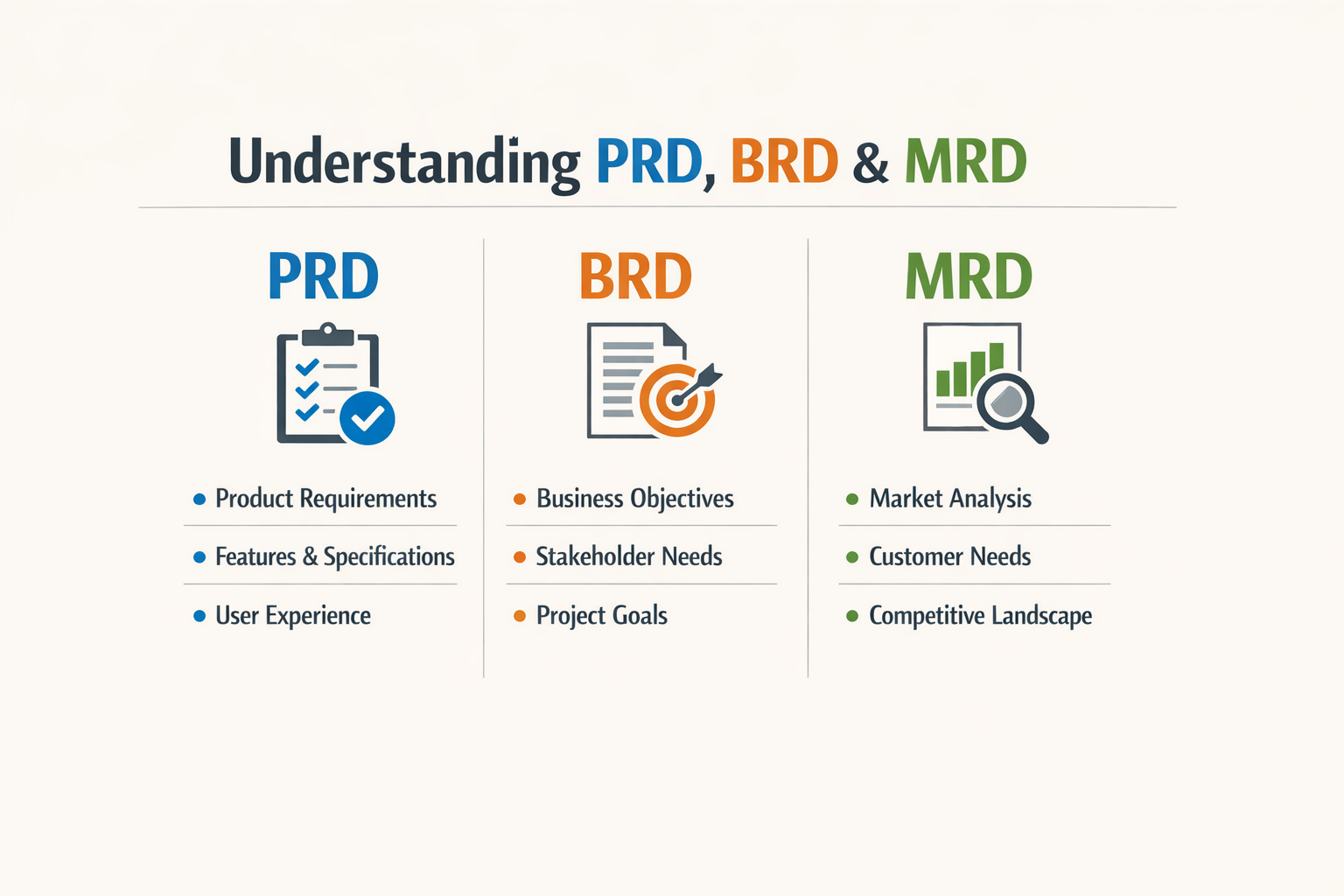
These three acronyms show up in every product conversation, but most teams use them interchangeably. Each document answers a different question at a different altitude.
What a PRD Actually Does
A Product Requirements Document is the canonical source of truth for what a team is building, why they are building it, and how success will be measured. It answers: What exactly should we build?
The PRD lives closest to the work. It specifies features, user flows, edge cases, and acceptance criteria. Engineers read it to understand what to ship. Designers read it to understand constraints. QA reads it to know what counts as done.
What a BRD Actually Does
A Business Requirements Document defines the business needs that a project or product should fulfill. It answers: Why should we invest in this?
The BRD sits one layer above the PRD. It captures the business problem, the organizational goals, and the success metrics that matter to executives. It explains ROI, risk, and strategic fit. Finance and leadership read it to decide whether to fund the work.
Where a PRD says "users can filter by date range," a BRD says "reducing manual reporting saves 40 hours per quarter and supports our compliance roadmap."
What an MRD Actually Does
A Market Requirements Document captures the market opportunity that a product or feature is designed to address. It answers: What does the market need?
The MRD sits upstream of both PRD and BRD. It synthesizes customer research, competitive analysis, and market trends. Product marketing and strategy teams write it. It defines target segments, unmet needs, and the competitive landscape.
An MRD might say "mid-market SaaS buyers need faster onboarding because implementation timelines are the top churn driver." The BRD translates that into "we need a self-serve setup flow to hit our Q3 revenue target." The PRD translates that into "the setup wizard must complete in under 10 minutes with zero support tickets."
Each document answers a different question: MRD asks what the market needs, BRD asks why the business should care, PRD asks what the team should build.
If you're a solo founder or small team, you probably don't need all three. Most early-stage projects collapse MRD and BRD into a single planning doc, then jump straight to a lightweight PRD. The distinctions matter most when multiple stakeholders need different views of the same work—executives want business justification, engineers want technical specs, and product marketing wants market positioning. For a deeper look at how to structure a PRD when you're building solo, see What Is a PRD? A Plain-English Guide for Non-Technical Founders.
Comparing PRD and BRD
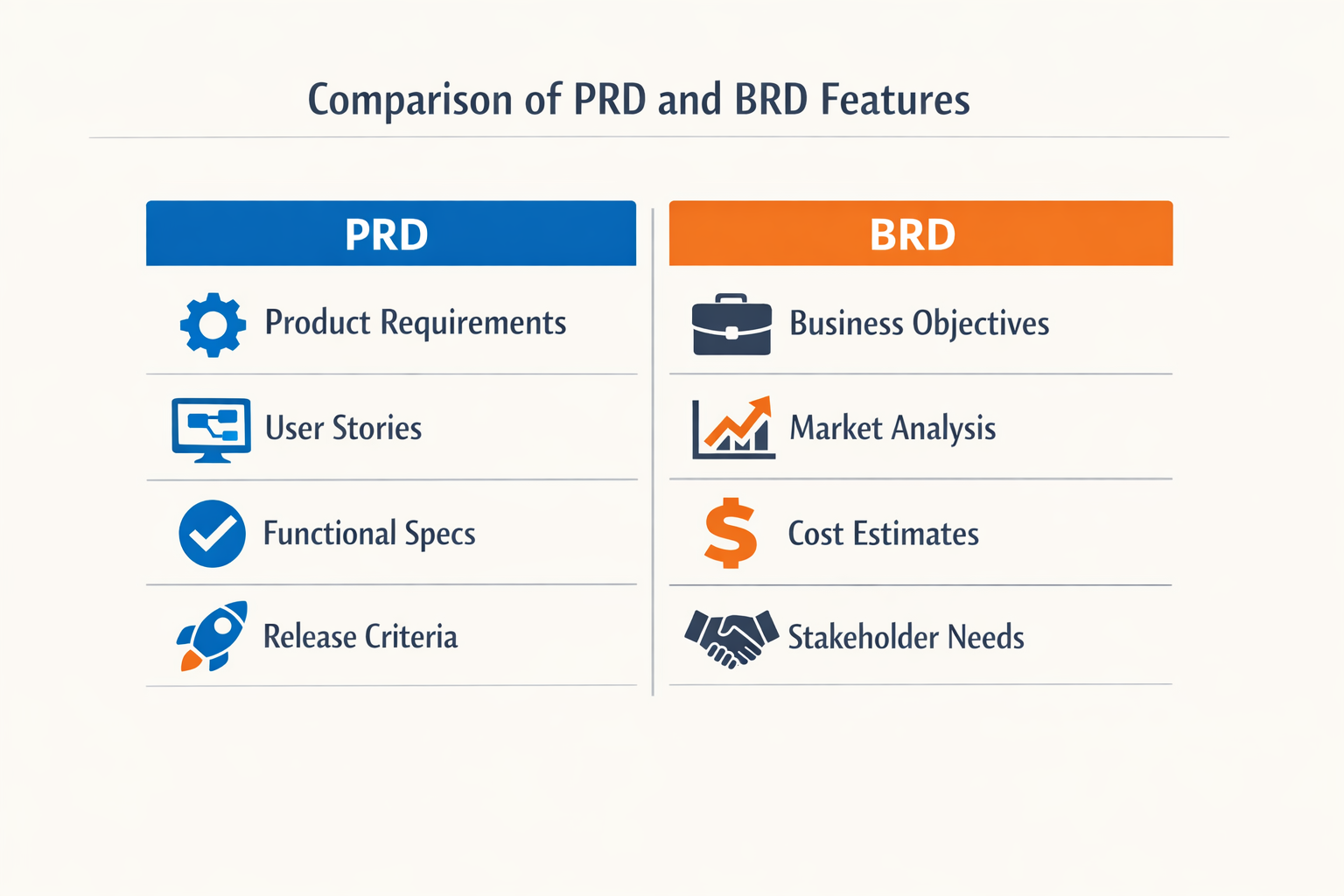
The BRD and PRD serve different stages of the same project. The BRD answers "why should we build this?" from a business perspective. The PRD answers "what exactly are we building?" from a product perspective. One justifies the investment; the other defines the deliverable.
Scope and Audience
A BRD targets executives and stakeholders who approve budgets. It contains business goals, ROI projections, and resource requirements. The language stays high-level because decision-makers care about outcomes, not implementation details.
A PRD targets product managers, designers, and engineers who execute the work. It contains feature specifications, user flows, and acceptance criteria. The language gets granular because builders need exact definitions to ship the right thing.
| Document | Primary Audience | Core Question | Detail Level |
|---|---|---|---|
| BRD | Executives, stakeholders | Why build this? | High-level business case |
| PRD | Product team, engineers | What are we building? | Granular feature specs |
When Each Document Leads
In some organizations, a detailed BRD can replace the PRD entirely. If the business requirements document specifies features with enough precision, developers can build directly from it. This happens most often in enterprise settings where business analysts own the full requirements process.
In product-led companies, the PRD is the authoritative document. The BRD might be a lightweight executive summary, while the PRD carries all the detail. The choice depends on who drives the product roadmap—business stakeholders or product managers.
The Handoff Pattern
The cleanest workflow treats the BRD as input to the PRD. Business analysts or product strategists write the BRD to secure approval. Once funded, the product manager writes the PRD using the BRD's goals as constraints. The PRD translates business objectives into buildable features.
This handoff reduces rework. If the PRD contradicts the BRD's business case, someone catches it before engineering starts. If the BRD promised a feature the PRD omits, the gap surfaces during review.
For founders building their first product, understanding what is a PRD helps clarify which document you actually need at each stage.
MRD Explained

A Market Requirements Document (MRD) captures the market opportunity that a product or feature is designed to address. It answers a single question: what does the market need? The MRD sits upstream of both the PRD and BRD, providing the strategic context that justifies building anything at all.
Where a PRD tells you what to build and a BRD tells you why the business needs it, an MRD tells you why the market cares. It documents user pain points, competitive landscape, and the opportunity size. Product Management owns the MRD and uses it to align product features with business objectives before anyone writes a line of spec.
The MRD Answers "Why" from the Market's Perspective
The MRD focuses on external signals. It compiles customer feedback, market research, and competitive intelligence to define what users actually want. This is not internal prioritization or feature planning — it is a document that proves demand exists before you commit resources.
If you are deciding whether to build a new product line or enter a new segment, the MRD is your starting point. It defines the opportunity and sets the boundaries for what comes next. Without it, you risk building a PRD that solves a problem no one has.
When You Need an MRD
You need an MRD when you are evaluating whether to pursue a market opportunity, not when you are specifying how to build something. If your team is debating whether a product idea has legs, write the MRD first. If you already know what to build and just need to document it, skip straight to the PRD.
For founders planning their first build, the MRD often feels like overkill. If you are validating an idea with a small prototype, a lightweight problem statement is enough. Save the full MRD for when you need to convince stakeholders or justify a significant investment. For a practical starting point on turning an idea into a buildable spec, see What Is a PRD? A Plain-English Guide for Non-Technical Founders.
Direct Comparison: PRD vs BRD vs MRD
The three documents form a cascade. MRD answers market needs, BRD addresses business justification, PRD specifies product details. Each sits at a different altitude.
The Cascade in Practice
MRD comes first. It identifies what users and the market need. BRD follows and determines if the project direction is correct—whether the business case holds. PRD comes last and outlines how the product will be implemented.
Think of it as strategy to execution. MRD defines the opportunity, BRD validates the investment, PRD instructs the build.
| Document | Primary Question | Audience | Timing |
|---|---|---|---|
| MRD | What does the market need? | Product, Marketing, Leadership | Before commitment |
| BRD | Does this make business sense? | Executives, Stakeholders | Before funding |
| PRD | How do we build it? | Engineering, Design, QA | Before development |
What Each Document Delivers
The PRD is technical specification. It lists features, user flows, acceptance criteria. Engineers read it to know what to build.
The MRD is market analysis. It describes segments, competitors, positioning. Marketing reads it to understand who buys and why.
The BRD is business justification. It forecasts revenue, cost, risk. Executives read it to decide whether to fund.
Interconnection and Traceability
The documents are interconnected. A feature in the PRD should trace back to a business objective in the BRD, which should trace back to a market need in the MRD. This chain ensures clarity from macro strategy to micro execution.
When the chain breaks, teams build features no one asked for or solve problems that don't justify the cost. The cascade keeps everyone aligned.
For a deeper look at how PRDs fit into the overall planning process, see What Is a PRD? A Plain-English Guide for Non-Technical Founders.
MRD defines the opportunity, BRD validates the investment, PRD instructs the build.
Who Should Choose What?
Pick based on who reads it and what they need to decide.
If you're writing for executives who sign checks, use a BRD. They need the business case—revenue impact, cost avoidance, competitive positioning. The BRD answers "why we're doing this" and "what it costs us not to." Keep it to three pages. Numbers matter more than features.
If you're handing off to engineers or designers, use a PRD. They need edge cases, error states, and acceptance criteria. The PRD answers "what this thing does when the user clicks here" and "how we know it's done." A good PRD eliminates the Slack thread where someone asks "wait, what happens if the file is empty?"
When You Need an MRD
If you're planning a product line or a multi-quarter roadmap, use an MRD. It sits upstream of the PRD and answers "what market we're entering" and "which customer segments we're ignoring." MRDs make sense when you have multiple stakeholders arguing about priorities—the MRD is the shared map everyone agrees to before writing individual PRDs.
Small teams often skip the MRD and fold market context into the BRD or PRD intro. That works until you have three product managers who need a single source of truth for positioning.
Matching Document to Project Phase
Early exploration: BRD or MRD. You're still proving the problem is worth solving.
Active build: PRD. You're answering implementation questions daily.
Post-launch iteration: updated PRD sections. The original BRD doesn't change—the business case already cleared. The MRD shifts only when you pivot markets.
If you're not sure which document you need, ask: "Who's blocked without this?" Write for that person. A PRD helps non-technical founders get from idea to buildable spec without endless revision cycles.
Hybrid Approaches
Some teams write a combined BRD/PRD for small features—two sections in one doc. That works when the business case is obvious and the feature is narrow. It fails when the doc tries to serve both the CFO and the QA engineer at the same time.
Other teams write an MRD once per year and PRDs every sprint. The MRD sets strategy; PRDs execute tactics. If your company uses OKRs, the MRD typically aligns to annual objectives and PRDs align to quarterly key results.
Common Misconceptions About PRD, BRD, and MRD
People get these documents wrong in predictable ways. The mistakes cluster around three themes: what each document does, who owns it, and when you actually need it.
These Documents Are Not Interchangeable
The biggest mistake is treating PRD, BRD, and MRD as three flavors of the same thing. They are not. A BRD answers why the business needs something. A PRD answers what engineering will build. An MRD answers which market opportunity justifies the effort. Swapping them creates confusion, not flexibility.
Some teams try to merge all three into one mega-document. This produces a file no one reads and everyone blames when the project drifts. Each document serves a different audience at a different decision point. Combining them dilutes that clarity.
You Do Not Always Need All Three
Another misconception: every project requires a full set. Small projects do not need an MRD. Internal tools rarely need a BRD if the problem is obvious. Solo founders building an MVP can often skip the BRD entirely and write a tight PRD that doubles as their own requirements doc.
The rule is simple: write the document that prevents the next mistake. If your team already agrees on the market and the business case, skip straight to the PRD. If you are pitching stakeholders who control budget, start with the BRD. Do not write documents to check boxes.
The Document Does Not Guarantee Alignment
Writing a PRD does not mean engineering understands the product. Writing a BRD does not mean stakeholders will fund it. The document is a tool, not a spell. It works only if the people reading it trust the person who wrote it and believe the assumptions inside.
Misalignment happens when the document skips over the hard questions or hides uncertainty behind jargon. A PRD that says "the system will scale" without defining load is a future argument waiting to happen. A BRD that says "users want this" without citing research is a guess dressed up as a requirement.
Ownership Confusion
People assume the person who writes the document owns the outcome. That is backwards. The BRD is written by the business analyst or product owner, but the business sponsor owns the decision. The PRD is written by the product manager, but engineering owns delivery. The MRD is written by product marketing, but the executive team owns the market bet.
When ownership is unclear, the document becomes a blame artifact instead of a decision tool. Clarify who signs off on each document before you start writing it.
These Documents Do Not Eliminate Risk
The final misconception: a well-written PRD, BRD, or MRD reduces project risk to near zero. It does not. These documents structure thinking and align teams, but they do not predict the future. Markets shift, technical assumptions break, and business priorities change.
The value is not in the document itself but in the conversation it forces. Writing a BRD makes you articulate the business case. Writing a PRD makes you confront edge cases. Writing an MRD makes you defend your market thesis. The act of writing is the risk reduction, not the finished file.
Best Practices for Using PRD, BRD, and MRD
A well-structured document prevents fragmentation. When your BRD is clear, the MRD and PRD that follow inherit that clarity. The strategic direction stays intact from business case through build.
Start with the BRD
Before writing anything else, nail the business pain points. Include expected benefits and the relevant business processes that justify the project's value. If you skip this, your MRD and PRD will drift because there's no anchor.
Keep Each Document Focused
The BRD answers why. The MRD answers what the market needs. The PRD answers how to build it. When you blur these lines, stakeholders argue about scope because they're reading three documents disguised as one.
Write each document for its primary audience. Executives read the BRD. Product and marketing read the MRD. Engineers and designers read the PRD. If you force everyone to read everything, nobody reads anything carefully.
Use Consistent Terminology
Pick your terms early and stick to them. If the BRD calls something a "user portal," don't rename it "customer dashboard" in the MRD and "login screen" in the PRD. Inconsistent naming creates confusion during handoffs.
Step 1
Establish a glossary
Create a shared glossary in the BRD. Every subsequent document inherits the same terms. When a new concept appears in the MRD or PRD, add it to the glossary and notify the team.
Version Control and Sign-Off
Each document should have a version number and a sign-off process. The BRD gets approved by business stakeholders. The MRD gets approved by product and marketing. The PRD gets approved by engineering leads.
Without formal sign-off, documents become suggestion lists. Teams build what they think you meant, not what you specified.
Link Documents Explicitly
The MRD should reference the BRD by section. The PRD should reference both. When someone asks "why are we building this feature?" they should be able to trace it back through the chain without asking you.
If you're starting from scratch and need a structured approach to planning, What Is a PRD? A Plain-English Guide for Non-Technical Founders walks through the build-focused document in detail.
Review and Update Regularly
Markets shift. Requirements change. A BRD written six months ago may no longer reflect current business priorities. Schedule quarterly reviews for the BRD and MRD, monthly reviews for active PRDs.
When you update one document, check if the downstream documents need updates too. A change in business strategy (BRD) often means a change in market positioning (MRD) and feature priorities (PRD).
Resources and Tools for Documentation
The right tooling turns documentation from a chore into a repeatable system. Most teams start with whatever they already have—Google Docs, Notion, Confluence—and that's fine for the first few documents. The trouble comes when you need version control, approval workflows, or a single source of truth that doesn't turn into a graveyard of outdated drafts.
Document Platforms
Notion and Confluence are popular for collaborative writing. Both support templates, inline comments, and linking between documents. Notion is lighter and faster for small teams; Confluence integrates tightly with Jira if you're already in the Atlassian ecosystem. For solo founders or small product teams, a shared Google Doc with a clear naming convention—PRD_FeatureName_v2_2024-01-15.docx—works until it doesn't. The failure mode is always the same: someone edits an old version, and the team ships from the wrong spec.
If you're working with developers who live in GitHub, consider writing PRDs in Markdown and storing them in the repo. This keeps the spec next to the code, makes diffs trivial, and forces everyone to use version control. The downside is that non-technical stakeholders won't touch it, so you'll need a separate BRD or summary deck for executives.
Templates and Frameworks
Start with a template and adapt it. A good PRD template includes sections for user stories, acceptance criteria, edge cases, and success metrics. A BRD template should cover business objectives, ROI projections, stakeholder roles, and risk assessment. An MRD template layers in competitive analysis, market segmentation, and go-to-market strategy.
Many product management communities share free templates. The key is to pick one that matches your team's maturity level. If you've never written a PRD before, use a simple template with clear prompts. If you're a product manager at a Series B company, you probably need something more structured with sections for technical dependencies and compliance requirements.
Collaboration and Review Tools
Google Docs and Notion both support inline comments, which is where most of the real work happens. Engineers flag unclear requirements, designers point out missing edge cases, and stakeholders ask why their feature didn't make the cut. The comment thread is often more valuable than the document itself.
For formal approval workflows, tools like Productboard or Aha! add structured review stages. These are overkill for most small teams but necessary once you have multiple product lines or regulatory requirements. The trade-off is speed: a lightweight Google Doc can go from draft to approved in a day; a formal workflow tool might take a week.
Linking Documentation to Development
The best documentation setup ties directly to your issue tracker. If you're using Jira, Linear, or GitHub Issues, link each requirement in your PRD to a specific ticket. This makes it trivial to see what's been built, what's in progress, and what's still in the backlog. It also prevents the common failure mode where the team builds something that sounds like the requirement but misses a critical detail.
For non-technical founders building with AI tools, consider using a PRD generator or outline tool to structure your thinking before you write. What Is a PRD? A Plain-English Guide for Non-Technical Founders walks through the process of turning a rough idea into a structured spec, which is half the battle when you're working solo.
When to Use Specialized Tools
If your product involves compliance, security, or regulated industries, you'll eventually need a requirements management tool like Jama Connect or Helix RM. These platforms track every requirement to every test case, which is essential for audits but painful for agile teams. Use them only when the cost of non-compliance exceeds the cost of the tool.
For market research and competitive analysis (MRD territory), tools like Crayon or Klue automate competitor tracking. They're worth it if you're in a fast-moving market where competitive positioning changes weekly. For most teams, a shared spreadsheet with competitor URLs, pricing, and feature grids is enough.
Conclusion
PRD vs BRD vs MRD isn't a trick question. Each document serves a different audience at a different stage. BRD tells the business what problem you're solving and why it's worth funding. MRD tells the market team what customers want and how you'll position it. PRD tells the engineering team exactly what to build.
Most projects fail not because they picked the wrong document type, but because they skipped the step that mattered. A solo founder writing a PRD without thinking through the business case is building in the dark. A product manager handing engineering an MRD instead of a PRD is asking them to guess.
I've written PRDs for products that shipped and PRDs for products that died in committee. The difference was never the format. It was whether the person writing it knew what question they were answering. If you're deciding what to build, you need a PRD. If you're deciding whether to build it, you need a BRD. If you're deciding how to sell it, you need an MRD.
Start with the question, then pick the document. If you're a non-technical founder trying to spec your first build, a tight PRD is your insurance policy against scope creep and rework. Write what the product does, not what you hope it becomes.
For a practical walkthrough on turning an idea into a buildable spec, see What Is a PRD? A Plain-English Guide for Non-Technical Founders.
The right document is the one your team can execute from. Everything else is overhead.
Related reading
PRD Example for a Mobile App: The Ultimate Simple Guide
App Requirements for Lovable: The Ultimate Simple Guide
How to Find App Ideas: 9 Simple Frameworks That Actually Work