
How to Write a PRD: The Ultimate Simple Conversational Guide
Introduction
Most founders treat PRDs like term papers — sit down, fill in sections, hope it covers everything. That approach burns time and misses half the decisions that actually matter. I've watched teams spend weeks on PRD documents that developers read once, shrug at, and then Slack about anyway.
The alternative is simpler: talk through your product idea with the right questions, capture what comes up, and let the document build itself from real dialogue. What Is a PRD? A Plain-English Guide for Non-Technical Founders explains the fundamentals, but this guide focuses on how conversation replaces most of the traditional PRD theater.
This guide walks through how to write a PRD by using structured conversation instead of template-filling. You'll learn what questions to ask, when to ask them, and how to turn answers into a document that developers can actually use. No frameworks, no ceremony — just the decisions that matter and the fastest path to capturing them.
The conversational method works because it forces clarity before documentation. When you talk through a feature, vague ideas collapse immediately. When you write alone, they survive until build time — which is exactly when you don't want surprises.
Learn how to write a PRD through effective conversation techniques to enhance your planning process.
Understanding PRD
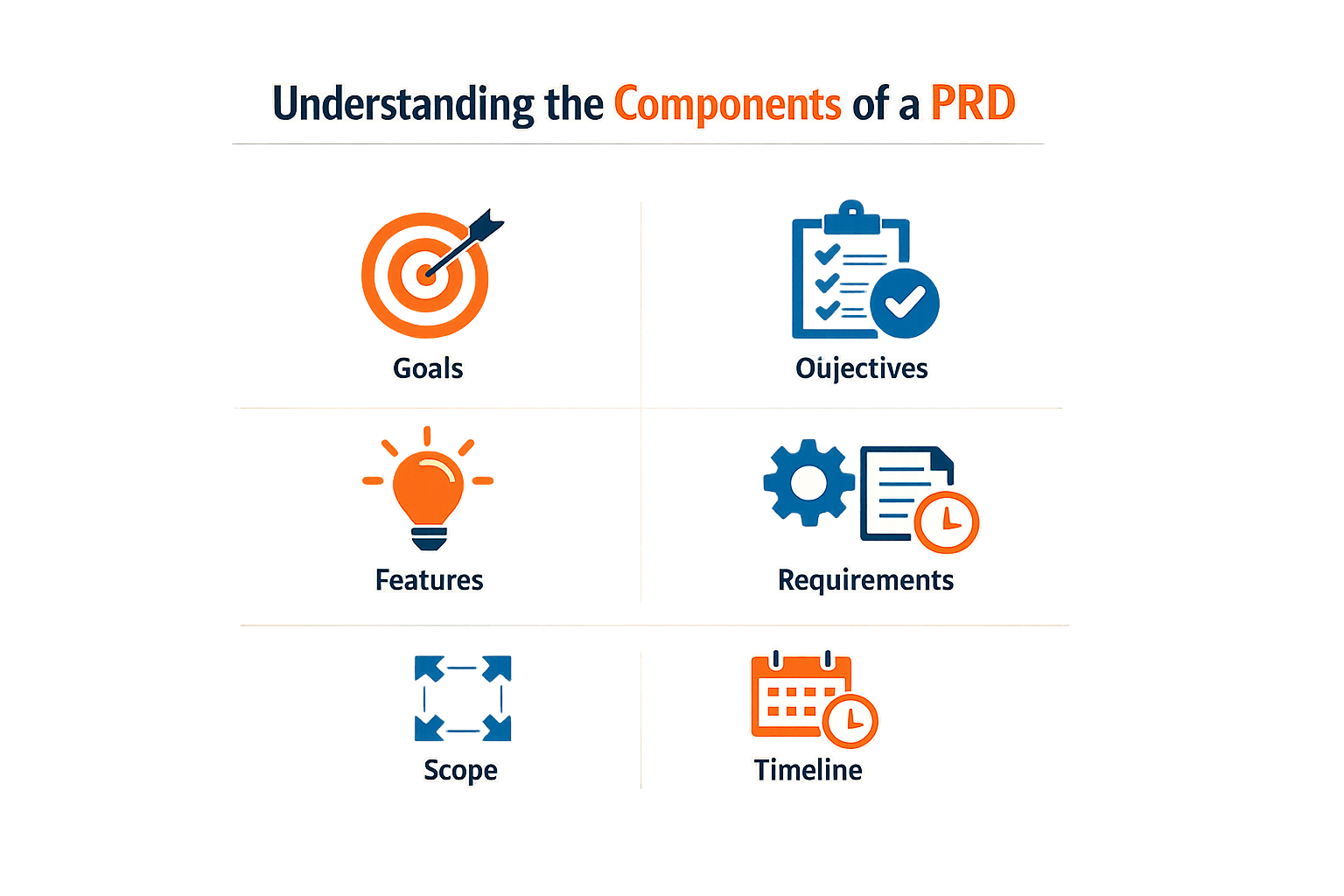
A Product Requirements Document is the single source of truth for what you're building. It defines the problem, the solution, and the acceptance criteria. That's it. Everything else is noise.
In 2026, a PRD is a living document assisted by AI tools. It's not a static spec that dies in a folder. It evolves as you learn, as users react, as edge cases surface. The format matters less than the clarity.
Why PRDs Matter in App Planning
Without a PRD, you're building from vibes and Slack threads. That works for exactly one person—you—and only until you sleep. A PRD forces you to name the problem before you fall in love with a solution. It separates "wouldn't it be cool if" from "this solves X for Y users."
The document also sets boundaries. Scope creep starts the moment you skip writing down what's in and what's out. A PRD is the line you draw so you can ship.
Core Components of How to Write a PRD
Every PRD should answer four questions: What problem are we solving? Who has this problem? What does success look like? What are we not building?
The problem statement comes first. If you can't write it in two sentences, you don't understand it yet. The user comes second—real humans with real constraints, not "power users" or "anyone who needs X." Success criteria come third: the number that moves, the behavior that changes, the complaint that stops. Finally, the exclusions—what you're deliberately leaving out.
For a deeper foundation on turning ideas into buildable plans, see What Is a PRD? A Plain-English Guide for Non-Technical Founders.
The best PRDs are the ones you can hand to a builder and get back exactly what you meant.
Most PRDs fail because they describe features instead of outcomes. "Add a dashboard" is not a requirement. "Let admins see which users haven't logged in for 30 days" is a requirement. The first is a solution; the second is a problem with a measurable result.
A PRD also lives at the right altitude. Too high and it's a vision doc. Too low and it's a Jira ticket. You want enough detail that a developer knows what to build, but not so much that you're writing code in prose.
Traditional PRD Writing Methods

Most teams write PRDs the same way they've been written since the 1990s: a PM opens a template, fills in sections, and circulates a draft for comment. The structure is rigid. The process is slow. The document often lands after decisions have already been made in hallway conversations.
The traditional method treats the PRD as a deliverable. You write it, you ship it, you move on. The problem is that writing happens in isolation. The PM sits alone with a blank page, trying to anticipate every question the team might ask. By the time the draft circulates, it's already outdated.
The Template-First Approach
Most organizations hand new PMs a PRD template with 15 sections: executive summary, user personas, success metrics, technical requirements, edge cases, rollout plan. The template promises completeness. In practice, it produces bloat.
PMs fill in sections because the template says they must. Half the content is speculative. The other half is copied from the last PRD. The result is a 12-page document that nobody reads past page 3.
Why Traditional PRDs Miss the Mark
The biggest failure in traditional PRD writing is describing solutions instead of problems. PMs jump straight to feature specs without articulating the user, the problem, or why solving it matters. The team builds what's in the document without understanding the underlying need.
Another common mistake: treating the PRD as static. The document gets written, approved, and filed. As decisions evolve, the PRD stays frozen. Six weeks into development, the source of truth is a Slack thread, not the PRD.
Edge cases get missed because the PM wrote the document alone. The engineer who knows the database schema wasn't in the room. The designer who understands the user flow wasn't consulted. The PRD reflects one person's mental model, not the team's collective knowledge.
If you're starting from scratch and wondering how to structure your thinking before writing anything down, What Is a PRD? A Plain-English Guide for Non-Technical Founders walks through the foundational concepts in operator terms.
The Approval Bottleneck
Traditional workflows treat PRD approval as a gate. The PM writes, stakeholders review, feedback trickles in over email, the PM revises, and the cycle repeats. Two weeks pass before the team can start building.
The bottleneck isn't the writing. It's the assumption that the document must be perfect before work begins. In reality, the PRD should evolve as the team learns. Waiting for perfection delays learning.
Most weak PRDs are weak because the PM skipped the step of clearly articulating the user, the problem, and why solving it matters.
The traditional method optimizes for documentation, not for shared understanding. The team ends up with a artifact that satisfies process requirements but doesn't actually help them build the right thing.
How to Write a PRD Through Conversation
Most PRDs die in the template. You open a 12-section doc, stare at "User Stories," and type nothing because the format demands answers before you've asked the questions. A conversational approach flips that: you talk through the problem first, then write down what you said.
The workflow is simple. Frame the problem in one sentence. Use that sentence to guide a conversation—with your co-founder, a design partner, or just yourself and a voice recorder. Synthesize what you heard into structure. Draft the PRD from that structure. Pressure-test it with edge cases. Make it engineer-ready.
Start With the Problem, Not the Interface
Your PRD should begin with the user problem and the business outcome, not with interface details or database fields. If you open with "The dashboard will have three tabs," you've already lost the engineer who wants to know why three tabs solve anything.
Conversation forces clarity. When you say the problem out loud, filler evaporates. "We need better analytics" becomes "Sales reps can't see which leads opened the demo email, so they call cold accounts first and waste morning hours." That second version is a PRD intro.
The Six-Step Conversational Workflow
Step 1
Frame the problem
Write one sentence: who has the problem, what they can't do now, and what it costs them. Read it to someone. If they ask clarifying questions, your frame is too vague.
Step 2
Synthesize research through conversation
Talk to 2–3 users or stakeholders. Record it. Listen for repeated phrases—those become your acceptance criteria. If two people say "I just want to know if it worked," that's your success metric.
Step 3
Draft structure with a template
Use a proven template: problem, outcome, scope, non-scope, acceptance criteria, edge cases. Fill in the template with bullet points from your conversation notes. Don't write paragraphs yet.
Step 4
Generate the first draft
Turn bullets into sentences. If you're using AI, paste your bullets and say "Expand this into a PRD intro." If you're writing by hand, aim for 3–5 sentences per section. Clarity beats completeness.
Step 5
Pressure-test with edge cases
Show the draft to an engineer and ask, "What breaks this?" Write down every edge case they name. Add a section called "Edge Cases" with one bullet per risk. If you have more than 8 edge cases, your scope is too wide.
Step 6
Make it engineer-ready
Add a single diagram if the flow isn't obvious. Link to designs if they exist. Remove adjectives. If you wrote "seamless" or "intuitive," delete it and describe the behavior instead.
Prioritize Scope With a Simple Framework
Intercom's RICE framework—Reach × Impact × Confidence ÷ Effort—is a simple way to stack-rank candidate scope and prioritize what makes the PRD. Reach is how many users hit the feature per quarter. Impact is 0.25 (minimal) to 3 (massive). Confidence is your gut as a percentage. Effort is person-weeks.
If your RICE score is below 5, the feature doesn't belong in this PRD. Park it in a "Future Considerations" section at the bottom. Conversation reveals scope creep faster than any template: when someone says "Oh, and we should also…" three times in one meeting, you're writing two PRDs, not one.
Why Conversation Beats Templates Alone
Templates give you structure. Conversation gives you content. A blank template is a writer's block machine. A conversation transcript is a first draft. You're not starting from zero—you're editing what you already said.
The conversational method also surfaces assumptions. When you explain a feature out loud, you hear yourself say "obviously" or "just"—those words mark hidden complexity. "We'll just add a filter" becomes "We need to index 4 new fields and cache query results" once you say it to an engineer.
For more on moving from idea to structure, see What Is a PRD? A Plain-English Guide for Non-Technical Founders.
Elements of Effective Communication
Effective PRD writing depends on communication skills that keep teams aligned without generating noise. The goal is shared understanding, not exhaustive documentation. If your PRD sits unread, it failed regardless of how complete it is.
Brevity Over Completeness
Good PRDs are concise and capture decisions, not descriptions. A 20-page PRD is often ignored. Aim for the shortest document that removes ambiguity. Write to be read, not to be comprehensive.
Clarity in Decision Points
Focus on what was decided and why. Skip the background essay. State the constraint, the choice made, and the trade-off accepted. Engineers need to know what to build and what to skip; they don't need the full deliberation transcript.
Use short declaratives. Avoid hedging language. "We will support OAuth only" is clearer than "We are considering primarily focusing on OAuth-based authentication as the initial approach."
Shared Context, Not Solo Authorship
Modern PRDs emphasize shared understanding over exhaustive detail. Write with the assumption that the reader was in the room for some of the conversations. Reference decisions made in Slack, design reviews, or standups. The PRD anchors those discussions; it doesn't replace them.
If you're writing alone in a vacuum, you're doing it wrong. PRDs emerge from conversation, not isolation. For more on collaborative planning approaches, see What Is a PRD? A Plain-English Guide for Non-Technical Founders.
Use Concrete Examples
Abstract requirements breed confusion. "The system should handle errors gracefully" means nothing. "When the API times out after 5 seconds, show the cached result and a yellow banner" is actionable.
Include screenshots, wireframes, or sample API responses. One example is worth three paragraphs of description.
Collaborative Tools for PRD Writing
The document is not the bottleneck anymore. AI tools removed that constraint. The bottleneck now is judgment: what problem you frame, what scope you call, what trade-offs you defend. Tools matter when they help your team reach shared judgment faster.
Conversational Interfaces Beat Template Libraries
Most PRD tools ship with template galleries. Templates help novices see structure, but they trap you in someone else's outline. Conversational interfaces let you start with the problem, not the format.
AI-assisted editors let you draft by talking through the decision. You say what you want to build and why. The tool asks clarifying questions. You refine. The PRD emerges from the conversation, not from filling blanks.
Living Documents Require Real-Time Collaboration
Minal Mehta, Head of Product at YouTube, describes a PRD as a living document that must be continuously updated as the product moves through its lifecycle. Static PDFs and locked Google Docs fail here. You need tools where engineers, designers, and stakeholders can comment inline, propose edits, and track what changed since the last review.
Notion, Confluence, and Coda all support threaded comments and version history. The winner is whichever one your team already uses for everything else. Switching tools mid-project costs more than any feature difference.
Async Communication Scales Judgment
Real-time meetings force synchronous thinking. Most PRD decisions benefit from overnight reflection. Tools that support async conversation—comment threads, Loom videos, annotated screenshots—let people contribute when they have clarity, not when the calendar says so.
For distributed teams, async-first tools are not optional. If your PRD lives in a tool that requires everyone online at once, you are limiting who can shape the plan.
AI tools have removed the document-production bottleneck, but they have not removed the judgment required for effective problem framing and scope calls.
Choosing Tools for Your Workflow
Pick tools that fit how your team already works. If you live in Slack, use a PRD tool with Slack integration. If you ship from Linear, write PRDs in Linear. The best tool is the one that does not require context-switching.
For solo founders and small teams, a simple markdown file in GitHub often beats heavyweight collaboration platforms. You get version control, inline diffs, and a single source of truth without learning a new UI. Larger teams need richer permissions and discoverability, which pushes you toward Notion-style platforms or dedicated product tools.
If you are just starting to formalize your process, check out What Is a PRD? A Plain-English Guide for Non-Technical Founders to understand the fundamentals before committing to a toolchain.
Common Challenges in PRD Writing
Most PRDs fail before the first line of code ships. The document sits in a folder, the team builds something else, and six weeks later everyone pretends the PRD never existed. The problem is not laziness. The problem is that PRD writing surfaces every unresolved question about scope, priority, and who decides what.
Gathering Accurate Requirements
Inaccurate requirements gathering was a primary cause of project failure for 37% of organizations surveyed. The failure mode is simple: someone writes down what they think the user wants instead of what the user actually needs. The PRD becomes a list of features nobody asked for, wrapped in jargon nobody understands.
The fix is conversation. Talk to users before you write a word. Record the problems they describe in their language. When you draft the PRD, read it back to them. If they squint at your document, you wrote it wrong.
Scope Creep and Feature Bloat
Every stakeholder wants their pet feature in the PRD. Sales wants integrations. Marketing wants analytics dashboards. Engineering wants to rebuild the auth layer. The PRD grows to 40 pages and describes a product that will ship in 2027.
The discipline is saying no. Each feature in the PRD should answer a user problem you can name. If a feature exists because "it would be cool" or "competitors have it," cut it. Save it for version two. Ship the smallest thing that solves the core problem, then iterate.
Misalignment Between Teams
Engineering reads the PRD and estimates six months. The CEO expects a demo in three weeks. Design mocks up flows that require backend work nobody scoped. The PRD becomes a blame document: everyone points to a different paragraph to explain why the project is late.
Alignment starts before you write. Gather engineering, design, and product in a room. Walk through the problem and the proposed solution. Let engineering flag technical constraints early. Let design sketch flows before you commit to them in writing. The PRD should document consensus, not create it.
Keeping the PRD Updated
You ship version one. Users complain about a workflow. Engineering proposes a fix. The fix changes three requirements in the original PRD. Nobody updates the document. Six months later, a new PM joins and reads the PRD. They build features you already deprecated.
The PRD is not a static artifact. Treat it like code: version it, update it when requirements change, and archive old sections instead of deleting them. If the PRD and the product diverge, the PRD is wrong. For teams moving fast, consider whether a living guide for non-technical founders fits your workflow better than a traditional locked document.
Case Studies of Successful PRDs
Most PRD case studies you'll find online are sanitized post-mortems written by teams with 40 engineers and a design system. That's not what you need. The conversational PRD approach works best when you're small, moving fast, and can't afford to write 30 pages no one will read.
The Weekend MVP That Shipped
A solo founder needed to turn a complex spreadsheet workflow into a working prototype. Instead of writing a traditional PRD with user stories and acceptance criteria, they opened a doc and talked through the problem: what the spreadsheet did, where it broke, what the app needed to do on day one.
The conversational doc ran 3 pages. It had screenshots of the spreadsheet, a bullet list of the 5 core actions, and 2 paragraphs on what could wait. They handed it to a contract developer on Friday. The prototype shipped Monday. No formal sections, no stakeholder sign-off process, no revision cycles.
The Team Alignment Document
A small product team kept missing each other on feature scope. Engineers built what they thought was requested. Designers mocked up flows that didn't match the technical constraints. The PM wrote a traditional PRD, and it sat unread in Notion.
They switched to a conversational format: one shared doc where the PM wrote the problem in plain language, the designer dropped mockups inline with questions, and the engineers added implementation notes directly under each feature. The doc evolved over 3 days of back-and-forth. When they started building, everyone had the same mental model because they'd built it together in the document.
The final PRD looked messy—comments, crossed-out sections, inline debates—but it worked. The feature shipped on time with no scope creep.
The best PRD is the one your team actually reads and updates together, not the one that looks clean in a portfolio.
The Pivot That Saved Time
A founder wrote a conversational PRD for a new feature, talking through the user problem and proposed solution in 2 pages. They shared it with 3 potential users before writing any code. Two of them pointed out a simpler workflow that solved the same problem with half the screens.
The founder updated the doc in 20 minutes and sent the revised version to their developer. Total time lost: one afternoon of conversation. Time saved: 2 weeks of building the wrong thing.
This is the real win with conversational PRDs. They're cheap to change because they're written in the language you already use to talk about the product. You can rewrite a section during a 15-minute call and ship the updated doc before the call ends.
What These Examples Share
Every successful conversational PRD starts with a clear problem statement, uses plain language, and invites collaboration. None of them followed a template. None of them had a formal review process. All of them got the team aligned and shipping faster than a traditional spec would have.
If you're trying to write your first PRD, focus on clarity and speed over format. Talk through the problem, write it down the way you'd explain it to a teammate, and iterate as you learn. For more on turning ideas into shippable plans, see I Have an App Idea: The Ultimate Simple Guide for Founders.
Final Tips for Writing a PRD
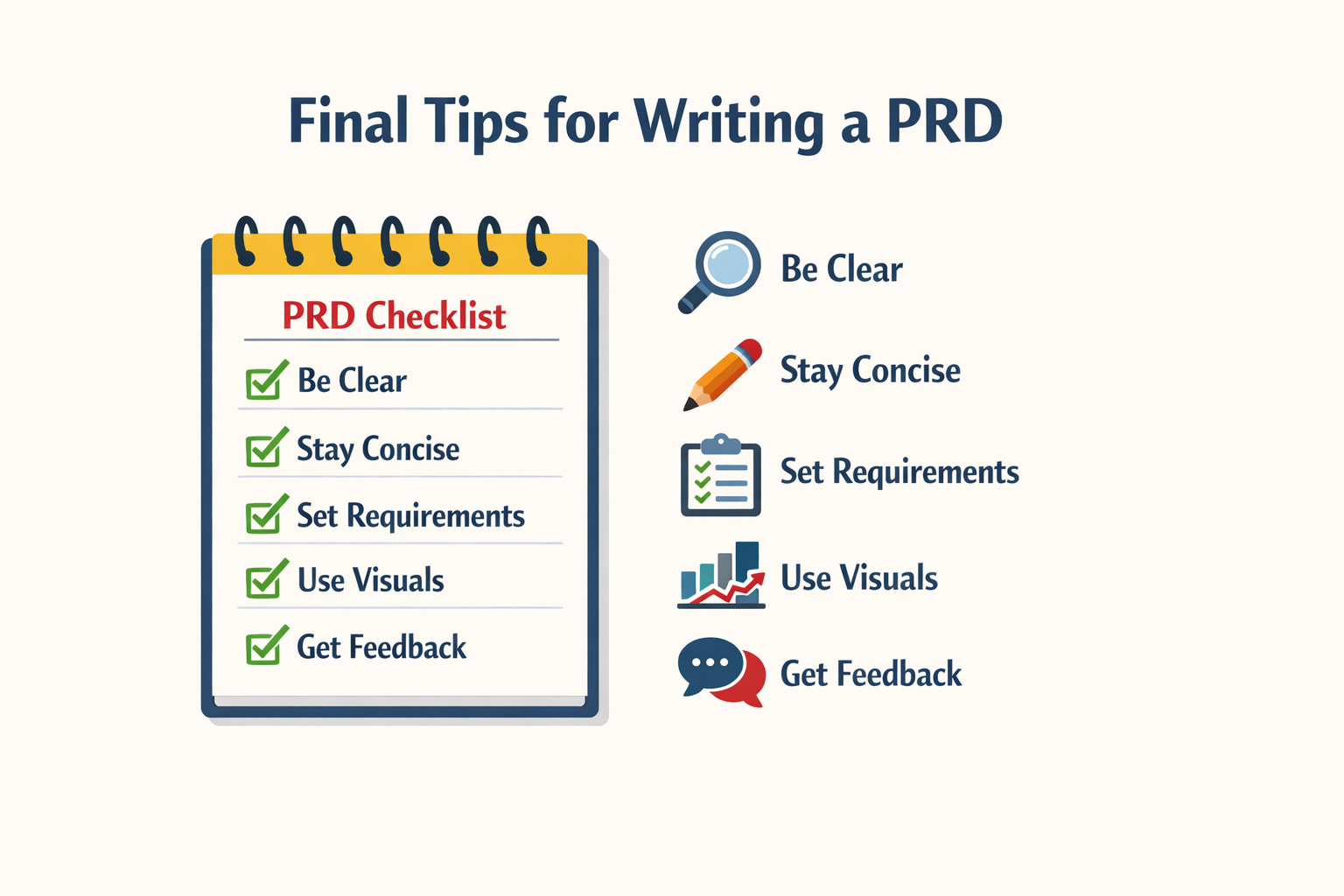
Speed beats polish. A clear, structured first draft in 30 minutes is more valuable than a beautifully formatted document delivered next Tuesday. The goal is to get the problem and solution on paper while the conversation is fresh.
Write for the person who has to build it, not for the person who has to approve it. If your engineer reads the PRD and still needs to schedule a clarification call, you wrote the wrong document.
Start with the Problem, Not the Solution
A strong PRD opens with a sharp problem statement backed by user evidence: quotes, behavioral data, specific failure modes, not a generic persona. The solution section should feel inevitable after reading the problem.
If you can't articulate why this matters in two sentences, the PRD isn't ready. Go back to the conversation. Ask why three more times.
Keep the Format Consistent
Pick a structure and use it every time. Your team should know where to find success metrics, where to find edge cases, where to find the "what we're not building" section. Consistency removes cognitive load.
Templates help, but don't let them become bureaucracy. If a section doesn't apply, delete it. If you need a new section, add it. The format serves the clarity, not the other way around.
Write in Present Tense, Active Voice
Describe the system as it will exist, not as a hypothetical. "The user uploads a file" is clearer than "The user will be able to upload a file." Active voice forces you to name the actor and the action.
Avoid hedging language. "Might," "could," "possibly" — these words signal unresolved decisions. If you're not sure, mark it as an open question and move on.
The best PRD is the one your team reads once and never needs to reference again because they understood it completely the first time.
Include What You're Not Building
Explicit scope boundaries prevent feature creep. List the things people will ask for and explain why they're out of scope for this version. This saves hours of mid-sprint debate.
If you're building a file uploader, say "We are not building folder uploads, drag-and-drop, or preview thumbnails in v1." Clear constraints are a gift to the team.
Test the PRD with a Cold Read
Hand the document to someone who wasn't in the conversation. Give them five minutes. If they can't explain the problem and the solution back to you, the PRD failed. Rewrite the unclear parts.
For more on turning early ideas into structured plans, see I Have an App Idea: The Ultimate Simple Guide for Founders.
The PRD is done when the next action is obvious to everyone who reads it. Until then, keep cutting and clarifying.
Conclusion
Writing a PRD doesn't require templates or process overhead. It requires clarity about what you're building and why it matters. The conversational approach strips away the ceremony and forces you to articulate the product in plain language—the same language you'd use to explain it to a teammate over coffee.
Start with the problem. Describe the user who has it. Walk through what they'll do and why it solves their need. That's the core. Everything else—technical details, edge cases, success metrics—flows from that foundation. When you write conversationally, you surface gaps early. If you can't explain a feature in two sentences, you probably don't understand it well enough to build it.
I've shipped products from rough notes and from 40-page specs. The notes worked better. The discipline isn't in the document length; it's in the thinking before you type. A good PRD is a forcing function for clear thought, not a box-checking exercise.
If you're moving from idea to build, a conversational PRD is the shortest path to shared understanding. Write it like you'd explain it. Read it aloud. If it sounds like jargon soup, rewrite it. Your team—and your product—will be better for it.
For founders starting from scratch, see I Have an App Idea: The Ultimate Simple Guide for Founders to connect your PRD to the broader planning process.
Related reading
PRD vs BRD vs MRD: The Ultimate Simple Decoder Guide