I Have an App Idea: The Ultimate Simple Guide for Founders
Top takeaways
- The mobile app market is worth $330 billion in 2026, but 42% of startups fail by building something nobody wants.
- Turning an app idea into reality requires validation, clear documentation, and deliberate tool choices before writing code.
- This guide walks you through research, prototyping, launch, and iteration — the full path from concept to deployed product.
- Solo founders can ship real apps by following a structured process that prioritizes learning over perfection.
Introduction
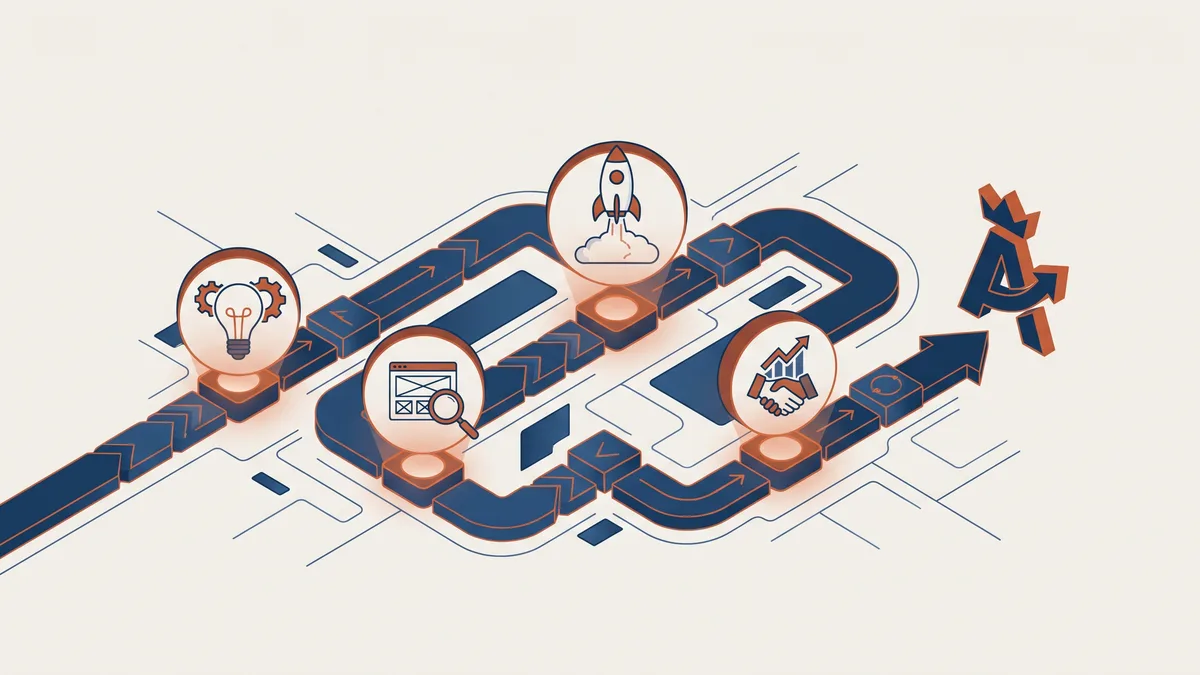
[Image: A roadmap illustrating the journey of launching an app, showing the complete path from i have an app idea to successful deployment]
You have an app idea. Maybe it solves a problem you face daily. Maybe you saw a gap in the market. Either way, the next step isn't coding — it's figuring out if anyone else cares.
The mobile app market is worth $330 billion in 2026, with over 320 billion downloads expected. That scale attracts competition. 90% of startups fail, and 42% of those failures come from building something nobody wants. The idea isn't the hard part. Execution is.
This guide covers the full journey: validating demand, writing a product requirements document, choosing tools, prototyping, launching, and iterating. Each section answers one question founders ask when they're staring at a blank screen wondering what to do first.
I've watched founders burn months on features users never asked for. I've seen solo operators ship profitable apps in weekends by keeping scope tight. The difference isn't talent — it's process. You don't need a technical co-founder to start. You need a plan that forces you to test assumptions before they cost you time.
If you're holding an app idea and don't know where to start, this roadmap gives you the next ten steps.
Discover how to turn your app idea into reality with our comprehensive guide for founders.
Understanding Your App Idea
[Image: An infographic showing the process of clarifying and structuring an app idea from vague concept to specific problem statement]
Most founders start with "I have an app idea" and nothing else. That's normal. The gap between having an idea and shipping something people pay for is specificity.
An idea becomes buildable when you can answer three questions without hedging: what problem does it solve, for whom exactly, and why would they care enough to download it. If any of those answers contain the word "everyone" or "could," you're still in the fuzzy zone.
From Concept to Concrete Problem
The best app ideas come from structured research, not random brainstorming. You don't need a whiteboard session with ten people throwing out features. You need one clear problem statement that a specific group of users will recognize immediately.
Write it in one sentence. "Helps freelancers track invoices without spreadsheets." "Lets parents share school pickup schedules with grandparents." If you need three sentences to explain the core job, the idea isn't clear yet.
What Makes an Idea Specific Enough
Specificity shows up in three places: user, pain, and alternative. You should be able to name the person ("freelance graphic designers"), the exact moment of friction ("chasing late payments via email"), and what they do today ("Excel or pen and paper").
If your idea requires the user to change their entire workflow, it's probably too big. If it saves them two steps in something they already do weekly, that's a wedge.
Once you have that clarity, the next move is validating whether anyone else feels the same pain. For founders new to structuring this kind of thinking, a PRD forces you to write down assumptions before you start building.
Research and Validation
[Image: A chart on market research and validation methods]
Most app ideas die because nobody wanted them. Forty-two percent of failed startups shut down for no market need. Validation is how you avoid that.
Validation means proving people will pay before you build. The work is cheap compared to six months of development nobody uses.
Why Market Research Comes First
You need two things: evidence that the problem exists and evidence that people will pay to solve it. Surveys and interviews give you the first. A manual version of your service gives you the second.
Talk to ten people who match your target user. Ask what they do now to solve the problem. Ask what they pay for it. Ask if they would switch. Write down the answers.
The Five-Step Validation Process
A structured validation process cuts guesswork. Start with research, then test willingness to pay.
Step 1
Define the core problem
Write one sentence that describes the pain your app solves. If it takes three sentences, your idea is too broad.
Step 2
Identify your target user
Name the person who has the problem. Job title, industry, and budget range. Generic descriptions produce generic validation.
Step 3
Interview ten prospects
Ask what they do now, what they pay, and what they wish existed. Record the answers. Patterns in language tell you how to position the app.
Step 4
Sell the manual version
Offer to solve their problem without the app — manually, over email, whatever it takes. Charge money. If they won't pay for the manual version, they won't pay for the app.
Step 5
Document what you learned
Write down which parts of the pitch worked, which objections came up, and what people said they would pay. This becomes your PRD input.
Testing Willingness to Pay
Validation without money is just conversation. You need proof people will open their wallets.
The cleanest test: sell a service version of your app idea before you write code. If your app idea is a meal-planning tool, offer to build custom meal plans by hand for $20. If your app is a scheduling assistant, offer to manage someone's calendar manually for a week.
Ten paying customers for the manual version means you have demand. Zero paying customers means you have more research to do.
The manual version is the app idea stripped to its core value — if that core isn't worth paying for, the app won't be either.
Creating a Product Requirements Document
A PRD is the single artifact that keeps your build from drifting. Write it before you write code. It forces you to decide what you're building and what you're not. Most founders skip this step, then spend months rebuilding features that never matched the original idea.
Start with one page. List the core problem, the user who has it, and the three features that solve it. Everything else is scope creep. If you can't explain your app in one page, you don't understand it yet.
What Belongs in a PRD
Your PRD needs four sections: problem statement, user personas, feature list, and success criteria. The problem statement is one paragraph. User personas are two to three sentences per type of user. The feature list is a numbered list with one-line descriptions. Success criteria are the metrics you'll check after launch.
Skip the fluff. No mission statements, no market size projections, no competitive analysis essays. Those belong in a pitch deck, not a PRD. A PRD is an operator's document. It tells a developer what to build and a designer what to design.
Writing Features That Ship
Each feature gets a title, a one-sentence description, and a priority tag: must-have, nice-to-have, or later. Must-haves are the three to five features that define your app. Nice-to-haves are things you'll add if time permits. Later means post-launch.
Describe features from the user's perspective. "User taps a button and sees a list of saved items" is better than "Implement local storage with IndexedDB." The PRD is not a technical spec. It's a contract between you and the person building it.
For a simple app, you're looking at a build time of 3–7 days. Medium-complexity apps take 2–4 weeks. If your PRD describes something that feels bigger, you're not building an MVP—you're building a fantasy. Cut features until the timeline makes sense.
Timelines and Scope
A genuine MVP lands in 8 to 14 weeks. That's design, build, test, and deploy. If your PRD implies a six-month timeline, you've listed too many features. Go back and cut half of them. Then cut half again.
The PRD is not set in stone. You'll revise it after user research, after prototyping, and after the first round of feedback. But you need a first draft before any of that happens. No PRD means no shared understanding. No shared understanding means wasted work.
If you've never written a PRD before, What Is a PRD? A Plain-English Guide for Non-Technical Founders walks through the format in detail. The template matters less than the discipline of writing it.
Choosing the Right Development Tools
You've validated demand and written a PRD. Now you need to pick a build path. The decision splits along two axes: speed versus control, and your technical capacity versus your budget.
Custom development gives you maximum control but carries a $200,000+ price tag and requires 6–24+ months depending on complexity. No-code and low-code platforms collapse that timeline to weeks and cost a fraction of the price. By 2026, roughly 75% of new application development will use no-code or low-code technologies.
Native vs. Cross-Platform
Native development means building separately for iOS and Android. You get the best performance and full access to device features, but you maintain two codebases. Cross-platform frameworks like React Native or Flutter let you write once and deploy to both platforms. The tradeoff: slightly lower performance and occasional platform-specific quirks.
For most founders, cross-platform is the right starting point. You reach both audiences without doubling your engineering effort. Switch to native only when you hit a hard technical constraint that cross-platform can't solve.
No-Code and AI-Assisted Tools
No-code platforms let non-technical founders ship working apps without writing code. Tools like Bubble, Adalo, and FlutterFlow handle the infrastructure while you focus on logic and design. The ceiling is lower than custom development, but the floor is much higher — you can test an idea in days instead of months.
AI-assisted tools like Lovable and Cursor add another layer. You describe features in plain English, and the tool generates working code. This is vibe coding — you stay in the driver's seat but the AI handles syntax and boilerplate. The output is real code you can inspect, modify, and own.
Evaluating Your Options
Match the tool to your constraints. If you have zero budget and no technical co-founder, no-code is the only realistic path. If you have $50K and six months, consider hiring a freelance developer to build a cross-platform MVP. If you have $200K+ and need deep integration with hardware or enterprise systems, custom native development may be justified.
Don't over-engineer version one. Pick the simplest tool that lets you test your core hypothesis. You can always rebuild later with more firepower once you have revenue and users.
Prototyping and Feedback
Most app ideas die in a Notes app, not in the market. Not because they were bad, but because nobody put them in front of a real person before writing code. A prototype is the cheapest way to learn whether your idea solves a problem someone will pay to fix.
Start with the lowest-fidelity version that demonstrates the core workflow. Figma screens, a Loom walkthrough, or a clickable PDF all work. The goal is to show the problem-to-solution path in under two minutes. If you can't explain it that fast, the idea isn't clear enough yet.
Who to Show It To
Find five people who already pay to solve the problem your app addresses. Not friends who like you, not hypothetical users, not people who say they "might" use it. People who currently hand money to someone else for a partial solution.
Book fifteen-minute calls. Share the prototype. Ask what they'd pay, what's missing, and whether they'd switch from their current tool. Write down exact words. If three out of five say no, the idea needs work.
What Feedback Actually Means
Ignore feature requests unless three separate people ask for the same thing. Ignore compliments. Pay attention to confusion, hesitation, and the moment someone says "I already tried something like this."
If users can't figure out the main action in ten seconds, the interface is wrong. If they ask "why would I use this instead of X," your differentiation isn't clear. If they say "interesting" and change the subject, they won't pay.
A good app startup idea in 2026 passes two tests: a specific cost shift made it cheaper to build, and a buyer already pays to solve the problem today. Your prototype should prove both. If it doesn't, iterate the concept before writing production code.
For founders building solo, vibe coding tools can turn validated prototypes into working MVPs faster than traditional development. But validation comes first. Code is expensive to rewrite; Figma files are free.
Launching Your App
[Image: Steps for effectively launching an app]
Launch is not one event. It's a sequence of gates you open deliberately.
Most founders treat launch as a single deadline. Ship the app, hit publish, wait for downloads. That approach wastes the only moment when you control the narrative. A staged launch gives you three things: containment if something breaks, signal from real behavior, and the ability to iterate before the crowd arrives.
Pre-Launch Checklist
Before you make the app public, verify the structure that keeps it standing.
- Store listings are final. App Store and Google Play screenshots, descriptions, and metadata go live exactly as submitted. Typos stay visible until the next release cycle.
- Crash reporting is live. Sentry, Firebase Crashlytics, or equivalent must be initialized before the first user session. You cannot debug what you cannot see.
- Payment flows work end-to-end. If you charge money, test the full cycle: purchase, receipt, entitlement, refund. Stripe test mode is not production.
- Support channel exists. Email, in-app chat, or a form. Users will find bugs you missed; give them a way to tell you.
Soft Launch Strategy
Open access to a small group first. Friends, early testers, or a single geographic market.
Watch three metrics: crash rate, session length, and drop-off points. If crash rate exceeds 1%, do not expand. If users leave within 30 seconds, your onboarding is broken. If a specific screen shows 80% exit rate, that screen is the problem.
Over 1 million builders have already launched production-ready apps on platforms like Anything since its August 2025 relaunch. Most of them used a soft launch to catch the issues that only appear under real usage patterns.
Public Launch
When the soft launch metrics stabilize, flip the switch.
- App Store Optimization (ASO) is live. Your app name, subtitle, and keyword field determine search visibility. Choose terms people actually type.
- Social proof matters early. Five good reviews in the first week outweigh fifty mediocre reviews later. Ask your soft launch users to rate the app before you go wide.
- Monitor the first 48 hours. Server load, API errors, and user complaints all spike at launch. Be available to push fixes.
The best launch is the one nobody notices went wrong.
If you planned your vibe coding workflow correctly, your build tools let you ship fixes in minutes, not days. Use that speed.
Post-Launch Monitoring
The first week tells you whether your assumptions held.
Track daily active users (DAU), retention at day 1 / day 7 / day 30, and the ratio of new installs to active sessions. If installs grow but DAU stays flat, your onboarding is losing people. If day-7 retention is below 20%, the core loop is not sticky enough.
Set up automated alerts for crash rate above 1%, API response time above 2 seconds, and any payment failure. These are the three things that kill apps silently.
Iteration Cadence
Plan your first update before launch day arrives. Users expect movement.
Ship small fixes weekly for the first month. After that, shift to a two-week cycle. Each update should close the top user-reported issue and add one small feature. Avoid the temptation to rebuild everything at once—users hate relearning an app they just figured out.
The personal finance application market reached $1.48 billion in 2025 and is projected to grow at a 6.2% compound annual growth rate through 2033, according to industry research. That growth comes from apps that launch, measure, and adjust faster than their competitors.
Marketing and User Acquisition
You built the thing. Now you need people to use it. Most founders treat marketing as an afterthought — something you bolt on after launch. That's backwards. User acquisition starts the day you validate your idea, not the day you ship.
The mechanics are simple: find where your users congregate, show up with something useful, repeat until you hit critical mass. The execution is harder because every channel has its own physics and most channels don't work.
Start Before You Launch
Build an email list while you're still prototyping. A landing page with a signup form costs nothing and gives you a direct line to early adopters. When you launch, those subscribers become your first cohort — the people who validate whether your onboarding works and whether anyone actually needs what you built.
Post progress updates in public. Pick one channel — Twitter, Reddit, a niche forum — and document what you're building. Not polished marketing copy. Real updates: what broke, what worked, what you learned. This builds credibility and attracts people who care about the problem you're solving.
Pick One Channel and Exhaust It
You don't need ten acquisition channels. You need one that works. Content marketing, paid ads, partnerships, community building — each channel has different unit economics and time horizons. Spreading thin means you never learn what actually converts.
Niche marketplaces are outperforming giants like Uber and Fiverr in growth rates because they own a specific channel completely. They're not trying to be everywhere. They're dominant in one place where their exact user hangs out.
Test fast, but commit slow. Run small experiments across a few channels to see what gets traction. Once you find signal, double down. Most founders quit a channel right before it starts working because they don't give it enough volume to prove out.
Content That Solves Real Problems
Write for people searching for solutions, not people searching for your app. Someone typing "i have an app idea" into Google doesn't know your product exists yet. They need a guide that walks them through validation, prototyping, and launch. If that guide is useful, they remember you when they're ready to build.
SEO takes months. Paid ads work immediately but stop the second you stop paying. Content compounds — each piece you publish continues to bring users long after you hit publish. For more on turning ideas into working prototypes without a technical background, see Vibe Coding 101: How Non-Technical Founders Build Real Apps With AI.
Paid Acquisition: Know Your Numbers First
Don't run ads until you know your conversion rate and lifetime value. Paid channels amplify what's already working. If your onboarding is broken or your value proposition is unclear, ads just accelerate your burn rate.
Start small. A $500 test budget on Facebook or Google Ads tells you whether your messaging resonates and whether people convert. If the unit economics work at small scale, you can scale up. If they don't, fix the product before spending more.
Leverage Network Effects and Virality
The best acquisition channel is your existing users. Build sharing into the core experience — not as an afterthought, but as a feature that makes the product better when more people use it. Referral programs, social proof, collaborative features — these turn users into your distribution engine.
AI wellness companions are seeing exceptional growth (market hitting $48.63 billion in 2026, 31% CAGR) partly because they create habitual use patterns that users naturally discuss with friends. The product becomes the marketing.
The best acquisition channel is your existing users.
Measure What Matters
Vanity metrics — downloads, page views, social followers — feel good but don't predict success. Focus on activation rate (percentage of signups who complete a key action), retention (percentage who come back after day 1, day 7, day 30), and revenue per user.
If activation is low, your onboarding is broken. If retention is low, you're not solving a real problem or the solution isn't good enough. If revenue per user is low, your monetization model doesn't match your value delivery. Fix these before scaling acquisition.
Set up analytics on day one. Google Analytics, Mixpanel, Amplitude — pick one and instrument your key user flows. You can't optimize what you don't measure, and guessing is expensive.
Measuring Success and Iterating
You shipped. Now what? Most founders watch downloads and call it done. That's not measuring; that's spectating. Real measurement tells you whether the thing works and where to fix it next.
Start with three numbers: daily active users, session length, and drop-off points. DAU tells you if people come back. Session length tells you if they stick around. Drop-off points tell you where the experience breaks. If DAU climbs but session length drops, you have a discovery problem—people find you but leave fast. If session length is solid but DAU is flat, you have a retention problem—first-timers don't return.
Pick Metrics That Drive Decisions
Track what you can act on. Revenue per user matters if you're charging. Referral rate matters if growth is viral. Time-to-first-value matters if onboarding is complex. Ignore vanity metrics—total downloads, page views, social followers. Those numbers feel good but don't tell you what to build next.
For a subscription app, measure trial-to-paid conversion and monthly churn. For a marketplace, measure transaction volume and repeat buyer rate. For a content app, measure return visits and content completion rate. Every business model has two or three metrics that predict survival. Find yours in the first two weeks.
Instrument Before You Need It
Add analytics on day one. Use Mixpanel, Amplitude, or PostHog—doesn't matter which, just pick one and wire it into every screen. Log button taps, form submissions, errors, and page transitions. When something breaks or a feature flops, you'll have data to read instead of guesses to argue about.
Don't wait for scale. A hundred users generating clean event logs beats ten thousand users with no instrumentation. You can't iterate without a feedback loop, and you can't build a feedback loop after the fact.
Iterate on Evidence, Not Opinions
When a feature underperforms, look at the funnel. Where do users bail? If 80% drop off at step two of onboarding, the problem is step two—not your messaging, not your ads, not your logo. Fix step two. If engagement spikes after a UI tweak, repeat the pattern elsewhere. If a new feature gets zero usage, kill it or hide it. Don't defend ideas; defend data.
Iteration cadence matters. For early-stage apps, ship small changes weekly and measure for three days. For mature apps, batch changes monthly and measure for two weeks. Faster cycles catch problems sooner but add noise. Slower cycles give cleaner signals but waste time on bad bets. Calibrate to your user volume—more users means faster signal, faster iteration.
The gap between "I have an app idea" and "I have an app that works" is closed by measurement, not momentum.
When to Pivot, When to Persist
If core metrics don't improve after three real attempts to fix them, the idea might be wrong. Three attempts means three distinct hypotheses tested with clean data—not three tweaks to button copy. If DAU stays flat after you've simplified onboarding, improved performance, and added a referral hook, the product might not solve a problem people care about.
Persist when engagement is there but growth is slow. Pivot when engagement is missing and you've tried everything in reach. The hardest part is distinguishing between "we haven't found the right users yet" and "the users we found don't want this." Let the data decide. If session length and return rate are strong but growth is weak, double down on distribution. If session length is under two minutes and churn is over 50%, the product needs rethinking.
For more on turning an idea into a structured plan that you can measure against, see What Is a PRD? A Plain-English Guide for Non-Technical Founders.
Conclusion
You started with "I have an app idea." Now you have a roadmap: validate the problem, write a PRD, prototype fast, launch small, measure what matters.
Most founders stall because they treat the idea as fragile. It isn't. The idea is the cheapest part. What kills apps is building for six months without talking to a single user, or shipping a feature list instead of a solution to a real cost.
The best app ideas pass two tests: a specific cost shift made them cheaper to build, and someone already pays to solve the problem today. If your idea clears both, you have permission to build.
Start this week. Write three problem statements. Interview two people who feel the pain. Draft a one-page PRD. Pick a tool and build a throwaway prototype in a weekend. You'll learn more in 72 hours than in a month of research.
If you're non-technical and want to move fast, vibe coding lets you build real apps with AI without hiring a dev team first. Most solo founders waste time looking for a co-founder when they could be testing with users.
The gap between idea and launch is smaller than it's ever been. You don't need venture funding, a technical co-founder, or a year of runway. You need a problem worth solving and the discipline to ship before you're ready.