App Idea Validation: The Ultimate Simple Guide to Test Demand
Introduction
Nine in ten apps fail. The number-one reason is building something nobody wanted. App idea validation is the process of gathering real evidence that a specific group of people has a problem worth solving and will use — ideally pay for — your solution before you commit a full development budget.
I've watched founders skip validation and ship apps that got four downloads. I've also seen solo operators test demand with a landing page over a weekend and kill bad ideas before writing a line of code. The difference isn't luck — it's method.
Validation means testing whether real users want, need, and will pay for your app before you invest in building it. It's not asking your friends if they like the idea. It's not building a prototype and hoping. It's structured evidence collection that tells you to proceed, pivot, or stop. If you're wondering how to turn an app idea into reality, validation is the first real step after writing down the concept.
This guide walks through the validation techniques that work, the mistakes that waste time, and how to choose the right method for your situation. By the end, you'll know how to test demand without burning your budget or six months of nights and weekends.
Discover effective app idea validation techniques to test demand before you build. Learn how to ensure your app meets market needs.
Understanding App Idea Validation
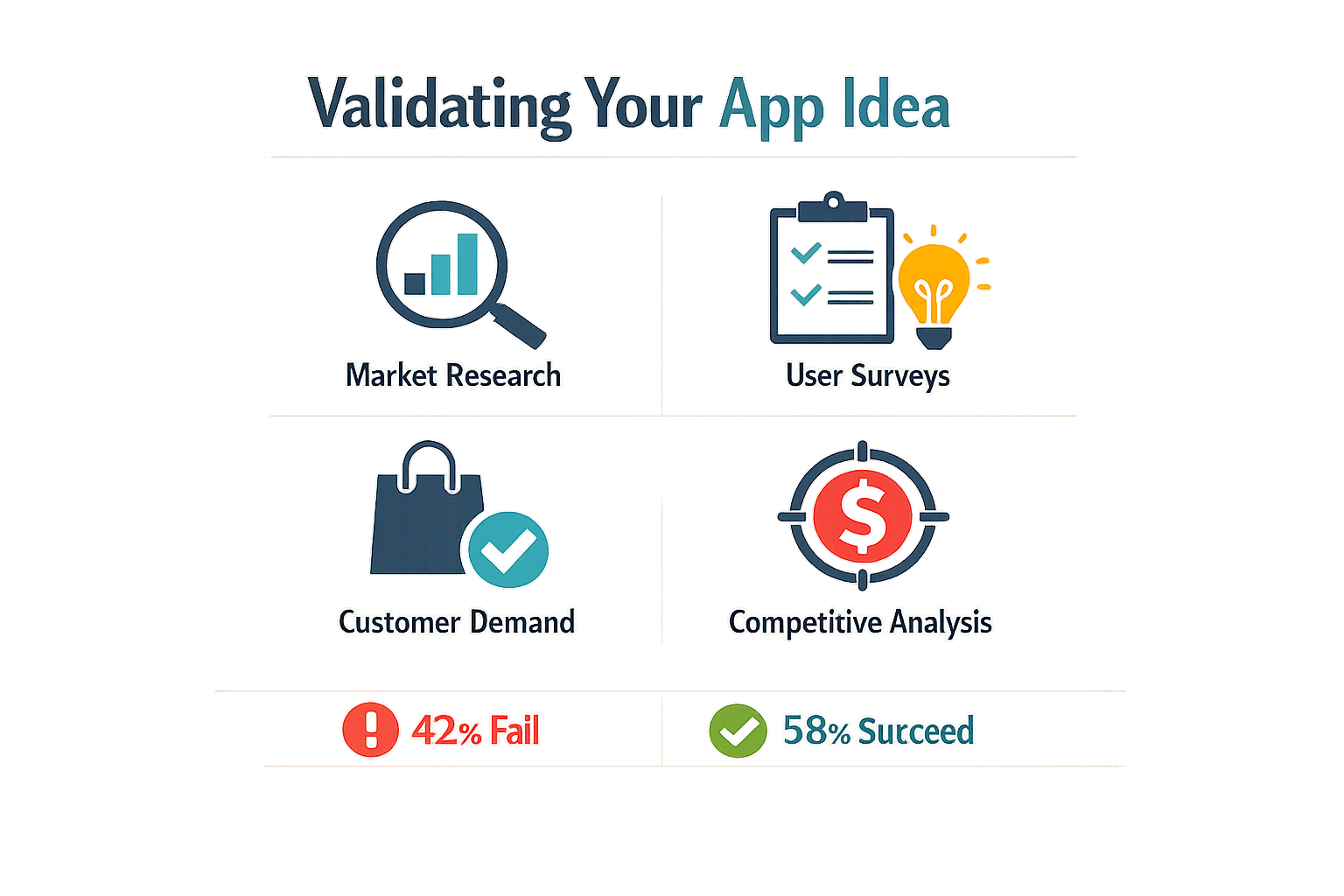
App idea validation is the process of testing whether real users want, need, and will pay for your app before you invest in building it. It means gathering concrete evidence that a specific group of people has a problem worth solving and will use your solution. Without validation, you're betting your budget on a guess.
Nine in ten apps fail. The number-one reason is building something nobody wanted. Validation shifts the risk from your wallet to a series of small, cheap tests. You confirm demand before you write a line of production code.
Why Validation Matters
Most founders skip validation because it feels slow. They want to ship. But shipping the wrong thing is slower. Validation tells you if the problem is real, if your audience will pay, and if your solution is the one they'll choose. It answers those questions in days or weeks, not months of wasted build time.
The traditional validation playbook — fifty interviews, endless surveys — is outdated. The new loop is tighter: confirm the problem with five target users, then build a core experience in one to two weeks. You test with real usage, not hypotheticals. If the core doesn't convert, you pivot or kill it before the budget bleeds out.
What Validation Is Not
Validation is not asking friends if your idea is good. It's not running a poll on social media. It's not building a full MVP and hoping for traction. Real validation requires skin in the game from your users — an email address, a pre-order, time spent using a prototype. Anything less is noise.
If you're starting with an app idea, validation is the firewall between excitement and expensive mistakes. It's the difference between building what you think people want and building what they'll actually use.
Steps to Validate App Ideas
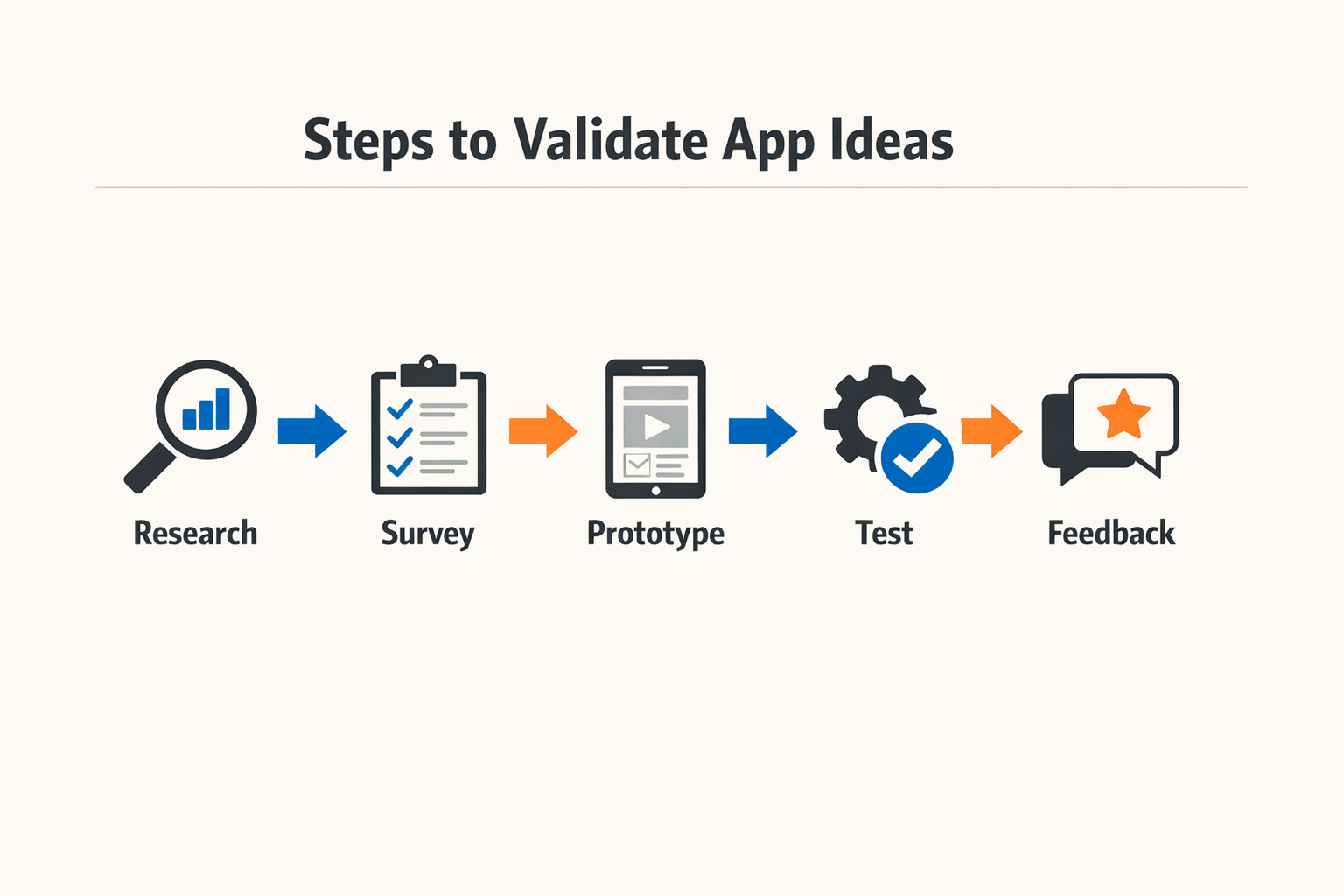
Validation is a sequence, not a single test. Each step filters risk before you commit time or money to the next one. Skip a step and you're guessing.
Define the Core Problem
Start by writing one sentence that describes the problem you're solving. Not the solution, not the features — the problem. If you can't state it clearly, you don't understand it well enough to validate it.
Step 1
Write the problem statement
Describe the friction your user experiences today in concrete terms. "Small business owners waste 6 hours per week manually reconciling invoices" is concrete. "Businesses need better tools" is not.
The problem statement becomes your filter for every validation conversation. If users don't recognize the problem, they won't pay for the solution.
Research Existing Demand
Check whether people are already searching for solutions. Use keyword research tools to measure search volume for terms related to your problem. Look at trends over the past 12 months — rising interest is a signal, flat or declining interest is a warning.
Step 2
Measure search demand
Identify 3-5 keyword phrases users would type when looking for your solution. Check monthly search volume and trend direction. Zero searches means you're inventing demand, not meeting it.
Existing demand means the market is teaching itself to want what you're building. You're joining a conversation already in progress.
Analyze the Competition
Competitors prove the market exists. No competitors might mean you're early, but it usually means there's no money there. Study what similar apps charge, what features they emphasize, and what users complain about in reviews.
| Competitor | Price Point | Top Complaint | Gap You Can Fill |
|---|---|---|---|
| App A | $10/month | Slow support | Real-time help |
| App B | $25/month | Complex UI | Simple workflow |
Your validation target is not "no competition" — it's "a specific gap the competition isn't filling."
Talk to Real Users
Interviews beat surveys. Find 10-15 people who experience the problem and ask them how they solve it today. Don't pitch your idea — listen to their current workarounds, what they pay for alternatives, and where those alternatives fail them.
If you're building for a role you've never held, talking to users is non-negotiable. Your assumptions about their workflow are wrong until proven otherwise. For more on structuring your validation process, see What Is a PRD? A Plain-English Guide for Non-Technical Founders.
Run a Smoke Test
Build the smallest artifact that lets users signal intent. A landing page with an email signup, a mockup you can show in a Zoom call, a pre-order form — anything that requires the user to take an action beyond saying "that sounds nice."
Step 3
Launch a demand signal
Create a simple page describing the problem and the solution. Drive 100-200 targeted visitors to it. Measure how many sign up, click "notify me," or attempt to purchase. Conversion below 2% means weak demand or unclear messaging.
Building a real product provides higher-quality validation signals than interviews or surveys — it reveals actual behavior, not stated preferences.
Smoke tests separate polite interest from real intent. Users lie in interviews, not with their wallets.
Common Methods for Demand Testing
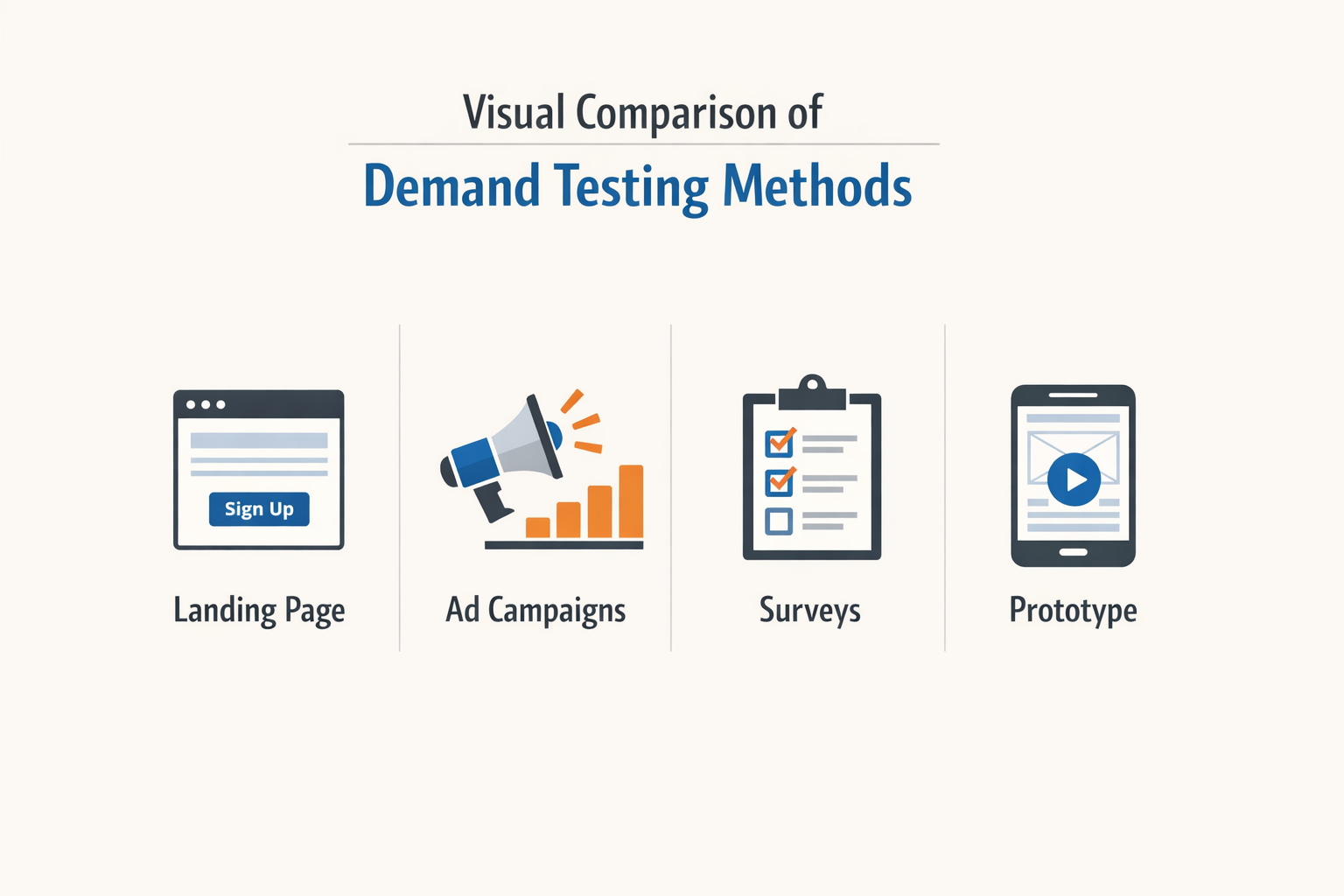
Most founders start with surveys and interviews. Those produce opinions, not behavior. The gap between what people say they'll do and what they actually do is wide enough to sink a product.
The strongest signal comes from building something real. A working prototype — even a rough one — reveals how users behave when they think the product exists. Clicks, signups, and time-on-task tell you more than any focus group.
Framework-Driven Validation
A structured approach beats ad-hoc testing. One reliable pattern includes four steps: mining demand signals from community forums, analyzing competitor presence in app stores, tracking technical trends, and scoring the combined data. Each step filters noise and surfaces genuine interest.
Step 1
Mine community demand
Search Reddit, niche forums, and support threads for recurring complaints that match your idea. Count how many people describe the problem unprompted. Real pain shows up in public venting.
Step 2
Analyze app store competition
Check existing apps in your category. High download counts with low ratings suggest unmet demand. No competition can mean no market or a hard problem — distinguish between the two.
Step 3
Track technical trends
Scan HackerNews and tech communities for emerging patterns. If your idea aligns with a rising trend, timing works in your favor. If it contradicts current momentum, you need a strong contrarian thesis.
Step 4
Score the signals
Combine qualitative and quantitative data into a simple scorecard. Weight each input by reliability. A prototype with real usage beats ten positive interviews.
Avoiding Bias Traps
Friends and family will lie to you. Not maliciously — they want you to succeed, so they'll soften criticism and inflate enthusiasm. Strangers who have nothing to gain give you cleaner data.
The best validation method depends on your constraints and the type of app you're building. If you're a non-technical founder exploring how to turn an idea into reality, start with low-code tools that let you test behavior without hiring a team.
Real Product vs. Hypothetical Testing
Hypothetical questions produce hypothetical answers. "Would you pay for this?" gets you polite yeses. A landing page with a price and a payment button gets you credit card numbers or silence. The second one is validation.
Build the smallest real thing you can. A single feature, a manual backend, a weekend prototype. Watch what people do when they think it's a product, not a concept.
Analyzing Results of Demand Testing
Validation compresses months of uncertainty into days of structured testing. The data you collect from landing pages, surveys, and interviews means nothing until you know what threshold separates signal from noise.
What Counts as Real Demand
Real validation means finding evidence that people have the problem, want a solution, and will pay for yours. A hundred survey responses praising your idea is less useful than three people who gave you their email and asked when they could buy.
Look at conversion rates first. A landing page with 500 visitors and 2 signups tells you the message didn't land. If 500 visitors produced 75 signups, you have something worth building. Industry benchmarks vary, but anything below 2% conversion on a cold audience is a red flag. Above 5% is green.
For interviews, count how many people describe the problem unprompted before you explain your solution. If you have to sell them on the pain point, they don't have it badly enough. Three interviews where the user interrupts you to say "yes, exactly that" outweigh ten polite conversations.
Reading Between the Numbers
Quantitative data shows you what happened. Qualitative data tells you why. A 10% signup rate looks strong until you read the survey comments and realize half the signups thought you were building something else.
Segment your results by source. Traffic from a targeted Reddit thread converts differently than traffic from a generic Facebook ad. If one channel produced 80% of your conversions, that's your actual audience—not the average across all sources.
The cheapest validation mistake is launching to the wrong 100 people and calling it proof.
Pay attention to the questions people ask. If most questions are about pricing, they're evaluating a purchase. If most questions are about features you haven't mentioned, they're trying to fit your app into a different problem than the one you're solving. For a deeper dive into structuring what you're building, see What Is a PRD? A Plain-English Guide for Non-Technical Foundations.
Setting Your Go/No-Go Threshold
Decide your threshold before you start testing. "I'll build if I get positive feedback" is not a threshold. "I'll build if 50 people give me their email in two weeks" is.
For pre-launch signups, 50–100 emails from a cold audience is a reasonable minimum for a niche B2B tool. Consumer apps need higher volume—500+ signups suggests you might have distribution figured out. If you're asking for payment up front, 10–20 committed buyers is enough to start.
If you hit your threshold, build a small version fast. If you miss it by half, the idea needs rework. If you miss it by 90%, the problem isn't real or you're talking to the wrong people.
Who Should Choose What Method
Not every validation method fits every founder. The right approach depends on how much time you have, what kind of access you have to users, and whether you need proof before writing code.
Match Method to Your Constraints
If you're a solo founder with no network, cold outreach and landing pages give you signal without needing warm intros. If you have industry connections, user interviews deliver faster insight—talk to 20-30 potential users before you build anything. If you're technical and impatient, a weekend prototype tests assumptions cheaper than a survey ever will.
| Method | Best For | Time Required | Upfront Cost |
|---|---|---|---|
| User interviews | Founders with network access | 2-4 weeks | Low |
| Landing page | Solo founders testing broad demand | 1-2 weeks | Low-Medium |
| Prototype | Technical founders validating workflow | 1-3 weeks | Medium |
| Surveys | Validating known problem at scale | 1 week | Low |
Avoid asking friends and family—they give you biased feedback that sounds like validation but isn't. Seek out people who will tell you no. Disconfirming evidence is cheaper than a failed launch.
Prioritize Conversations Over Research
User interviews beat market research every time. Reading reports tells you what happened; talking to users tells you why it matters to them. If you're choosing between a survey and 10 phone calls, take the calls. For a deeper look at how to structure your planning before validation, see What Is a PRD? A Plain-English Guide for Non-Technical Founders.
The method that gets you to a real conversation with a real user fastest is the right method. Everything else is overhead.
Avoiding Common Validation Mistakes
Most apps don't fail because of bad code. They fail because nobody wanted them in the first place. Validation is supposed to prevent that, but only if you avoid the traps that make validation worthless.
Asking Friends and Family
Your mom will tell you it's a great idea. Your college roommate will say they'd definitely use it. None of that matters. Friends and family provide biased feedback because they want to support you, not because they see a real problem worth solving. Skip them entirely.
Instead, talk to people who have no reason to lie to you. Strangers with the problem you're solving will tell you the truth because they have nothing to lose. If you can't find strangers willing to spend 15 minutes on a call, that's a signal.
Ignoring User Interviews
Market research tells you the size of a space. User interviews tell you whether your specific solution fits a real workflow. The second one matters more. If you skip interviews and jump straight to building, you're guessing at the problem from a spreadsheet.
User interviews should happen before you write a single line of code. Talk to people who currently experience the problem. Ask how they solve it today, what they've tried, and where those solutions break down. If they can't articulate the pain, you don't have a validated problem. For more on structuring this work, see What Is a PRD? A Plain-English Guide for Non-Technical Founders.
Treating Validation as a Checkbox
Validation is not a one-time event. It's a continuous process that runs through the entire build. Founders who validate once and then disappear into a six-month development cycle come back with something nobody recognizes. The market moved, the problem shifted, or the solution missed the mark.
Stay in contact with early users while you build. Show them rough prototypes. Let them break things. Adjust based on what you see, not what you hoped would happen.
Validation that stops after the first round of interviews is just expensive permission to waste time building the wrong thing.
Case Studies of Successful App Validation
Two validation patterns show what fast, real-world testing looks like when you skip the survey theater and build something small.
Expense Splitting App: Reddit as Demand Signal
One founder scanned subreddits where roommates complained about splitting bills. The same frustration surfaced across multiple communities—people wanted a cleaner way to track shared expenses. Instead of running a survey, the founder treated recurring complaints as pre-validation. The app concept had built-in distribution: frustrated users were already congregating in public forums, which meant the problem was real and the audience was reachable.
The lesson: when the same pain point shows up unprompted in multiple places, you have a demand signal. You still need to build something small to confirm people will use it, but you're not starting from zero.
Tipping Page: Four Days from Idea to Live Product
Another founder confirmed user frustration in five conversations, then built a minimal tipping page in four days. The goal was not to ship a polished product—it was to get real usage data immediately. Once live, the page collected actual behavior: who clicked, who paid, how much they tipped. That data answered the validation question faster than any survey could.
Both cases share the same structure: identify the problem in the wild, talk to a handful of people who have it, then build the smallest version that produces real behavior. If you're working through your first app idea, this is the pattern to follow—short cycles, real data, no pretense.
Future Trends in App Idea Validation
The cost and time to validate app ideas have collapsed. In 2020, building an MVP required $100–300k and 3–6 months. By 2026, the same outcome costs $0–5k and takes 1–2 weeks. AI tooling and infrastructure made the difference. The old playbook—interview 50 people, write a spec, hire a dev shop—no longer matches the economics.
The New Validation Loop
The updated framework skips extensive surveys. Instead, confirm the problem with five target users, then build a core experience in 1–2 weeks. The artifact itself becomes the validation instrument. Users interact with something real, not a concept. Their behavior tells you more than their survey answers ever did.
This shift changes who can validate ideas. Non-technical founders who once needed $50k in capital can now prototype directly. Vibe coding workflows let solo operators turn a problem statement into a working app over a weekend. The barrier is no longer funding—it's clarity about what to build first.
What This Means for Demand Testing
Traditional demand testing relied on proxies: landing pages, surveys, waitlists. These still work, but they measure intent, not behavior. When you can ship a functional MVP in two weeks, you test real usage instead. The user either completes the job or abandons the flow. No interpretation required.
The trade-off: faster cycles mean less time to think. You validate by building, so each iteration must answer a specific question. The discipline shifts from research design to rapid prototyping with clear hypotheses. If you can't articulate what the next build will prove, you're just adding features.
Conclusion
Validation is the difference between building something nobody wanted and building something that sells itself. Nine in ten apps fail because founders skip this step — they confuse excitement for evidence. Validation is gathering real proof that a specific group of people has a problem worth solving and will use your solution before you commit a full development budget.
You now have a framework: talk to users, test with landing pages, run small experiments, and measure real behavior. Each method trades speed for certainty. Choose the one that fits your timeline and risk tolerance, but choose something. Sitting on an untested idea costs more than a failed test — it costs months of build time on the wrong thing.
I've watched founders spend six months on apps that died in week one because they never asked if anyone cared. I've also seen ideas pivot three times in validation and ship profitably in eight weeks. The difference was not talent or luck — it was willingness to test assumptions before writing code. If you're serious about building, start with a clear plan and realistic scope. Validate first, build second.
The best validation is the one you finish this week. Pick a method, set a two-week deadline, and commit to a decision rule. If the data says stop, you saved yourself six months. If it says go, you're building with confidence instead of hope.
Related reading
Best Vibe Coding Tools in 2026 (Compared)