Idea to MVP: The Ultimate Simple Plan in 30 Days
Introduction
Most founders sit on an app idea for months. They sketch wireframes, debate features, and wait for the perfect moment. The idea grows in their head until it becomes too big to start.
The Idea to MVP path is different. You pick one problem, solve it barely well enough, and put it in front of users within 30 days. No polish. No extras. Just the core loop that proves someone will use what you built.
This guide walks through a realistic 30-day plan to move from idea to a working product in users' hands. The timeline is tight on purpose — it forces you to cut ruthlessly and focus on the one thing that has to work. If you're a non-technical founder exploring how to validate and plan your app idea, this framework gives you a concrete path forward.
The MVP approach aligns with startup reality: limited resources, high uncertainty, and the need to learn fast. You ship earlier, gather real feedback, and focus on solving the core problem exceptionally well instead of guessing what users might want six months from now.
The next sections break the 30 days into phases, walk through each key step, and show you how to avoid the traps that turn a lean MVP into a bloated project that never ships.
Learn how to turn your app idea into an MVP in just 30 days with this structured plan.
Understanding Minimum Viable Product (MVP)
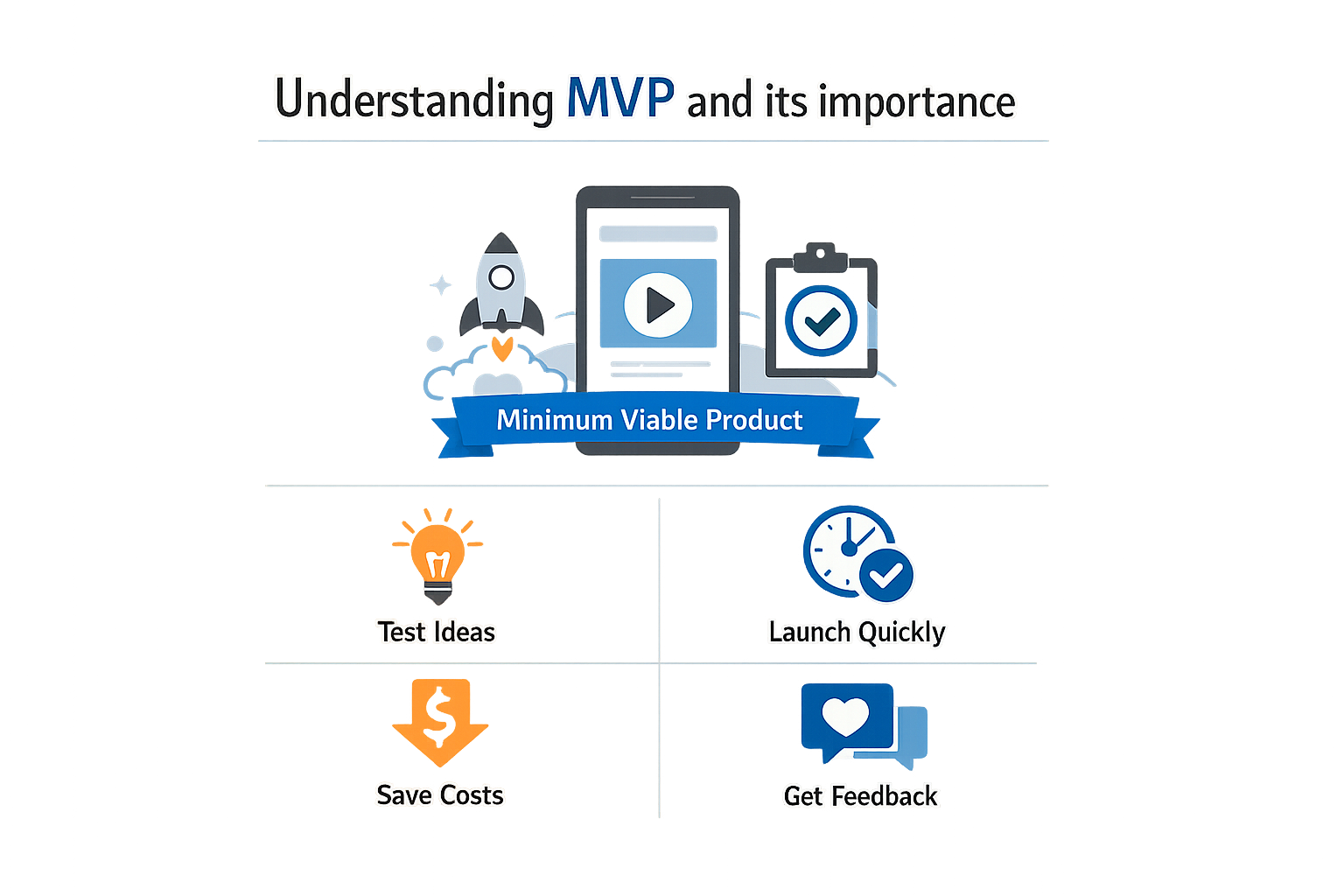
An MVP is the smallest version of your product that solves the core problem well enough to deliver real value and generate meaningful market feedback. It is not a prototype. It is not a feature list trimmed to fit a budget. It is a test designed to validate market demand and reduce risk by aligning the product with real user needs.
The word "minimum" misleads founders into building half-broken toys. Minimum means scope, not quality. Your MVP should do one thing well enough that users would notice if you turned it off tomorrow. If they would not notice, you built the wrong thing.
Why an MVP Matters
Most app ideas fail because founders guess what users want instead of testing it. An MVP forces you to pick one hypothesis and prove it before you spend six months building features nobody asked for. You ship fast, watch what breaks, and learn whether the core idea has legs.
The feedback loop is the point. An MVP that ships in 30 days and gets real usage data is worth more than a polished product that launches in six months to crickets. Speed wins when the goal is learning, not perfection.
What Makes a Good MVP in Practice
A good MVP has three properties: it solves one specific problem, it works reliably enough to collect feedback, and it can scale without a full rewrite when you add features later. That last point trips up founders who treat the MVP as throwaway code. If your first version is held together with duct tape, your second version will be a six-month rebuild.
In practice, this means picking a narrow use case and building it with production-grade tools from day one. You can skip features, but you cannot skip infrastructure. Authentication, data persistence, and error handling are not optional just because you are moving fast.
If you are non-technical, this is where a structured approach like vibe coding helps. You can move quickly without accumulating technical debt that kills momentum later.
The Modern MVP Definition
The MVP playbook has shifted. Today, an MVP is designed for rapid development, real-time feedback, and scalability without requiring a rewrite. AI tools have compressed timelines, but the core discipline remains: solve one problem, ship it, measure it, iterate.
You are not building the final product. You are building the cheapest experiment that proves whether the final product is worth building at all.
Planning Your 30 Days
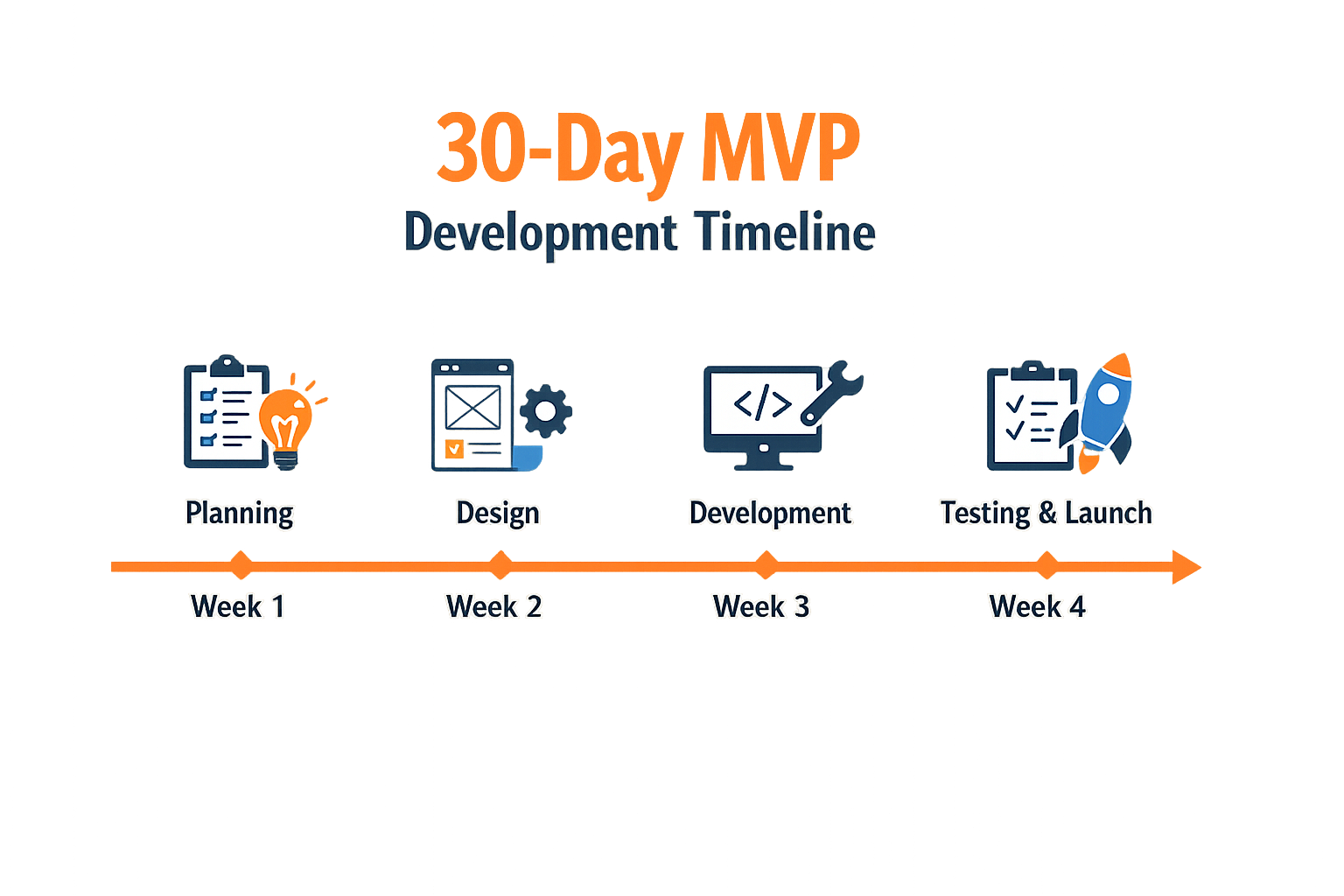
A 30-day MVP timeline is tight but doable if you scope hard and ship small. The goal is not a polished product — it's a working prototype that proves one core hypothesis. Most founders waste weeks debating features that don't matter yet. A structured plan keeps you shipping.
The timeline splits into three phases: definition, build, and validation. Week one is all planning. Weeks two and three are build. Week four is test and adjust. If you stick to this structure, you'll have something real by day 30.
Week 1: Define the Problem and Scope
The first seven days are about clarity. Write a one-sentence problem statement that names the user and the pain. Then map the simplest user flow that delivers relief — no branches, no edge cases. List every feature you think you need, then cut half of them. What's left is your feature list.
Step 1
Document the problem
Write down who has the problem, what they're doing now, and why it's painful. One paragraph. If you can't write it clearly, you don't understand it yet.
Step 2
Draw the user flow
Sketch the steps from problem to solution. Start at the moment of pain, end at relief. No detours. This becomes your spec.
Step 3
List and cut features
Write every feature idea. Then delete anything that isn't on the critical path. Save the rest for version two.
By the end of week one, you should have a problem statement, a user flow diagram, a feature list, and a short risk register — things that could kill the project if you ignore them.
Week 2–3: Build the Core
Weeks two and three are pure execution. Pick one tech stack and stick with it. If you're non-technical, this is where vibe coding or a no-code tool becomes critical — you need to move fast without getting stuck in framework debates.
Build the happy path first. Ignore error handling, edge cases, and polish. If the core flow works for one ideal user, you have an MVP. Everything else is iteration.
Test locally as you build. Don't wait until day 29 to see if it works. Run the flow yourself every day. If something breaks, you'll know immediately.
Week 4: Test and Adjust
The final week is validation. Put the MVP in front of three to five real users — not friends, not family. Watch them use it without coaching. Note where they get stuck, what they skip, and what they ask for.
You're not gathering feature requests. You're checking if the core hypothesis holds. If users complete the flow and say they'd use it again, you have signal. If they bail halfway through, your scope was wrong.
Make one or two small fixes based on feedback, but don't rebuild. The goal is to finish day 30 with a working prototype and a decision: keep going or pivot.
The 30-day plan isn't about perfection — it's about proving you can finish something that solves a real problem.
Key Steps to Move from Idea to MVP
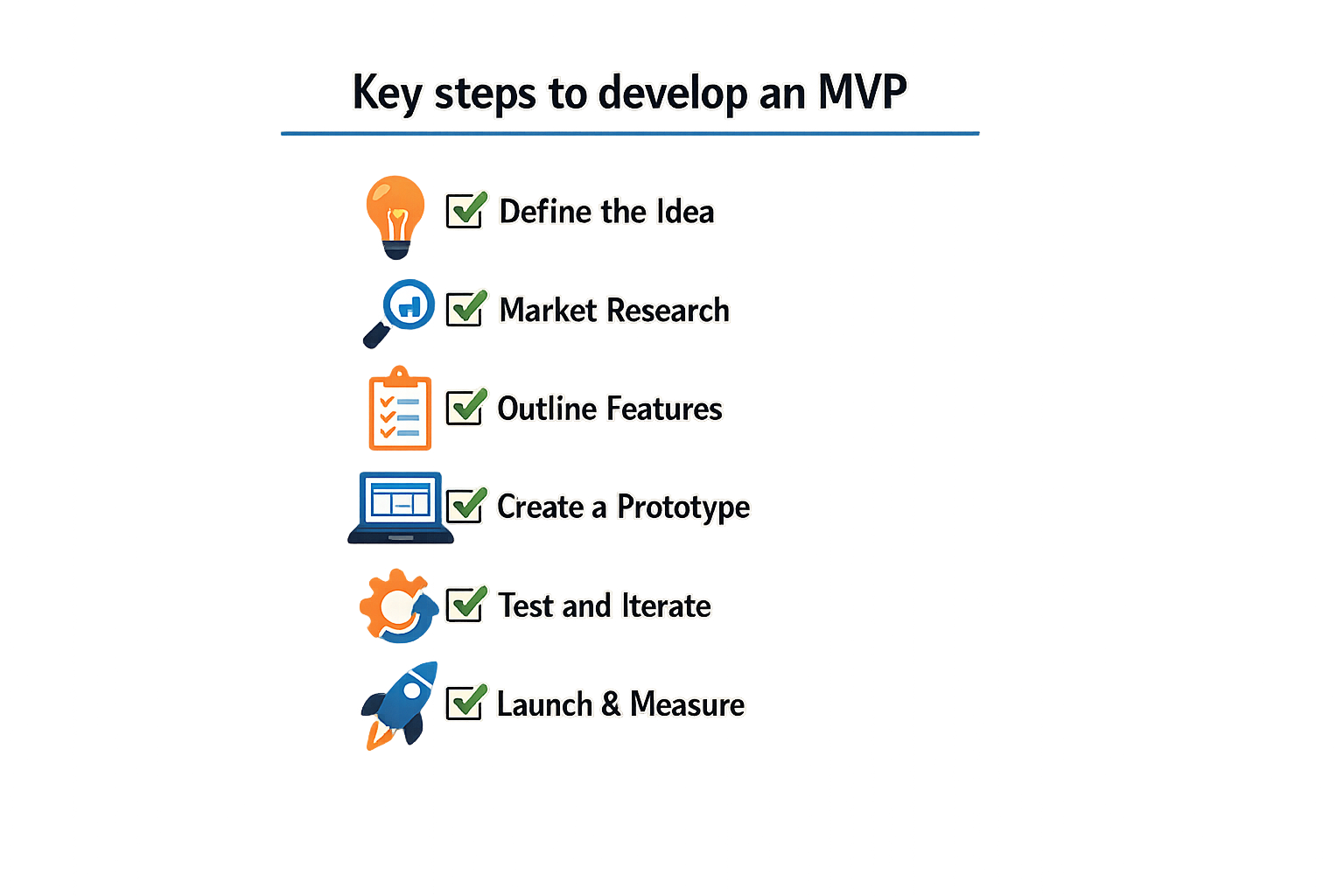
Most founders jump straight from idea to code. That skips the steps that determine whether the code is worth writing. The path from idea to MVP breaks into five stages: sharpen the idea, scope the smallest version, design the core flow, build the thin slice, and launch to real users to learn.
Sharpen the Idea
Narrow your idea into one testable bet. If you skip this, you build something too complex that nobody wants. Write down the single assumption you need to validate. Example: "Freelancers will pay $20/month to track invoices in Notion." That's a bet. "Freelancers need better tools" is not.
Scope the Smallest Version
For each feature on your list, ask: does this change whether the bet is validated? If not, cut it. Your MVP should test the core assumption, not solve every adjacent problem. A payment processor tests whether users will pay. A dashboard with twelve chart types does not.
Step 1
List every feature you think you need
Write them all down. No filtering yet.
Step 2
Apply the validation test
For each feature, ask: "If I remove this, can I still test my bet?" If yes, remove it.
Step 3
Lock the scope
What remains is your MVP feature set. Write it down and stop adding to it.
Design the Core Flow
Sketch the user's path from landing to the moment that validates your bet. This is not visual design. It's the sequence: sign up, connect account, see first result, decide to pay. If you're building with AI tools, this flow becomes your PRD. The clearer the flow, the less you'll rebuild later.
Build the Thin Slice
Code only what the flow requires. If your bet is "users will book a demo after seeing their audit score," you need: score calculation, score display, demo booking form. You do not need: user profiles, settings pages, email notifications, or a blog. Build the thinnest version that completes the flow once.
Launch to Real Users
Put it in front of people who match your target. Not friends. Not other founders unless they're the market. Real users who have the problem. Watch what they do. Most won't finish the flow. That's the data. Fix the biggest drop-off point, then launch again.
Common Pitfalls to Avoid
Most MVPs die from self-inflicted wounds. The common thread: founders who mistake motion for progress. You add features that sound important, skip the hard work of defining the problem, and wake up six weeks later with a prototype no one asked for.
Skipping Problem Definition
If you can't write the problem in one sentence, you don't understand it well enough to build a solution. Vague ideas produce vague products. The fix: write down exactly who has the problem, what triggers it, and what they do today when it happens. If the answer changes every time you explain it, you're not ready to code.
Building Features You Can't Defend
Cut anything that doesn't directly solve the core problem for your primary user. Nice-to-have features, advanced customization, and support for multiple user types all sound reasonable until you realize you spent three weeks on a dropdown menu no one will touch. The test: if removing the feature means your MVP still works for the target user, it doesn't belong in version one.
Step 1
Audit your feature list
Go through every planned feature and ask: does this solve the core problem, or does it make the product feel more complete? If it's the second one, delete it. Your job is to validate the problem, not to ship a polished app.
Over-Engineering Before Validation
You don't need user roles, admin dashboards, or a scalable backend before you have ten people who want to use the thing. Founders over-engineer because it feels safer than talking to users. The work is real, the progress is measurable, and you can avoid the uncomfortable truth that no one might care. Save the infrastructure work for after you know the product has a pulse.
If you're stuck in planning mode, a plain-English PRD forces you to define scope before you write a line of code.
Ignoring the 30-Day Constraint
Thirty days is not a suggestion—it's a forcing function. If your MVP can't launch in a month, you haven't cut enough. The deadline exists to prevent the slow feature creep that kills momentum. When you feel the urge to add "just one more thing," write it down for version two and keep moving.
Testing and Gathering Feedback
You don't know if your MVP works until real people use it. Testing isn't a formality — it's the entire reason you built a minimum product instead of a full one. Ship to a small group, watch what breaks, and listen to what they say.
Start with Five Users
Five real users will surface 80% of your critical issues. More testers means more noise early on. Pick people who match your target audience but aren't close friends — you need honesty, not politeness. Give them a single task and watch where they get stuck.
Ask Specific Questions
Open-ended questions like "What do you think?" produce useless answers. Ask: "Which step felt unclear?" or "Would you pay $X for this?" Tie every question to a decision you need to make. If the answer won't change your roadmap, don't ask it.
Before you start testing, clarify the problem you're solving and validate the market through user engagement. Define must-have features and separate them from nice-to-haves — testing should confirm whether your core assumption holds, not whether users like every detail.
Track Behavior, Not Opinions
Users will tell you they love a feature they never use. Instrument your MVP to log real actions: signup-to-activation rate, time to first value, drop-off points. If 70% of testers abandon the flow at step three, that step is broken regardless of what they say in the survey.
The MVP approach aligns with startup reality: limited resources, high uncertainty, and the need to learn fast.
Gather Feedback in Rounds
Test in waves. Fix the top three issues from round one, then test again with fresh users. Each cycle should answer one question: does this solve the core problem better than the last version? If you're still guessing after three rounds, your problem definition is wrong.
For founders moving from idea to working product, vibe coding workflows let you iterate quickly without waiting on a dev team — you can push fixes between test rounds in hours, not weeks.
Iterating Based on Feedback
Feedback without action is noise. The iteration phase separates builders who ship from those who stall. Once you have user input—whether from five testers or fifty—your job is to decide what to fix, what to ignore, and what to build next. The goal is not to please everyone; it's to make the core flow work better for the people who will actually pay.
Triage the Signal
Not all feedback is equal. Start by sorting input into three buckets: broken (the feature does not work as designed), friction (it works but feels slow or confusing), and requests (users want something new). Fix broken first. Address friction if it blocks the main workflow. Requests go on a backlog unless three or more users ask for the exact same thing unprompted.
Ignore feature requests that expand scope beyond your original one-feature core. If your MVP is a task tracker and someone asks for calendar sync, that's a different product. Write it down, but do not build it in the iteration window.
Make Small, Testable Changes
Iteration works best in tight loops. Pick one fix, deploy it, and retest with the same users who reported the issue. If you batch ten changes at once, you will not know which one solved the problem or introduced a new bug. Each iteration should take hours or days, not weeks.
For friction issues, start with the smallest change that might help. If users say a button is hard to find, move it before you redesign the whole screen. If a form feels too long, cut one field and see if completion rates improve. Measure the result, then decide whether to go further.
Step 1
Identify the highest-impact issue
Review your feedback triage and pick the one problem that affects the most users or blocks the critical path. If nothing is broken, choose the friction point that slows down your core workflow.
Step 2
Implement the smallest fix
Make the change in code, test it locally, and deploy to a staging environment. Do not add new features at this stage—just fix what is broken or smooth what is rough.
Step 3
Retest with original users
Go back to the people who reported the issue and ask them to try the updated version. Watch how they interact with the fix. If it solved the problem, move to the next issue. If not, iterate again.
Know When to Stop Iterating
You can iterate forever. The question is when to call the MVP good enough and move to launch. A useful heuristic: if your core workflow runs end-to-end without breaking, and at least three users have completed it without help, you are ready. Polishing the UI or adding convenience features can wait until after public launch.
Iteration is not about perfection. It's about removing the blockers that prevent real usage. Once the path is clear, ship it. For more on structuring your build and iteration cycles, see Vibe Coding for Beginners: The Ultimate Easy Weekend Guide.
Launching Your MVP
Launch is a deadline, not a destination. The point is to get your MVP in front of real users before you've convinced yourself to add one more feature. Most founders delay launch because the product feels incomplete—it's supposed to feel incomplete. That's the whole idea.
Set a Hard Launch Date
Pick a date 30 days out and tell someone who will hold you to it. A public commitment—even just to a friend or a small group—creates the forcing function you need to stop tweaking and start shipping. The calendar matters more than polish at this stage.
Choose Your Launch Channel
You don't need a multi-channel campaign. Pick one place where your early users already hang out—a Slack community, a subreddit, Product Hunt, or even a LinkedIn post. Spend your energy writing a clear, honest description of what the product does and who it's for. Skip the hype; just explain the problem you're solving.
Prepare for Day-One Issues
Something will break. A form won't submit, an email won't send, or a user will find a workflow you didn't anticipate. Have a way to hear about it fast—put your email or a feedback link in the app itself. Respond within hours, not days. Early users forgive bugs if they see you fixing them in real time.
Track One Metric That Matters
Don't drown in analytics on day one. Pick the single behavior that proves your MVP is working—logins, completed tasks, invites sent—and watch that number. Everything else is noise until you know whether people are using the core feature. For more on turning early ideas into structured builds, see What Is a PRD? A Plain-English Guide for Non-Technical Founders.
The slow part of moving from idea to launch is not the engineering but the decisions about what features to include or exclude from the MVP.
Communicate Clearly About What's Next
Tell your early users this is version one. Let them know you're listening and that updates are coming based on their input. A simple roadmap—even just three bullet points—signals that you're serious about improvement without overpromising.
Launch is the beginning of learning, not the end of building. Ship it, watch what happens, and adjust.
Long-term Strategies After Launch
Your MVP shipped. Users logged in. The first week is over. Now the real work starts — turning a validated bet into a product people pay for month after month.
Most founders treat launch as the finish line. It's the starting gun. The 30-day sprint proved someone will use the thing; the next 90 days prove whether they'll stay.
Measure What Actually Matters
Track retention, not vanity metrics. If 100 users sign up and 3 are still active two weeks later, you have a leak, not a product. Set a weekly retention threshold — 20% week-two retention is a reasonable floor for early SaaS — and treat anything below it as a code-red.
Log where users drop off. If they bail after the second screen, that screen is lying to them about what the product does. If they complete onboarding but never return, onboarding taught them the wrong job.
Expand the Bet Without Diluting It
Your MVP solved one narrow problem for one type of person. Growth means finding adjacent people with the same problem, not adding features for different problems.
If solo recruiters loved the ranked shortlist, try small agency recruiters next — same pain, slightly different context. Don't add applicant tracking or interview scheduling until the core ranking job is bulletproof for both segments.
New features should make the existing job faster or more reliable. Anything else is a new product masquerading as a feature.
Build the Minimum Viable Business Operations
Product-market fit doesn't pay invoices. You need billing, support, and basic customer success infrastructure before you can scale.
Set up:
- Automated billing with clear retry logic (failed payments kill 10–15% of early revenue)
- A support inbox with a 24-hour SLA, even if it's just you
- A simple onboarding email sequence — three emails over two weeks, each tied to one activation event
These aren't growth levers. They're table stakes. If users can't pay you reliably or get an answer when something breaks, retention collapses no matter how good the product is.
The cheapest growth channel is keeping the users you already have.
Decide What You Won't Build
Every user will ask for something. Most requests are users trying to bend your product into a tool for a different job. Say no to anything that doesn't serve the core bet.
Keep a "not now" list — feature requests that might make sense later but don't move the current needle. Review it quarterly. If a request shows up from five different users in five different ways, it might be a real signal. If it's one user asking five times, it's noise.
When to Pivot vs. Double Down
If week-two retention stays below 15% for eight weeks and you've shipped three rounds of fixes based on real feedback, the bet is probably wrong. That's a pivot signal.
If retention is climbing — even slowly — and users are starting to describe the product to others without prompting, double down. Add the smallest feature that removes the biggest remaining friction, then measure again.
Pivots are cheap in month two. They're expensive in month twelve. Move fast while the stakes are still low.
For a deeper breakdown of how to validate and refine your product idea before and after launch, see What Is a PRD? A Plain-English Guide for Non-Technical Founders.
Conclusion
Moving from idea to MVP in 30 days is achievable when you treat the timeline as a forcing function, not a fantasy. The discipline is in what you cut, not what you build. Every feature you defer is a decision you can test with real users instead of guessing in a vacuum.
The 30-day plan works because it collapses the distance between assumption and evidence. Week one forces you to write down what you think matters. Week two proves whether you can build the simplest version that demonstrates the core value. Week three puts that version in front of people who will tell you if it solves their problem. Week four is where you decide if the idea survives contact with reality.
Most founders fail because they build something nobody needs—90% of startups fail for exactly that reason. The MVP framework doesn't eliminate risk, but it does let you fail faster and cheaper if you're going to fail at all. If you're going to succeed, you'll know sooner and waste less time polishing features that don't move the needle.
MVP thinking provides the discipline to identify and build only what delivers value earliest. After hundreds of PRDs and dozens of vibe-coded prototypes that either shipped or died in staging, the pattern is consistent: the teams that launch are the ones that treat the first version as a question, not an answer.
Start with a one-page PRD. Build the smallest thing that lets a user complete one job. Show it to five people who have the problem. If they use it twice without you in the room, you have something. If they don't, you saved yourself six months. For a structured approach to planning your build, see What Is a PRD? A Plain-English Guide for Non-Technical Founders.
The 30 days start when you stop planning and start writing code—or hiring someone who will.