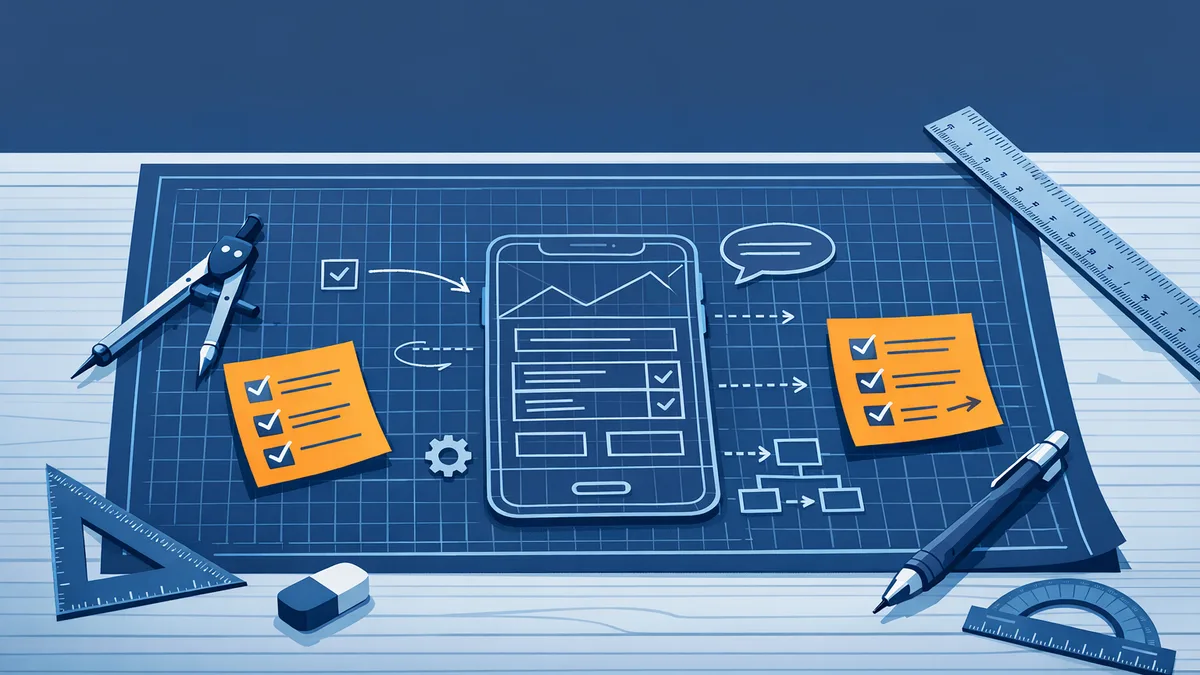
What Is a PRD? A Plain-English Guide for Non-Technical Founders
You have an app idea. Maybe you've had it for months. You can picture the screens, you know exactly who would use it, and you're pretty sure it could be a real business. Then you talk to a developer — or an AI coding tool — and the first thing they ask is: "Do you have a PRD?"
If your honest answer is "a what?", this guide is for you. We'll explain what a PRD actually is, why every serious app project starts with one, and how to write one even if you've never worked in tech.
Key Takeaways
- A PRD (Product Requirements Document) is a plain-language blueprint that describes what your app does, who it's for, and what "done" looks like
- You don't need to be technical to write one — you need clarity about the problem you're solving
- A good PRD saves thousands of dollars by preventing developers (human or AI) from building the wrong thing
- Modern AI coding tools perform dramatically better when you feed them a structured PRD instead of a vague prompt
What Does PRD Actually Stand For?
PRD stands for Product Requirements Document. Strip away the corporate jargon and it's simply a written description of the product you want built: the problem it solves, the people it serves, the features it needs, and the rules it has to follow.
A PRD is not code. It's not a technical specification full of database diagrams. The best PRDs are written in plain English and could be understood by your co-founder, your developer, and your mother.
Why Skipping the PRD Is the Most Expensive Mistake Founders Make
When founders go straight from idea to "just start building," three things reliably happen:
- Scope creep: without a written boundary, every new idea feels essential, and the project balloons
- Misunderstood requirements: the developer builds what they heard, not what you meant
- Endless rework: changes that would have been a sentence edit in a document become weeks of rebuilding
A PRD doesn't slow you down. It's the difference between building your app once and building it three times.
What Goes Inside a PRD (The Plain-English Version)
You'll find fancy templates with twenty sections, but every useful PRD answers six questions:
| Section | The question it answers | Example |
|---|---|---|
| Problem statement | What pain are you solving, for whom? | Freelancers waste hours invoicing clients manually |
| Target users | Who exactly uses this? | Solo freelancers billing 2–10 clients a month |
| Core features | What must version one do? | Create invoice, send by email, track payment status |
| Out of scope | What are you deliberately NOT building yet? | No team accounts, no multi-currency in v1 |
| User flows | How does someone move through the app? | Sign up → add client → create invoice → send |
| Success criteria | How will you know it works? | A user can send their first invoice in under 5 minutes |
How to Write Your First PRD in Three Steps
Step 1
Describe the problem before the product
Write one paragraph about the person you're helping and the pain they feel today — without mentioning your app at all. If you can't describe the problem without describing your solution, you don't understand the problem well enough yet.
Step 2
List features, then cut half
Brain-dump every feature you can imagine. Then mark each one: is this essential for the very first version, or just nice to have? Move everything non-essential into the "later" list. Version one should be embarrassingly small and still solve the core problem.
Step 3
Walk through your app out loud
Narrate what a user does from the moment they open the app: what they see, what they tap, what happens next. Every screen and decision you narrate becomes a user flow in your PRD. Gaps in your story are gaps in your plan.
PRDs in the Age of AI App Builders
Here's what's changed: a PRD used to be a document you handed to a human team. Today it's also the highest-leverage input you can give an AI coding tool. Tools like Cursor, Lovable, Bolt, and Replit produce dramatically better results when they're working from structured requirements instead of a one-line prompt.
This is exactly the gap LaunchCraft exists to close. Instead of staring at a blank template, you have a guided conversation about your idea — and LaunchCraft turns your answers into a complete, developer-ready blueprint you can hand to a human team or an AI builder.
Frequently Asked Questions
How long should a PRD be?
For a first version of an app, 2–5 pages is plenty. If it's longer than ten, you're probably specifying too much too early. Clarity beats completeness.
Do I need a PRD if I'm using a no-code or AI tool?
Arguably you need it more. No-code and AI tools build fast — which means they build the wrong thing fast, too. The PRD is what keeps the speed pointed in the right direction.
What's the difference between a PRD and a business plan?
A business plan explains why the company will make money. A PRD explains what the product does. Investors read business plans; developers and AI tools read PRDs.
Related reading
Best Vibe Coding Tools in 2026 (Compared)