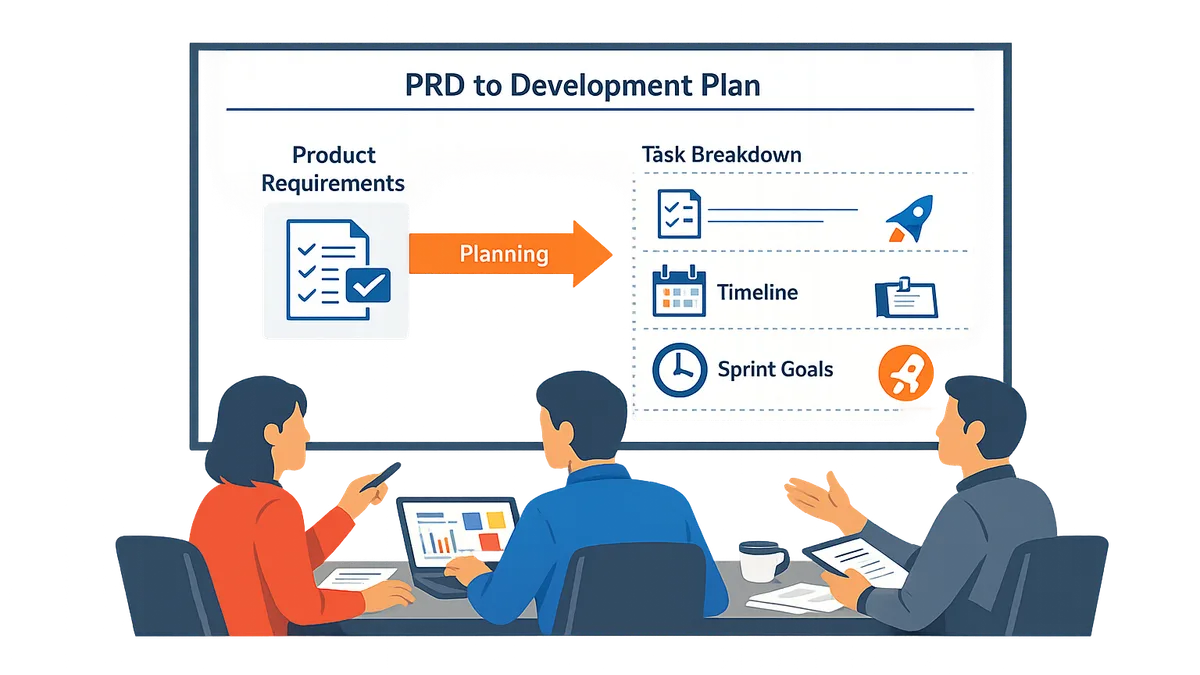
PRD to Development Plan: The Ultimate Simple Guide to Action
Introduction
A PRD describes the destination. A development plan is the turn-by-turn route. Most projects stall not because the idea was bad, but because the team never converted specifications into concrete tasks with owners and dates.
You write a PRD to align stakeholders on what success looks like. You write a development plan so engineers know what to build Monday morning. The gap between those two documents is where projects die—or where they gain momentum.
I've watched solo founders ship working prototypes in weekends because they treated the PRD as a contract with themselves, then broke it into a checklist they could actually finish. I've also seen teams with pristine PRDs spend months in meetings because no one turned "user can log in" into "implement OAuth, set up session store, write middleware." The difference is the development plan that converts specifications into action.
This guide walks through the exact process of taking a PRD—no matter how rough—and producing a development plan that your team (or your AI coding agent) can execute without constant clarification. You'll learn the steps, the common traps, and the decisions that separate a plan that works from one that sits in a Notion page forever.
Learn how to convert a PRD to a development plan effectively, ensuring your project transitions smoothly from concept to execution.
Understanding PRD
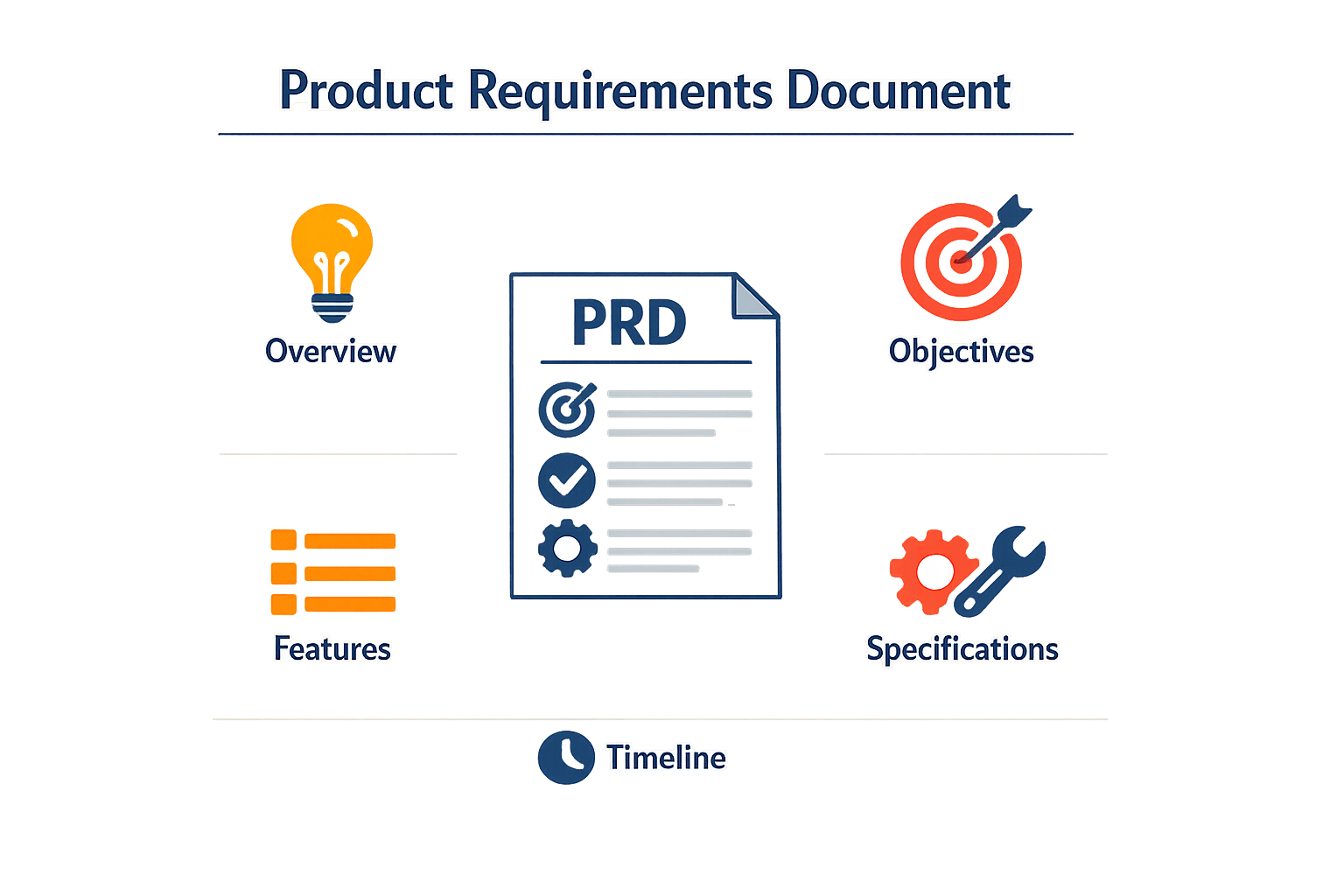
A Product Requirements Document (PRD) articulates the purpose, features, and functionality of a product, serving as a blueprint for development teams. It's the written contract between what you want to build and what engineering will deliver. Without it, you're asking developers to read your mind.
The PRD translates business goals into technical language. It answers why the product exists, who will use it, and what success looks like. When a designer asks "Should this button be blue?" and an engineer asks "Does this need to scale to a million users?", the PRD already has those answers written down. If you're starting from scratch, What Is a PRD? A Plain-English Guide for Non-Technical Founders walks through the document's role in the build process.
Core Components of a Modern PRD
A complete PRD includes ten structural elements. Each one maps to a question someone on your team will ask:
- Introduction & Purpose — What problem does this solve?
- Target Audience & User Personas — Who is this for?
- Features & Functionality — What does it do?
- User Flow & Design — How do users move through it?
- System & Technical Requirements — What infrastructure does it need?
- Assumptions and Constraints — What are we betting on, and what can't change?
- Risks & Dependencies — What could break this?
- Success Metrics & Release Criteria — How do we know it worked?
- Timeline & Release Plan — When does each piece ship?
- Stakeholder Review & Approval — Who signs off?
What the PRD Does Not Contain
The PRD defines what and why, not how. It doesn't include implementation details like database schemas, API endpoints, or UI mockups. Those live in separate documents that reference the PRD. If your PRD has code samples or CSS, you've gone too far.
It also doesn't replace conversation. The PRD is a shared reference point, not a substitute for talking to your team. When engineering says "This requirement is ambiguous," the correct response is to clarify the PRD, not to defend it.
Importance of a Development Plan
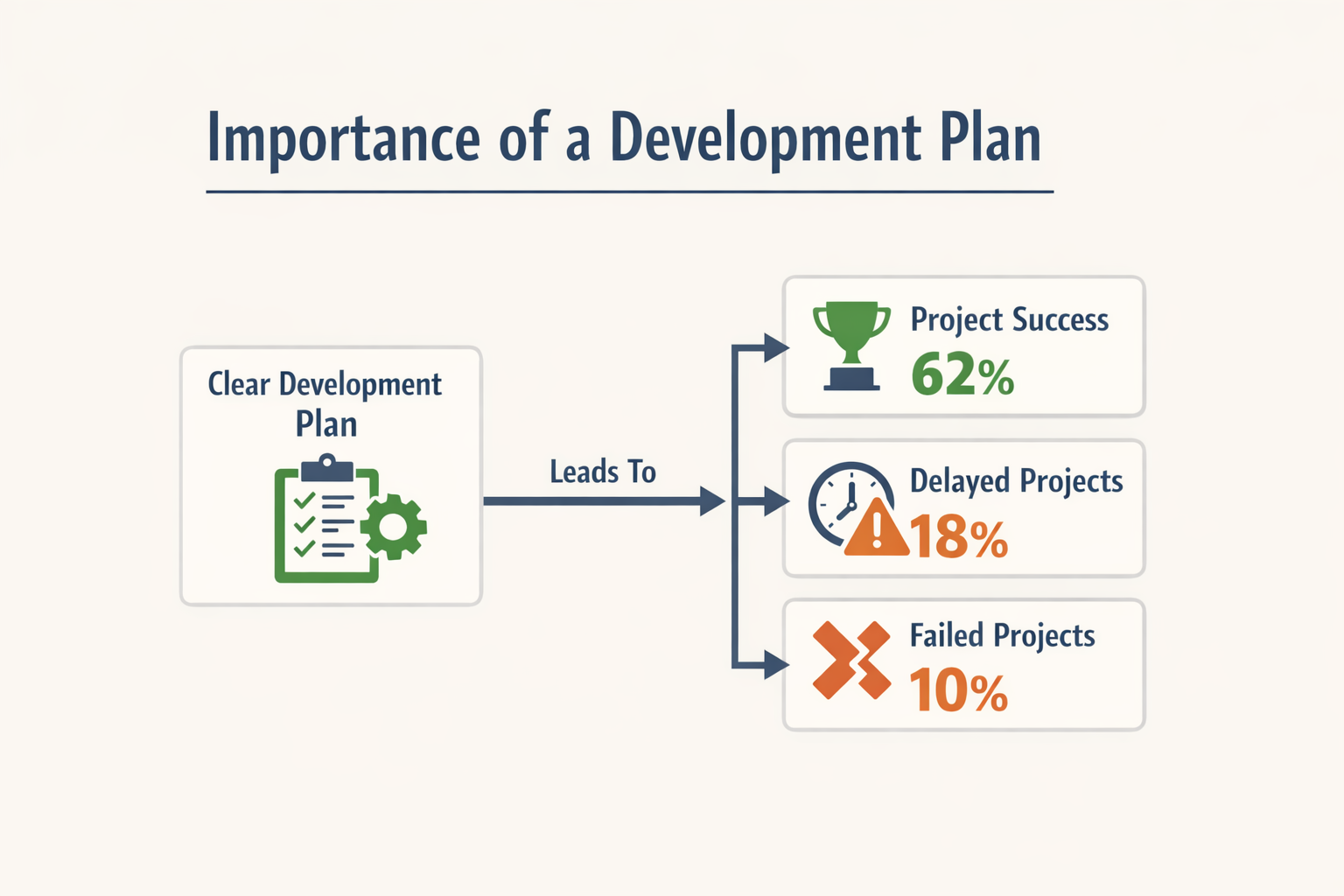
A development plan is the bridge between intention and execution. Without it, a PRD is just a wish list. The plan turns abstract requirements into concrete tasks, assigns ownership, and sets timelines. It answers the question: who builds what, and when?
The difference shows up immediately. Teams with a plan know their next three moves. Teams without one argue about scope in Slack. A development plan creates shared understanding before anyone writes code.
Why Planning Prevents Thrash
Most project failures trace back to unclear next steps. A PRD says what the product should do. A development plan says how the team will make it happen. The gap between those two documents is where projects stall.
Planning forces prioritization. Not everything in a PRD ships in version one. The development plan identifies the critical path and defers the rest. This keeps momentum high and scope creep low.
A plan also surfaces dependencies early. Backend APIs before frontend screens. Authentication before user profiles. The development plan sequences work so no one is blocked waiting for someone else's piece.
Clarity for Stakeholders
Stakeholders want dates and milestones. A development plan provides both. It translates technical work into business-readable checkpoints. Marketing knows when to schedule the launch. Support knows when to train on new features.
The plan also sets expectations. If a feature requires eight weeks, the plan documents that timeline. This prevents the recurring question: "Is it done yet?" Everyone sees the same roadmap.
A development plan turns a PRD from a document into a shared commitment with measurable progress.
For solo founders and small teams, the development plan is even more critical. Limited bandwidth means every hour counts. The plan ensures that effort goes toward the highest-impact work first. If you're building alone, understanding what a PRD is helps you structure that work before you start coding.
Reducing Risk Through Structure
Plans reduce technical risk by breaking large features into testable increments. Instead of building everything and hoping it works, teams deliver small pieces and validate as they go. This iterative approach catches problems early, when they're cheap to fix.
The development plan also documents assumptions. If a feature depends on a third-party API, the plan notes that dependency. If performance requirements are unclear, the plan flags the gap. Making assumptions explicit prevents surprises later.
Steps to Convert PRD to Development Plan
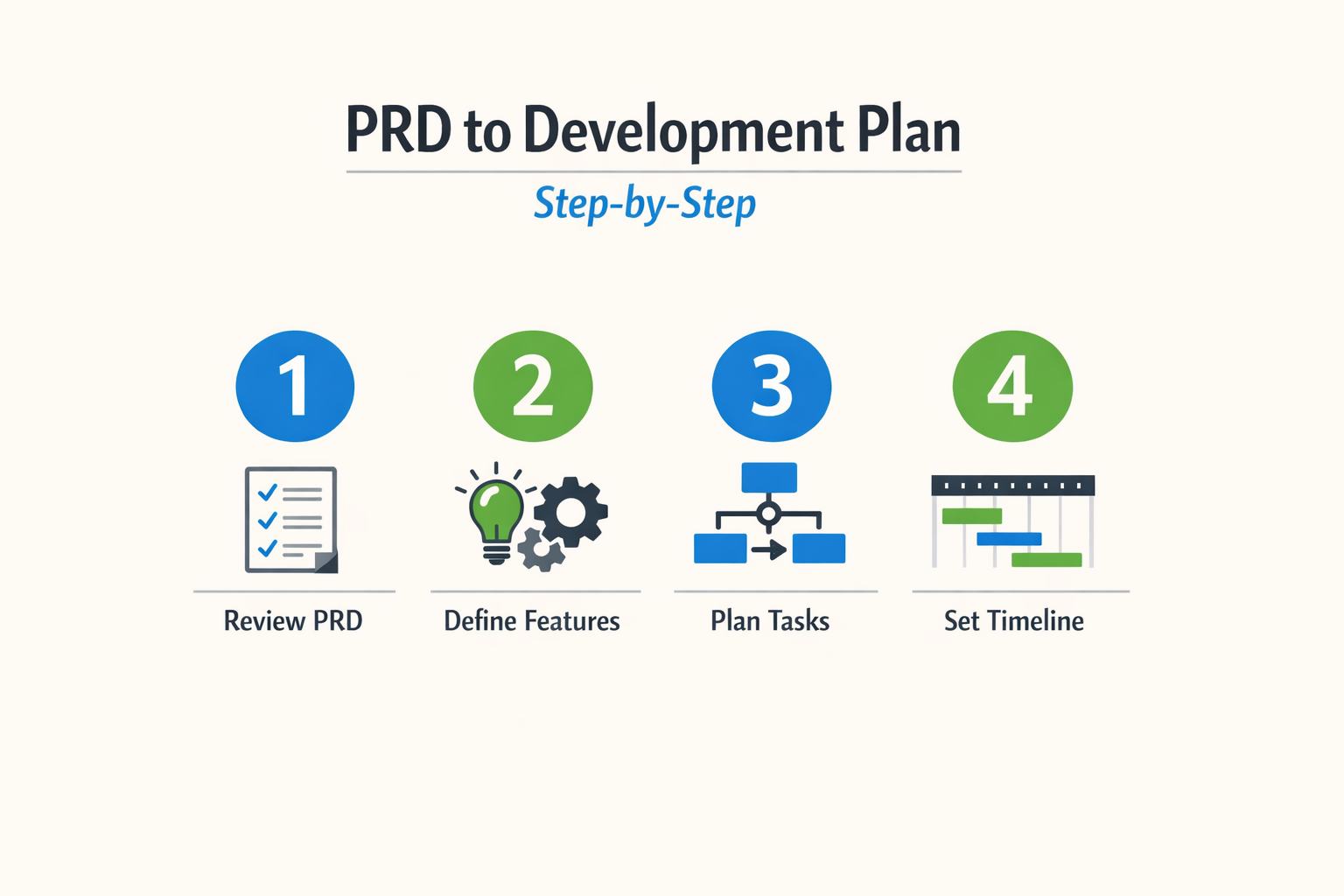
Converting a PRD to a development plan is not magic. It's a repeatable workflow. Follow these steps to turn specifications into structured tasks your team can execute.
Step 1: Gather All Inputs
Before you write anything, collect everything. You need the PRD, target platform details, technical constraints, and any existing system context. Ambiguity at this stage compounds downstream. If your PRD says "fast performance" but doesn't define the metric, you'll build the wrong thing.
Step 1
Inventory your inputs
List the PRD, platform requirements, constraints, existing codebase context, and any third-party dependencies. If something is missing, stop and get it. A half-complete input set produces a half-useful plan.
Step 2: Clarify Requirements
Read the PRD with a critical eye. Flag anything vague, contradictory, or technically impossible. This is where you translate product language into engineering language. "User-friendly interface" becomes "responsive layout with 3-second load target on 3G."
Ask questions now. Every assumption you leave unvalidated becomes a task that gets rewritten later. If you're using vibe coding workflows, this is where you catch the failure modes before they ship.
Step 3: Generate the Implementation Plan
Now you structure the work. A solid implementation plan includes six components: overview, architecture, data model changes, API changes, rollout plan, and risks with mitigations. Each component answers a specific question.
Step 2
Draft the implementation plan
Start with a one-paragraph overview of what you're building. Then document architecture decisions, data model updates, API modifications, rollout sequence, and known risks. If a section is empty, write "No changes" — explicit is better than implicit.
The architecture section describes how the pieces fit together. The data model section lists new tables, fields, or schema changes. The API section specifies endpoints, request formats, and response shapes. The rollout plan defines the deployment sequence. The risks section names what could go wrong and how you'll handle it.
Step 4: Break It Into Tasks
The implementation plan is still too abstract to execute. Break it into discrete tasks. Each task should take one to three days. If a task is bigger, split it. If it's smaller, batch it.
Step 3
Create structured tasks
For each component in the implementation plan, list the individual tasks required. Include acceptance criteria, dependencies, and estimated effort. Use a consistent format so the team knows what "done" looks like.
Good tasks have clear outcomes. "Implement user authentication" is too broad. "Add bcrypt password hashing to signup endpoint with unit tests" is a task. The difference is specificity.
A task without acceptance criteria is a wish, not a plan.
Step 5: Validate and Iterate
Show the plan to the people who will execute it. Engineers will spot technical gaps. Product will spot scope drift. Stakeholders will spot budget overruns. Collect feedback, revise, and lock it down.
This step is not optional. A plan that survives contact with the team is worth ten that don't.
Tips for Effective Conversion
Moving from PRD to development plan isn't a one-time handoff. It's a continuous process where assumptions surface, scope crystallizes, and hidden risk gets tagged early. The teams that ship on time treat this conversion as an ongoing negotiation between what's written and what's buildable.
Make Assumptions Explicit
Every PRD carries implicit assumptions about user behavior, technical feasibility, and resource availability. The conversion process forces these into the open. When a feature description says "users will upload files," the development plan must specify file size limits, supported formats, storage costs, and error handling. If the PRD doesn't answer these questions, the plan must flag them as blockers before a single line of code gets written.
This workflow prevents fake certainty and unshippable plans by surfacing what you don't know before it derails the schedule.
Include Acceptance Criteria Early
Acceptance criteria aren't polish—they're the contract between spec and delivery. Each feature in the development plan needs clear pass/fail conditions that both product and engineering agree on. "Login works" isn't criteria; "user can authenticate with email/password, receive a session token, and access protected routes within 2 seconds" is.
Write acceptance criteria during conversion, not after development starts. If the PRD doesn't supply them, the plan must generate them or escalate the gap. Ambiguous acceptance criteria guarantee rework.
Review Plans Continuously
Development plans created once and reviewed months later are effectively dormant. Requirements shift, technical constraints emerge, and priorities realign. Treat the plan as a living document that gets revisited at regular intervals—weekly for active sprints, biweekly for longer projects.
Short review cycles catch scope creep early and keep the plan aligned with current reality. If the PRD changes, the plan changes. If the plan reveals a PRD gap, the PRD gets updated. The conversion isn't finished until the last feature ships.
The best development plans are the ones that change when reality demands it, not the ones that stay frozen and wrong.
Link Tasks to PRD Sections
Every task in the development plan should trace back to a specific section or requirement in the PRD. This linkage makes it easy to assess impact when requirements change and prevents orphaned work that doesn't serve the product vision. If a task can't be mapped to the PRD, it's either out of scope or the PRD is incomplete.
Use explicit references: "Implements PRD section 3.2: User Authentication" rather than vague descriptions. This traceability also helps during retrospectives when you need to understand why certain decisions were made. For more context on structuring product requirements, see What Is a PRD? A Plain-English Guide for Non-Technical Founders.
Break Down Large Features
PRDs often describe features at a high level. The development plan must decompose these into concrete, estimable tasks. A PRD feature like "user dashboard" might expand into twenty tasks covering data fetching, UI components, state management, error handling, loading states, and responsive design.
Smaller tasks are easier to estimate, easier to parallelize, and easier to track. They also surface hidden complexity early. If a feature explodes into fifty tasks during breakdown, that's a signal to revisit scope or timeline before committing.
Common Challenges in Conversion
Converting a PRD to Development Plan hits predictable friction points. Most teams trip over the same three obstacles: scope creep during translation, misaligned stakeholder expectations, and the gap between what a PRD describes and what a development plan must specify.
Keeping the PRD Dynamic Without Losing Control
In Agile environments, a PRD becomes a living artifact that includes purpose, features, and timeline rather than a static report. This fluidity creates tension when you need a stable development plan. The PRD evolves as you learn; the development plan needs fixed milestones to allocate resources.
The solution is versioning discipline. Treat each conversion event as a snapshot. The PRD can update continuously, but the development plan references a specific PRD version. When the PRD changes enough to invalidate the plan, you trigger a new conversion cycle.
Translating Features Into Sequenced Tasks
A PRD describes what the product does. A development plan breaks that into who does what, when. The gap between these two views is where most plans fail. A feature like "user authentication" expands into database schema, API endpoints, frontend flows, testing scripts, and deployment config. Miss one piece and your timeline is fiction.
The core workflow pattern converges on Research → Plan → Execute → Review → Ship. This structure forces you to map each PRD feature to all five phases. Authentication isn't one task; it's a research spike to evaluate libraries, a planning session to design the flow, implementation work, security review, and deployment.
Step 1
Map features to workflow phases
For each PRD feature, list the concrete deliverables in Research, Plan, Execute, Review, and Ship. If you can't name a deliverable in every phase, the feature definition is incomplete.
Step 2
Identify cross-feature dependencies
Authentication blocks profile management. Profile management blocks user-generated content. Draw the dependency graph before you sequence tasks. Hidden dependencies are the primary cause of timeline slippage.
Managing Stakeholder Expectations During Conversion
Stakeholders read the PRD and imagine a finished product. They read the development plan and see dates. The conversion process is where optimism meets constraints. Product wants everything in the PRD; engineering sees six months of work; the business needs revenue in three.
The fix is transparent trade-off documentation. When you convert the PRD, produce a second artifact: a priority matrix that shows what gets built in phase one versus what waits. Stakeholders must sign off on the phasing, not just the full-scope plan. If they want faster delivery, they choose which features to defer.
Handling Ambiguity and Missing Specifications
PRDs leave gaps. Sometimes intentionally, to preserve flexibility. Sometimes because no one thought through the edge cases. When you convert to a development plan, every gap becomes a decision point. Do you block on getting clarity, or do you make assumptions and document them?
The operator's answer: document assumptions aggressively and set review gates. If the PRD doesn't specify error-handling behavior, write down your assumed approach in the development plan and flag it for product review before implementation starts. Unreviewed assumptions become technical debt or rework.
For a deeper look at structuring PRDs to minimize these gaps, see What Is a PRD? A Plain-English Guide for Non-Technical Founders.
Who Should Choose What
Converting a PRD to a development plan isn't a solo job. The people who write the spec, the people who build it, and the people who ship it all need different things from the same document. The trick is knowing who owns which decision and when to let them make it.
Product owner: scope and priority
The product owner decides what ships and in what order. They write the PRD, but they don't convert it alone. Their job during conversion is to clarify intent, answer "why" questions, and hold the line on scope. When engineering proposes a phased rollout or a technical shortcut, the product owner decides if the tradeoff is acceptable. They don't dictate implementation, but they own the acceptance criteria.
Engineering lead: architecture and feasibility
The engineering lead translates the PRD into buildable chunks. They decide how to structure the work, which systems to touch, and where technical risk lives. They choose the tools, the patterns, and the sequencing. If the PRD says "real-time notifications," the engineering lead decides whether that means WebSockets, polling, or push tokens. They also surface what's expensive, what's brittle, and what will haunt the team six months later.
The engineering job has shifted: product sense and the ability to express intent clearly now matter more than raw coding speed. An engineering lead who can read a PRD and immediately spot the three hardest problems is worth more than one who writes perfect functions but misses the forest.
Individual contributors: task breakdown and estimates
Once the engineering lead has sketched the plan, individual contributors break it into tasks. They estimate effort, flag dependencies, and call out missing context. They don't rewrite the PRD, but they do push back when a requirement is underspecified. A good IC will say "this PRD doesn't define error states" before writing a single line of code.
Designer: interaction and edge cases
If the PRD touches UI, the designer owns the interaction model. They convert abstract requirements into flows, screens, and states. They also catch edge cases the PRD missed—empty states, loading states, error states. A designer who waits until development starts to flag these gaps will cost the team a full sprint.
Project manager: timeline and coordination
The project manager sequences the work, tracks dependencies, and keeps the plan synced with reality. They don't decide what to build, but they decide when to escalate a slip and when to resequence tasks. They also own the handoff between phases—making sure QA knows what's coming and stakeholders know what's shipping.
Solo founders: all roles, one person
If you're building alone, you wear all these hats. The conversion process is the same, but you do it in passes. First pass: product owner—decide what matters. Second pass: engineering lead—decide how to build it. Third pass: IC—break it into tasks you can finish this week. Don't try to do all three at once; your brain will optimize for the wrong thing. For practical guidance on managing this juggling act, see I Have an App Idea: The Ultimate Simple Guide for Founders.
The smallest viable team for a clean PRD-to-plan conversion is two people: one who knows what to build and one who knows how to build it. Everyone else is there to make that handoff faster and cheaper.
Case Studies
Real conversions show patterns. Three projects moved from PRD to development plan with different constraints and different outcomes.
Solo Founder SaaS: Inventory Tracker
A founder with no technical team wrote a 4-page PRD for a warehouse inventory app. The PRD listed features: barcode scanning, low-stock alerts, CSV export. No priorities, no user stories, no acceptance criteria.
The conversion step was simple: the founder rewrote the feature list as a 3-sprint plan. Sprint 1: manual entry and basic list view. Sprint 2: CSV import and export. Sprint 3: barcode scanning. Each sprint had a single deliverable and a 2-week budget.
The plan worked because the founder accepted that barcode scanning—the headline feature—would ship last. The first sprint delivered a working app in 10 days. Users started testing immediately. The PRD stayed the same; the plan made it buildable.
Agency Build: Client Portal
An agency received a 12-page PRD from a legal services client. The PRD included wireframes, user roles, and a fixed launch date 8 weeks out. The development plan broke the PRD into 4 milestones: authentication and user management (week 2), document upload and storage (week 4), client messaging (week 6), admin dashboard (week 8).
The plan included a risk column: authentication required third-party integration, so the team front-loaded that work. Document storage hit a compliance requirement mid-build; the plan had 1 week of buffer built into milestone 2, so the delay didn't cascade.
The project shipped on time because the plan treated the PRD as a constraint, not a script. The agency added buffer where the PRD was vague and locked scope where the PRD was specific.
Internal Tool: Data Pipeline
A 3-person engineering team converted a PRD for an internal ETL tool into a 6-week development plan. The PRD specified data sources, transformation rules, and output formats. The plan divided work by data source: one engineer per source, with shared transformation logic in a common module.
The plan included daily syncs and a shared task board. Week 1 was schema design and API contracts. Weeks 2–5 were parallel development. Week 6 was integration and testing.
The plan succeeded because the PRD was technical and the team was small. No handoffs, no dependencies across engineers until integration week. The PRD gave the what; the plan gave the who and when.
For more on turning early ideas into buildable plans, see I Have an App Idea: The Ultimate Simple Guide for Founders.
Summary of Key Points
Converting a PRD to a development plan is a structured process that transforms written intent into executable work. The core workflow follows a predictable rhythm: research the requirements, plan the technical approach, execute the build, review progress, and ship increments. Each phase depends on the clarity of the PRD and the discipline of the team to stick to the plan without drifting into scope creep.
A development plan is only useful if it stays current. Plans created once and shelved for months lose their value—development is continuous, and the plan must flex with reality. Regular reviews keep the plan aligned with changing constraints, new information, and evolving priorities. If your plan hasn't been touched in three months, it's documentation, not a working tool.
The conversion process requires clear ownership boundaries. Product defines what and why; engineering defines how and when. Ambiguity in these roles leads to rework, missed deadlines, and friction. The best conversions happen when both sides agree on scope before any code is written, and when changes to scope trigger explicit re-planning, not silent feature creep.
Most failures in PRD-to-plan conversion come from underspecifying edge cases, over-optimistic estimates, or skipping dependency mapping. A good development plan names every external service, every data migration, every integration point—and assigns each one a realistic time cost. If the plan doesn't account for testing, deployment, and rollback procedures, it's incomplete.
For solo founders or small teams, the conversion process can be informal but should never be skipped. Even a one-page plan with milestones, dependencies, and a rough timeline prevents the aimless drift that kills side projects. The format matters less than the discipline of writing it down and checking it weekly. For more guidance on structuring early-stage projects, see What Is a PRD? A Plain-English Guide for Non-Technical Founders.
Conclusion
A development plan isn't a one-time artifact. It's the contract between what the PRD promised and what the team ships. If your PRD sits in a doc and your devs work from memory, you're running two projects—one on paper, one in code. The gap between them is where schedules slip and features drift.
Converting a PRD to Development Plan means breaking promises into tasks, tasks into sprints, and sprints into shippable increments. Focus on one to three priorities per quarter. Any more and you're managing a wishlist, not a roadmap. Review progress weekly, not annually. Plans that sit untouched for eleven months weren't plans—they were paperwork.
I've watched solo founders skip this step and vibe-code their way into production. Sometimes it works. More often, they rebuild the same feature three times because no one wrote down what "done" looked like. The PRD says what. The development plan says when, who, and how much. Both matter.
Start small. Pick the riskiest assumption in your PRD, staff it, scope it, and ship it. Then do it again. The plan that survives contact with users is the one you kept simple enough to update every week.
Related reading
Describe App Idea: The Ultimate Easy Guide for AI Development