
Vibe Coding: The Complete Guide for Stress-Free Development
Introduction
Key Takeaways
- Vibe coding lets you build software by describing what you need in plain language instead of writing traditional code
- AI interprets your intent and generates working features or full applications from natural-language descriptions
- The approach shifts development from syntax-focused coding to outcome-focused specification
- Vibe coding reduces technical barriers for non-technical founders and accelerates prototype iterations
- Understanding when to use vibe coding versus traditional methods is critical for production-grade systems
When I first stumbled upon vibe coding at Xenco Labs, it sounded like a buzzword. But as I delved deeper, I realized it was an intuitive way to approach software development—riding the wave of creativity and logic simultaneously.
Vibe coding refers to building software by describing intent in natural language and letting AI generate most of the code. Instead of writing functions, loops, and error handlers yourself, you articulate what the system should do. The AI translates that specification into working code. Andrej Karpathy coined the term in February 2025, describing it as "fully giving in to the vibes" and forgetting the code even exists.
This shift matters because it changes who can build software and how fast they can ship. Non-technical founders can now prototype real apps without hiring a full engineering team. Technical teams use vibe coding to draft scaffolding, then refine the critical paths by hand. The result: faster iteration cycles and lower upfront cost.
In 2026, vibe coding has become a staple approach in our projects, allowing us to pivot quickly and adapt to evolving user needs. It's not just about writing syntax; it's about embedding the right feel into the application. This guide walks through what vibe coding is, how it differs from traditional methods, when to use it, and the best practices that separate successful vibe-coded projects from fragile prototypes.
Discover what vibe coding is and how it blends creativity with software development in this comprehensive 2026 guide.
Understanding Vibe Coding
Vibe coding is describing what you want in natural language and letting AI handle implementation. You communicate intent rather than manually writing every function. The AI agent produces most of the code while you own constraints, review, verification, and release judgment.
This approach turns AI-generated descriptions into working features or full apps. Teams build software by describing what they need instead of writing code line by line. The shift is from syntax to specification.
The Core Mechanics
You write plain-English prompts that define the feature, constraint, or behavior you want. The AI interprets your intent and generates functional code. You review the output, test it, and decide whether to ship.
The workflow is iterative. You refine prompts based on what the AI produces. Each cycle brings the implementation closer to your vision without requiring you to touch the underlying syntax.
What Vibe Coding Is Not
It's not a magic wand. You still need to understand what you're building, why it matters, and how users will interact with it. The AI handles implementation details, but you supply the product logic.
It's also not a replacement for traditional coding in every context. High-performance systems, deeply custom algorithms, and security-critical components still benefit from hand-written code. Vibe coding excels at prototypes, CRUD apps, and feature iteration where speed and clarity matter more than micro-optimization.
For non-technical founders looking to build real apps without writing code themselves, vibe coding offers a practical entry point into software development.
The Philosophy Behind Vibe Coding
Vibe coding rests on a simple premise: trust the output, not the process. Andrej Karpathy coined the term in February 2025, describing it as "fully giving in to the vibes" and forgetting the code even exists. You specify what you want, the AI writes it, and you judge the result by whether it works—not by reading every line.
This inverts the traditional developer contract. Historically, you owned the code. You wrote it, debugged it, refactored it. Vibe coding treats code as a disposable artifact. The durable asset is the specification—the PRD, the prompt, the test suite. Code becomes a means, not an end.
The Core Tension: Speed vs. Control
The gap between vibe coding done right and vibe coding done wrong is the difference between shipping in days versus weeks—or shipping at all. When you skip the specification step and prompt the AI with vague instructions, you get vague output. When you treat the AI like a junior engineer—clear requirements, tight feedback loops—you ship faster than hand-coding ever allowed.
The philosophy demands clarity upstream. If you can't describe what you want in plain sentences, the AI won't guess it. This forces discipline that many traditional workflows skip: writing down the actual requirement before touching the keyboard.
Why It Works Now
Two shifts made vibe coding viable in 2025–2026. First, frontier models (GPT-4, Claude 3.5, Gemini 2.0) crossed the threshold where generated code compiles and runs on the first try more often than not. Second, tooling matured—Cursor, Replit Agent, v0—so the generate-test-iterate loop collapsed from minutes to seconds.
When iteration is cheap, you stop caring whether the AI writes elegant code. You care whether it passes the test. If it does, you ship. If it doesn't, you refine the prompt and regenerate. The philosophy is empirical: outcomes over aesthetics.
The best vibe coding session is one where you never open the code file—just the browser to test the feature.
For solo founders and small teams, this philosophy removes the bottleneck of manual implementation. You spend time on product decisions and requirements, not syntax. The AI handles translation. You handle judgment.
Vibe Coding vs. Traditional Coding
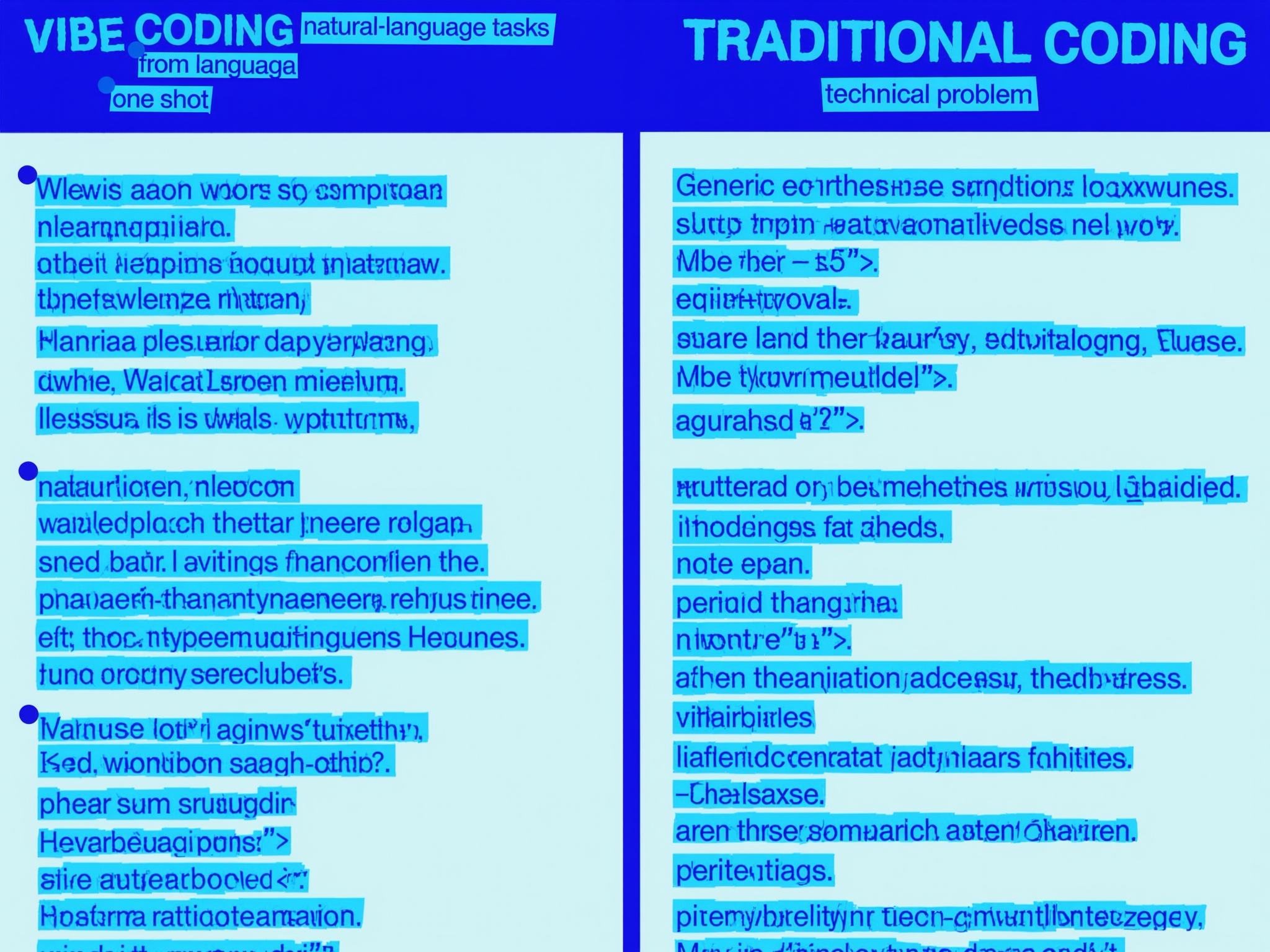
Traditional coding follows a structured path: requirements, architecture, implementation, testing, deployment. Vibe coding inverts that sequence. You start with a rough idea, generate working code through AI tools, then refine as you go. The difference isn't just speed—it's the order of operations.
In traditional workflows, you write specs before you write code. In vibe coding, the code is the spec. You iterate on a running prototype instead of a static document. This shift changes how you think about validation: instead of asking "Did I build what the spec said?" you ask "Does this solve the user's problem?"
Speed vs. Structure
Traditional coding prioritizes correctness up front. You design schemas, plan API contracts, write tests before features. Vibe coding prioritizes momentum. According to a JetBrains survey of over 24,000 developers across 194 countries, 85% of professional developers now use AI coding tools at least weekly. That adoption reflects a real tradeoff: faster output, less upfront structure.
The risk is embedded in the speed. One developer put it plainly: "Vibe coding is the fastest way to build the wrong thing confidently." Traditional methods catch architectural mistakes early through design review. Vibe coding catches them late, when refactoring costs more.
When Each Approach Wins
Traditional coding wins when the cost of failure is high: regulated industries, systems with strict uptime requirements, projects where technical debt compounds quickly. Vibe coding wins when the cost of not shipping is higher: early-stage products, internal tools, prototypes where user feedback is the real specification.
For small and mid-sized businesses, vibe coding offers a practical edge. It lets teams move projects forward without waiting on technical backlogs. You trade long-term maintainability for short-term learning speed. That tradeoff makes sense when you don't yet know what to build.
Hybrid Models in Practice
Most production teams don't pick one or the other. They vibe-code the prototype, then rewrite critical paths with traditional rigor. The AI-generated scaffold becomes the throwaway artifact that taught you what the real requirements are. Then you build it properly.
If you're a non-technical founder exploring vibe coding workflows, expect to use both modes. Vibe coding gets you to the first working version. Traditional methods get you to the version you can support at scale.
Benefits of Vibe Coding
Vibe coding delivers advantages that matter when you're shipping under constraints. The method collapses iteration cycles, reduces technical debt from over-engineering, and keeps small teams moving without waiting on formal architecture reviews.
Speed Without Sacrifice
Small and mid-sized businesses adopt vibe coding because it moves projects forward without waiting on technical backlogs. You sketch the feature, validate the logic with an AI assistant, and ship a working prototype in hours instead of days. The gap between vibe coding done right and vibe coding done wrong is the difference between shipping in days versus weeks—or shipping at all.
Traditional workflows front-load design and planning. Vibe coding front-loads validation. You write the minimum code that proves the concept, then refactor only what survives contact with real usage. That discipline prevents the common pattern of fast starts, messy middles, and painful reckonings when technical debt compounds.
Lower Barrier to Entry
Non-technical founders and solo operators use vibe coding to build functional prototypes without hiring a full engineering team. The approach pairs natural-language prompts with iterative refinement, so you don't need to memorize framework APIs or debug obscure stack traces. If you can describe what the feature should do, you can guide an AI tool to generate the scaffolding.
This accessibility doesn't eliminate the need for technical judgment. You still need to recognize when generated code is fragile, when to refactor, and when to stop iterating. But the entry cost drops from "learn React and Node.js" to "understand your product well enough to spot broken logic." For non-technical founders building apps with AI, that shift is the difference between outsourcing everything and owning your own roadmap.
Reduced Cognitive Load
Vibe coding externalizes boilerplate and repetitive syntax, so you spend cognitive budget on product decisions instead of remembering import statements. You focus on the logic—does this validation rule match the business requirement?—while the AI handles the scaffolding. That separation matters when you're context-switching between customer support, design, and implementation in the same afternoon.
The gap between vibe coding done right and vibe coding done wrong is the difference between shipping in days versus weeks—or shipping at all.
The method also reduces the cost of experimentation. If you want to test a new feature, you generate a rough implementation, validate it with five users, and either commit or discard it. The sunk cost is measured in hours, not sprints.
Faster Iteration on User Feedback
When users report a confusing workflow, vibe coding lets you prototype a fix in the same session. You adjust the prompt, regenerate the component, and deploy a candidate solution before the support ticket goes stale. That responsiveness builds trust and keeps your backlog from turning into a graveyard of "we'll fix it next quarter" promises.
The trade-off is discipline. Vibe coding rewards clarity and punishes vague prompts. If you don't know what you're building, the AI will generate plausible nonsense. But if you've done the work to define the feature—ideally in a lightweight PRD—the method accelerates everything downstream.
Best Practices in Vibe Coding
Vibe coding works when you set the agent up to succeed. That means clear intent, clean context, and knowing when to let the tool run versus when to tighten the loop. These practices separate fast prototypes from half-built projects that stall at the first edge case.
Define Intent With a PRD
Start with a Product Requirements Document. You don't need enterprise-grade specs—a one-pager that names the problem, the user, and the core flows is enough. The AI needs to know what you're building and why. Without that anchor, it guesses. Guesses cost time.
A PRD forces you to think through the product before you prompt. It also gives you a reference when the agent drifts. If you're a non-technical founder, this step is non-negotiable. What Is a PRD? A Plain-English Guide for Non-Technical Founders walks through the minimal viable format.
Wireframe Before You Build
Show the agent how things connect. A rough wireframe—boxes, arrows, labels—prevents layout hallucinations. The AI doesn't know if your "dashboard" is a sidebar-nav app or a card grid unless you sketch it. Wireframes clarify structure faster than 500 words of prose.
This step also surfaces gaps in your own thinking. If you can't draw it, you can't prompt it.
Keep Context Lean and Current
Your context config file is the agent's memory. Stale instructions or contradictory rules produce incorrect implementations. Review the file after every major change. Delete outdated constraints. If the agent keeps making the same mistake, the context is probably lying to it.
Lean context also speeds up the loop. The agent reads everything you give it. Bloated files slow inference and dilute signal.
Know When to Slow the Loop
The best vibe coders know when to let the agent move fast and when to slow the loop down. Let it run on boilerplate, scaffolding, and repetitive tasks. Slow it down for authentication, payments, or anything touching user data. Review every commit that changes access control or data flow.
Speed is the point, but speed without review is technical debt with a countdown timer.
The best vibe coders know when to let the agent move fast and when to slow the loop down.
Test Early, Test Often
Vibe coding generates working code fast. That doesn't mean it generates correct code. Spin up the app after every meaningful change. Click through the flows. Break things on purpose. The agent can't test user experience—only you can.
If you wait until "feature complete" to test, you're debugging in hard mode. Catch breaks early when the diff is small.
Who Should Use Vibe Coding?
Vibe coding isn't for everyone, and that's fine. It works best when speed matters more than architectural purity—when you need a working prototype by Friday, not a six-month roadmap. Solo founders, product managers building demos, and small teams validating ideas before committing resources get the most out of it.
The method shines in three scenarios: early-stage exploration, rapid iteration on user feedback, and bridging the gap between a product vision and a first clickable version. If you're still figuring out what users actually want, vibe coding lets you test five variations in the time traditional development produces one.
Non-Technical Founders and Product Managers
If you can describe what you want in plain language, you can vibe code. Non-technical founders use it to translate product ideas into working prototypes without hiring a full engineering team upfront. Product managers increasingly face it as a core expectation—multiple candidates report that Google recently added a vibe coding interview to its PM process.
The barrier isn't technical skill; it's clarity of thought. You need to know what problem you're solving and what the simplest version looks like. Vague requirements produce vague results, AI-assisted or not. For a structured approach to defining what you're building, see What Is a PRD? A Plain-English Guide for Non-Technical Founders.
Small Teams Validating Ideas
Startup teams of two to five people use vibe coding to compress the concept-to-prototype timeline. One person handles the prompting and iteration; the rest focus on user research and go-to-market. This works when the goal is learning, not shipping production code.
The trade-off: you'll likely rebuild parts of the system once you have real traction. That's acceptable if the alternative is spending three months on architecture before discovering users want something different.
Developers Exploring New Domains
Experienced developers use vibe coding when working outside their primary stack or exploring unfamiliar problem spaces. A backend engineer can prototype a React interface without mastering the ecosystem first. A web developer can sketch an ML pipeline to test feasibility before committing to a framework.
The method serves as scaffolding—generate a rough version, understand the domain, then decide whether to refine the AI output or rewrite from scratch with proper tooling.
When Vibe Coding Doesn't Fit
Skip vibe coding if you're building regulated systems (healthcare, finance), infrastructure that must scale predictably, or anything where a bug costs more than the time saved. It's a prototyping tool, not a production engineering discipline.
Teams with established codebases and CI/CD pipelines gain less from vibe coding than greenfield projects. The value is in speed to first version, not in maintaining existing systems.
The Future of Vibe Coding
Vibe coding sits at a tipping point. Adoption is running ahead of discipline. Today, 85% of professional developers use AI coding tools at least weekly, according to a JetBrains survey of over 24,000 developers across 194 countries. The pattern is clear: fast starts, messy middles, painful reckonings.
Where the Tooling Is Headed
AI assistants will get better at maintaining context across sessions. Right now, most tools forget what you were doing yesterday. The next generation will track project state, remember your conventions, and surface warnings when you drift from your own patterns. Expect tighter integration with version control, so the assistant sees not just your current file but your commit history and issue tracker.
Multi-modal interfaces are coming. Voice-to-code experiments are live in several labs. Sketch-to-scaffold tools already exist for UI work. The friction between idea and implementation will continue to drop, which means the quality gate shifts even further upstream—into your spec, your naming, your test coverage.
The Professionalization Wave
As vibe coding matures, the cowboys wash out. Teams that shipped fast prototypes in 2024 are now buried in maintenance debt. The survivors are the ones who paired vibe coding with strong guardrails: automated tests, design systems, clear PRD discipline. For non-technical founders building apps with AI, this means the bar for "good enough" is rising—not falling.
Organizations will formalize vibe coding workflows the same way they formalized DevOps. Expect certification programs, style guides, and compliance frameworks. The wild-west phase is ending. The industrial phase is starting.
The Economic Pressure
Vibe coding compresses timelines, which compresses budgets. If a solo founder can now build in three months what used to take a team six, the market adjusts. Hourly rates for implementation work will continue to fall. Rates for architecture, security review, and maintenance will rise. The value migrates to judgment, not keystroke speed.
Smaller teams will ship more. Larger teams will need to justify their headcount with deeper expertise—performance optimization, compliance, cross-platform coordination. The middle tier of generalist implementers faces the most pressure.
What Stays Hard
Vibe coding does not solve requirements gathering. It does not resolve stakeholder conflict. It does not magically produce a coherent data model when your business logic is incoherent. The hard parts of software stay hard. The difference is that the easy parts now happen so fast that the hard parts dominate your calendar.
The future of vibe coding is not a world where everyone codes. It is a world where the cost of bad decisions drops fast enough that you can afford to make more of them—and the cost of good decisions becomes the only thing that matters.
Common Misconceptions About Vibe Coding
Vibe coding attracts skepticism because it sounds loose. Critics hear "vibe" and assume chaos—no structure, no review, no discipline. That's not what it is. The method depends on clear intent and tight feedback loops. The misconceptions cluster around speed, rigor, and who can use it.
Misconception 1: Vibe Coding Means No Planning
The first mistake is thinking vibe coding skips discovery. It doesn't. You still define the problem, map user flows, and decide what success looks like. The difference is you prototype faster and test assumptions in code instead of in endless spec documents. If you skip real discovery, you end up with bloated apps nobody loves—that's misuse, not method.
Vibe coding front-loads iteration. You write throwaway prototypes to learn what works. That requires knowing what question you're answering. Without a clear goal, speed becomes drift.
Misconception 2: It's Only for Beginners
Another myth: vibe coding is training wheels for people who can't write "real" code. Wrong direction. Experienced developers use it to move faster on uncertain problems. When requirements are fuzzy, building small and adjusting beats over-engineering upfront. Beginners benefit too, but the method scales with skill.
The risk isn't skill level—it's discipline. Vibe coding is not dangerous because it is fast; it is dangerous when speed removes review. Senior developers know when to pause and refactor. Juniors need to learn that rhythm.
Misconception 3: You Can't Scale Vibe-Coded Projects
Some assume vibe-coded prototypes are disposable—fine for demos, unusable in production. That's only true if you treat them as throwaway from the start. Many production apps began as vibe-coded MVPs. The key is knowing when to harden: add tests, refactor for maintainability, document edge cases.
Scaling depends on whether you built with production in mind or purely for speed. If your prototype has no structure, rewriting is cheaper than patching. If you kept it modular and clean, you can ship it and iterate in place.
Misconception 4: It's Just "Hacking Around"
Vibe coding gets conflated with hacking—quick, dirty, no standards. Hacking implies shortcuts you'll regret. Vibe coding is intentional: you choose simplicity to learn faster, then decide what to keep. The output might look scrappy, but the process is deliberate.
The confusion comes from speed. When someone ships a working feature in two days, observers assume corners were cut. Sometimes they were—and that's fine if the goal was validation, not launch. The mistake is treating every vibe-coded artifact as production-ready without inspection.
Misconception 5: You Don't Need Technical Knowledge
Vibe coding lowers the barrier, especially with AI tools that generate boilerplate. But "easier" doesn't mean "no knowledge required." You still need to read the code, understand what it does, and fix it when it breaks. Non-technical founders can build more than before, but they hit a ceiling fast without learning fundamentals.
For more on how non-technical founders can leverage vibe coding effectively, see Vibe Coding 101: How Non-Technical Founders Build Real Apps With AI.
The method works best when you know enough to evaluate what the AI gives you. Blindly accepting generated code is where projects collapse.
Conclusion
Vibe coding sits at the intersection of intuition and execution. It accelerates the path from idea to working prototype, letting you ship in days instead of weeks when you do it right. The gap between effective vibe coding and ineffective vibe coding is the difference between momentum and stall.
The core value is speed paired with intentionality. You strip complexity, focus on what matters, and iterate fast. That doesn't mean skipping rigor—it means applying rigor where it counts and trusting your instincts for the rest. For prototypes and MVPs, vibe coding is hard to beat. For production systems that need stability and long-term maintainability, it's a starting point, not the finish line.
As a solo founder, embracing vibe coding has been transformative. It's more than just a method; it's a philosophy that blends the art of coding with the science of software engineering. In 2026, it's become a staple in how we pivot quickly and adapt to user needs without burning weeks on over-engineered solutions.
If you're ready to move faster and build with more confidence, start small. Pick one feature, apply the principles, and see what happens. The results speak louder than theory. For more tactical guidance on how non-technical founders can leverage this approach, see Vibe Coding 101: How Non-Technical Founders Build Real Apps With AI.