Do I Need a Developer for My App? The Ultimate Simple Guide
Introduction
Every founder with an app idea hits the same question: do I need a developer for my app, or can I build this myself? The answer isn't universal. A decision framework for non-technical founders includes assessing whether to build an MVP themselves or hire a developer based on factors like budget, timeline, and product complexity. The wrong choice can waste months and thousands of dollars.
I've watched founders burn cash on developers for prototypes they could have shipped in a weekend with Cursor, and I've seen others attempt vibe-coded builds that collapsed under real-world load. The threshold has moved — tools like v0, Bolt, and Replit Agent let non-technical founders ship working software faster than most agencies can draft a proposal. But those tools have edges, and knowing where they break matters more than knowing they exist.
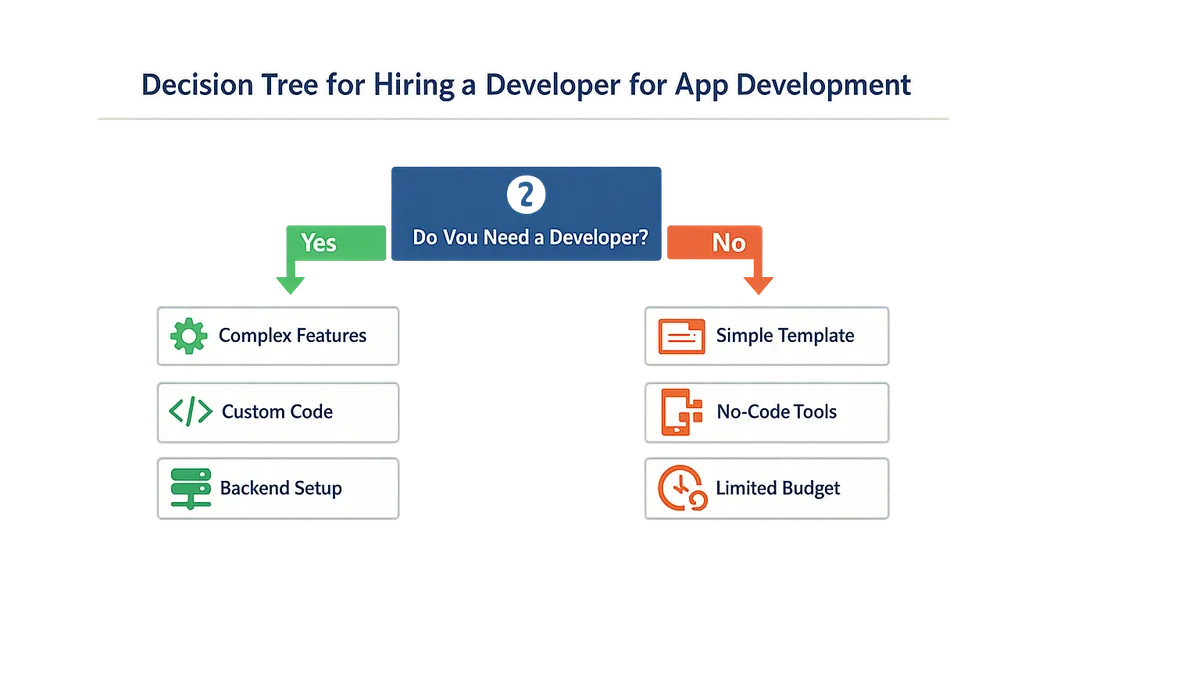
This guide walks through a decision tree tailored to founders who need clarity, not platitudes. You'll assess your app's requirements, evaluate your skill set, weigh budget and time constraints, and arrive at a defensible answer. If you're still in the idea phase and need help structuring your concept before making this decision, start with I Have an App Idea: The Ultimate Simple Guide for Founders.
The sections ahead break down when to hire, when to build, and how to evaluate the middle cases where the answer isn't obvious. By the end, you'll have a framework that maps your situation to a concrete next step.
Discover if you need a developer for your app with our decision tree tailored for founders.
Understanding App Requirements
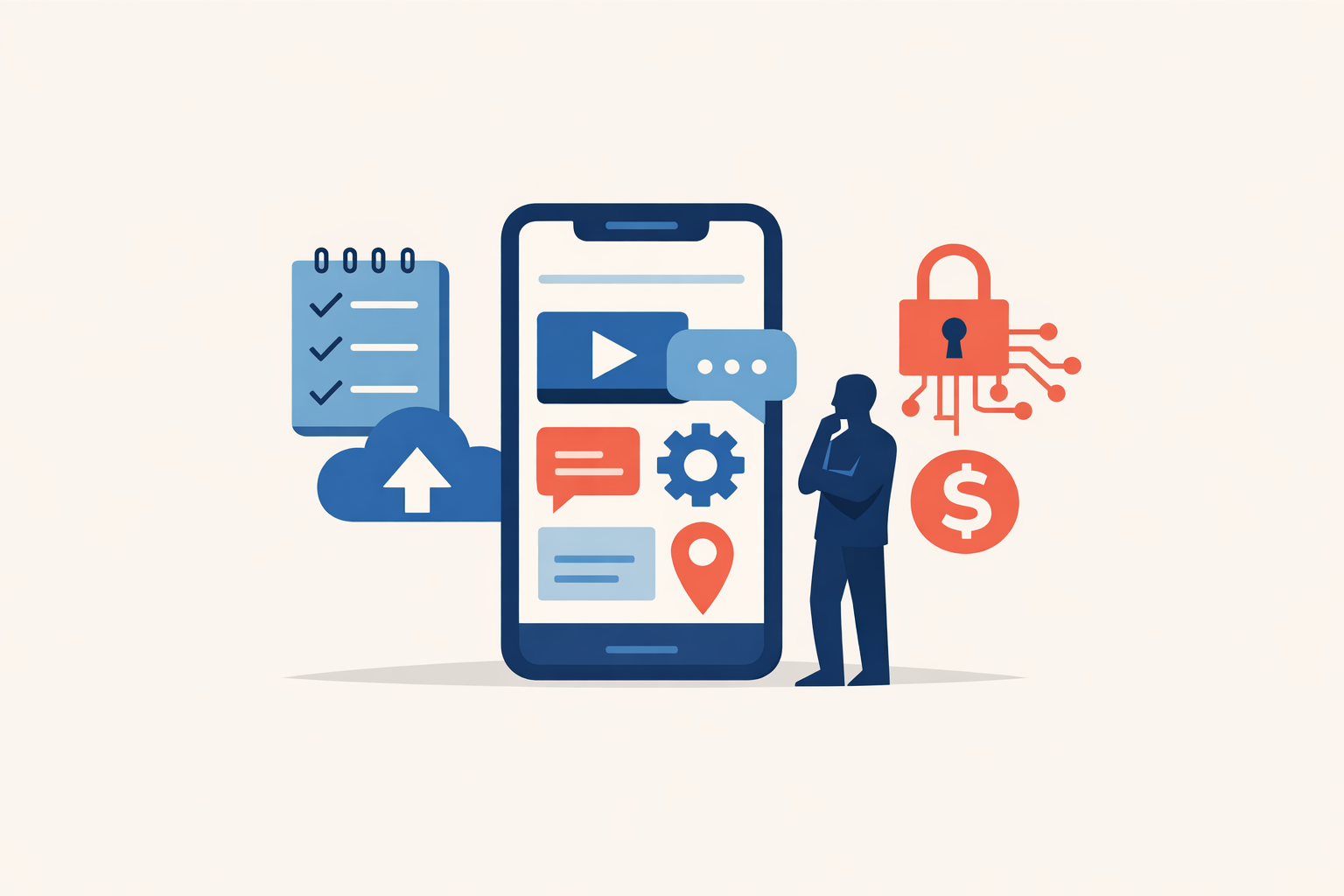
Before you decide whether to hire a developer or build yourself, map what you're actually building. Requirements fall into categories that predict cost, risk, and whether no-code tools will hold up.
Feature Complexity
Simple apps handle one job: a form collector, a content viewer, a basic calculator. Complex apps coordinate multiple systems—user auth, payment processing, real-time data sync, third-party API orchestration. The more moving parts, the more surface area for failure.
Validate demand first. Build the lightest version that proves people will use it, then assess whether the next layer requires professional help. Most founders overestimate feature complexity on day one.
Platform and Performance Needs
Web apps tolerate rough edges. Native mobile apps face App Store review, platform-specific UI conventions, and user expectations shaped by billion-dollar products. If you need offline mode, background processing, or hardware access (camera, GPS, biometrics), you're outside the no-code comfort zone.
Performance requirements multiply complexity. A dashboard that refreshes every 30 seconds is different from one that updates live for 500 concurrent users. Storage, caching, and query optimization matter when scale isn't theoretical.
The cheapest build is the one that ships before you convince yourself it needs ten more features.
Risk Tolerance
Some apps carry reputational or regulatory weight. If you're handling payments, health data, or anything that triggers compliance frameworks, the cost of getting it wrong exceeds the cost of hiring someone who's done it before.
Platform lock-in is another risk vector. No-code tools let you move fast, but migrating off them later can mean a full rewrite. If your app is a core business asset with a multi-year horizon, understanding what a PRD captures helps you think through what you're committing to.
Budget and timeline constraints are real, but they don't override technical fit. A hybrid approach—prototype yourself, hire for production—often splits the difference.
When to Hire a Developer

Some apps need a professional from day one. The decision isn't about ego or capability—it's about risk tolerance and what breaks when you get it wrong.
Payments, Auth, or Sensitive Data
If your app handles money, user authentication, or personal information, hire a developer. These systems fail in ways that cost you users, reputation, and sometimes legal exposure. A payment gateway misconfigured by someone learning as they go will leak transaction details or fail silently under load. Authentication bugs let strangers into accounts. Sensitive data stored incorrectly becomes a compliance liability.
You can prototype the rest of the app yourself, but the moment real user data or money enters the system, bring in someone who's debugged these problems before.
Paying Customers or Investor Timelines
Once you have revenue or outside capital, your app is no longer a learning project. Paying customers expect uptime, performance, and fixes that ship in days, not weeks. Investors expect milestones hit on schedule. A founder learning to code while also running the business will miss both.
Hire when the cost of delay exceeds the cost of the developer. If a feature delayed by two months loses you a pilot customer worth five figures, the hourly rate stops mattering.
Performance-Critical or Specialized Systems
Some apps live or die on performance—real-time collaboration tools, video processing, high-frequency data pipelines. Others require domain expertise you don't have: embedded systems, machine learning inference, or legacy integrations. If your app's core value depends on something you can't learn in a weekend, hire someone who's already solved that problem.
The cheapest developer is the one who prevents the rewrite six months in.
For founders weighing the build-versus-hire decision more broadly, What Is a PRD? A Plain-English Guide for Non-Technical Founders walks through how to define requirements clearly enough to evaluate whether you need help.
When You Can Build Your Own App
You don't always need a developer. If your app fits a common pattern—directory, booking form, simple CRUD—and you have 3–6 months to learn, building it yourself is often the right move. The tools exist. The question is whether your situation lines up with the constraints.
The Non-Technical Founder Profile
You can build your own app if you meet these conditions: you have time to learn (3–6 months is realistic for a first MVP), your product is simple enough to fit a template or no-code platform, your budget is under $2,000, and you want deep technical ownership of the stack. That last point matters more than founders admit—if you plan to iterate fast or pivot without waiting on a contractor's calendar, owning the code is leverage.
Non-technical doesn't mean incapable. It means you haven't written production code yet. The gap closes faster than it used to, especially with AI-assisted workflows that handle boilerplate and surface errors in plain English.
When the MVP Fits a Pattern
Most MVPs are remixes. If your idea maps cleanly to an existing template—Airbnb clone, SaaS dashboard, marketplace—you're building on a solved problem. No-code platforms (Bubble, Softr, Glide) and low-code frameworks (Retool, Supabase + a UI kit) cover 80% of these cases. The remaining 20% is your specific business logic, which you can wire up without touching a compiler.
The test: can you describe your app in five sentences without using the words "custom" or "proprietary"? If yes, you're in template territory. If no, you're either overthinking it or you actually need custom work—and that's the next section's problem.
If your app fits a common pattern and your goal is to validate or launch, building without a developer is advisable.
Budget and Ownership Trade-Offs
Building yourself costs time, not cash. A developer costs $5,000–$50,000 for an MVP; a no-code platform costs $30–$300/month. If you're pre-revenue and your budget is tight, the math is clear. The hidden cost is your learning curve—expect to spend evenings and weekends for three months. If that time would generate more than the cost of a developer, hire. If not, build.
Ownership is the other variable. When you build it, you control the roadmap. When you hire, you depend on someone else's availability and interpretation of your specs. For solo founders who plan to iterate weekly based on user feedback, that dependency is friction you can't afford.
Do I Need a Developer for My App?
The question isn't binary. Most founders face a spectrum: full hire, partial hire, no hire, or hybrid. The right answer depends on five gates you can walk through in order.
Gate One: Have You Validated Demand?
If you haven't confirmed that people will pay for what you're building, don't hire anyone yet. Build the cheapest proof you can — a landing page, a Typeform, a spreadsheet tool. Hiring before validation burns capital on features nobody asked for.
If demand is real and repeatable, move to gate two.
Gate Two: How Complex Are Your Core Features?
Simple CRUD apps — data in, data out, basic workflows — can be vibe-coded or built with no-code platforms. If your app is a form collector, a dashboard, or a spreadsheet replacement, you probably don't need a developer for the MVP.
Complex features — real-time sync, custom algorithms, hardware integration, high-concurrency backends — require engineering discipline. If your product relies on any of these, you need a developer or you need to descope until it doesn't.
Gate Three: What's Your Platform Risk Tolerance?
No-code platforms lock you in. If the vendor raises prices, sunsets a feature, or goes under, you rebuild from scratch. If you can stomach that risk for 12–24 months while you learn what customers actually want, skip the hire.
If your business model requires you to own the stack — because you're in a regulated industry, need custom data pipelines, or plan to raise venture capital — hire a developer who can give you portability.
Gate Four: Do You Have a Trusted Developer Referral?
Hiring blind is expensive. If you don't have a referral from someone who's worked with the developer on a shipped product, your odds of a clean build drop by half. No referral means you're also hiring for judgment, not just execution.
If you have a trusted referral and gates one through three point toward hiring, hire. If you don't, consider a hybrid: you build the MVP, then hire to harden it once it's earning revenue.
Gate Five: Can You Afford a Hybrid Approach?
Hybrid means you build the first version, validate it, then bring in a developer to rebuild or extend it. This works when:
- You have 3–6 months to learn the problem space before committing capital.
- You're comfortable with throwaway code.
- You can articulate what you built well enough that a developer can take over cleanly.
If you can't afford to throw away the first build, hire from the start. If you can, hybrid de-risks both the product and the hire.
The cheapest developer is the one you don't hire until you know exactly what you're hiring them to build.
Considering Budget and Time
Budget and timeline are the two constraints that turn abstract app ideas into concrete trade-offs. Most founders underestimate both. A developer costs $50–150/hour for contract work, or $80k–150k/year for a full-time hire. A simple CRUD app takes 200–400 hours to ship; anything with third-party integrations or real-time features doubles that. Do the math before you commit.
Timelines compress when you hire someone who already knows the stack. A developer who has shipped three React Native apps will move faster than you will on your first build, even with AI tools. But hiring introduces coordination overhead—writing specs, reviewing pull requests, managing scope creep. If your runway is six months and you spend two months finding the right person, you've burned a third of your budget on search costs.
When Budget Favors DIY
If you have more time than money, no-code tools and vibe coding let you validate an idea for under $100/month in tooling costs. You trade your own hours for cash savings. This works when the app is simple, the stakes are low, and you can afford to learn in public. It stops working when technical debt compounds faster than you can ship features.
Bootstrapped founders often start with a hybrid: build the MVP yourself, then hire a developer to refactor the mess once you have revenue. This only works if you avoid lock-in—stick to standard frameworks and document your decisions. A pile of spaghetti code written in a proprietary no-code platform is harder to hand off than a messy but conventional codebase.
When Time Favors Hiring
If you need to ship in 60 days to hit a funding milestone or beat a competitor, hiring is the only path. A senior developer can compress a six-month solo timeline into two months of focused work. The cost is real—$20k–40k for a contract sprint—but the alternative is missing the window entirely.
Speed also matters when the app is a wedge, not the business. If you're a consultant building an internal tool to scale your service, every month you spend learning React is a month you're not billing clients. Hire someone, ship it, get back to your actual business.
The cheapest developer is the one who ships before your runway ends.
The Hidden Costs
Budget isn't just salary. Developers need tools—GitHub, hosting, monitoring, CI/CD pipelines. Add $200–500/month in infrastructure. They also need clear requirements. If you hand someone a vague idea and expect them to fill in the gaps, you'll pay for rework. Writing a tight spec takes 20–40 hours; skipping it costs 2–3x that in wasted dev cycles.
Time has hidden costs too. If you spend three months building an app yourself and it flops, you've lost three months of market learning. A developer might have shipped it in six weeks, giving you six extra weeks to iterate or pivot. The opportunity cost of slow execution is harder to measure than a contractor invoice, but it's often larger.
Evaluating Your Skill Set
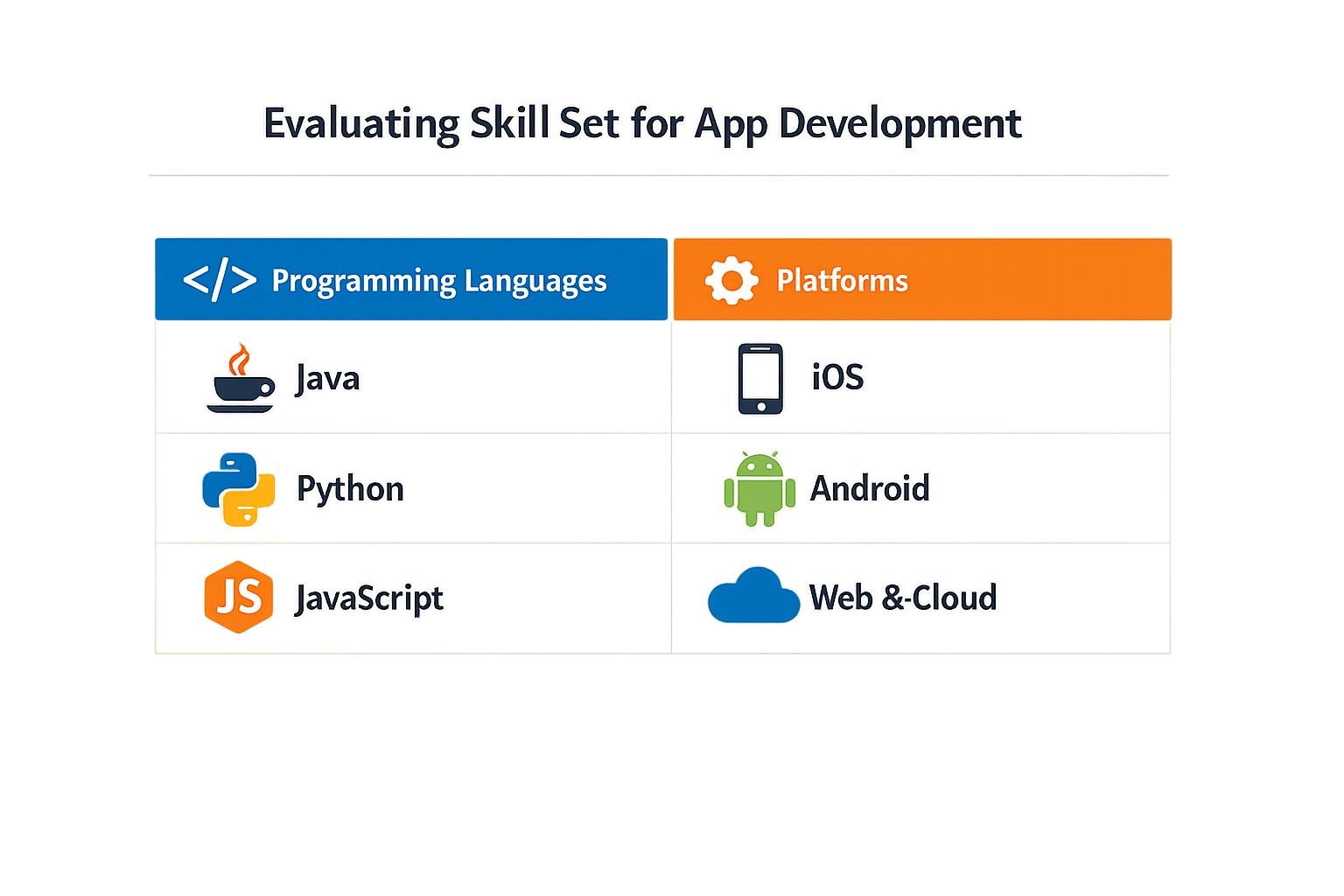
Your technical skill set determines the path you take, not whether you can ship. Founders who can't write a for-loop have built profitable apps. Founders with CS degrees have hired developers. The question isn't "am I technical enough?" — it's "which route costs me less time and money to validate this idea?"
The Self-Taught Path Works
Building without a developer is often the smarter path for validating an idea or shipping a first version. A self-taught developer from Mauritius built Habit Pixel, a cross-platform habit tracker, and documented the full journey from $0 to $1K monthly recurring revenue in 8 months. No bootcamp, no degree, no co-founder.
The gap between "I don't code" and "I shipped a working app" is smaller than it was two years ago. No-code platforms handle CRUD apps. AI assistants write boilerplate. Vibe coding workflows let non-technical founders steer AI tools through feature builds. You don't need to memorize syntax — you need to know what you're building and why.
When Your Skills Point to Hiring
Hire when the delta between your current ability and the technical complexity of the app is wide enough that learning would delay validation by months. Real-time video processing, custom ML pipelines, HIPAA-compliant backend architecture — these aren't weekend builds. If the core value of your app lives in technical depth you don't have, pay someone who does.
Hire when your time is worth more elsewhere. If you're a domain expert closing enterprise deals, spending six months learning React is opportunity cost. If you're a designer who can ship a pixel-perfect prototype in Figma but React Native makes you want to quit, hire.
The Honest Audit
Write down three things:
- The riskiest technical assumption in your app (the thing you're least sure is possible)
- How many hours per week you can dedicate to learning or building
- Your monthly burn rate while you're not shipping
If the risky assumption requires skills you don't have and can't learn in the time you have before the money runs out, hire. If you can de-risk it with a prototype in two weekends, build.
Most founders overestimate how hard building is and underestimate how hard managing a developer is. Both paths have friction. Pick the one where the friction teaches you something useful.
Getting Help from Other Sources
You don't need to choose between hiring a full-time developer and building everything yourself. Several middle paths exist that give you speed, control, or expertise without the overhead of a permanent hire.
AI App Builders
AI builders let you describe an app in plain language and generate a working prototype without writing code. They work well for idea-validation builds, marketing sites, MVPs that need frequent iteration, and internal tools where shipping fast matters more than custom architecture. You trade flexibility for speed—most AI builders impose structure and limit how deeply you can customize the result.
If you're exploring this path, Vibe Coding 101: How Non-Technical Founders Build Real Apps With AI walks through the workflow and common failure modes.
Freelancers and Contract Developers
Freelancers give you access to specialized skills without long-term commitment. You pay for output, not salary and benefits. The risk is coordination overhead—you need to write clear specs, review work, and manage handoffs. A bad hire costs you weeks of rework; a good one delivers exactly what you asked for and nothing you didn't need.
Use freelancers when the scope is well-defined and you can describe success in concrete terms. Avoid them when the requirements are fuzzy or you need someone to make product decisions on your behalf.
Online Resources and Communities
Tutorials, documentation, and developer communities (Stack Overflow, Reddit, Discord servers) can fill knowledge gaps when you're building yourself. They don't replace a developer, but they reduce the number of times you get stuck. The cost is time—you'll spend hours reading threads and testing solutions that may or may not apply to your specific case.
These resources work best when you already understand the basics and need help debugging a specific error or choosing between two approaches.
Making the Final Decision
You've mapped your requirements, checked your budget, measured your skill set, and scoped alternative paths. Now you stand at the fork: hire or build.
The wrong choice can waste months and thousands of dollars. The right choice compounds: every hour you invest early either accelerates your learning curve or buys you velocity you couldn't generate alone.
Frame the Decision as a Bet
You're not choosing a permanent identity—"technical founder" versus "business founder." You're placing a bet on the fastest path to validated learning. If you hire, you're betting that a developer's output will teach you more about your market than six weeks of your own trial and error. If you build, you're betting that hands-on context will make you a better product owner than any amount of second-hand reporting.
Neither bet is safer. Both carry different failure modes.
Prepare Before You Commit
Before hiring a developer, founders should prepare a clear problem statement, define their ideal user, outline the main workflow, and have references for product direction. If you can't articulate these in two pages, you're not ready to hire. A developer can't read your mind; vague direction produces vague software.
Before building yourself, run the same exercise. If you can't sketch the main workflow on paper, vibe-coding won't save you—it'll just let you build the wrong thing faster.
The Tiebreaker Questions
When the decision still feels even:
- Can you afford to be wrong twice? If budget allows one rebuild, bias toward hiring. If you're bootstrapped to the bone, bias toward building—at least you'll own the learning.
- Do you have a technical co-founder in your network? If yes, build a prototype and show it to them before you hire anyone. Their feedback is worth more than any consultant's pitch.
- Is your competitive window shrinking? If a competitor just raised or a regulatory window is closing, hire. Speed beats education.
Most founders oscillate. That's fine. Just don't oscillate for three months while the market moves.
Conclusion
The wrong choice can waste months and thousands of dollars. That's not a scare tactic—it's the tax you pay for guessing instead of thinking.
If your app needs real-time sync, third-party APIs, or handles money, hire a developer. If it's a simple CRUD tool and you're willing to learn, no-code or AI-assisted tools can get you to launch. The decision isn't about what feels right; it's about matching your constraints—budget, timeline, technical debt tolerance—to the problem you're solving.
I've watched founders burn six months on a no-code prototype that couldn't scale past 100 users. I've also seen solo operators ship profitable SaaS products in eight weeks because they scoped ruthlessly and picked the right tool. The difference wasn't talent; it was honest self-assessment.
A 2025 analysis found that global IT spending more than tripled since 2005, yet software success rates have not markedly improved in 2 decades. More money doesn't fix bad decisions. A clear PRD, a realistic timeline, and an honest inventory of what you can and can't do will take you further than any budget.
If you're still unsure where to start, What Is a PRD? A Plain-English Guide for Non-Technical Founders walks through the planning step that precedes this decision. Write the spec first. Then decide who builds it.
You don't need certainty. You need a decision tree, a budget cap, and the discipline to walk away from sunk costs when the path changes. Make the call, timebox the experiment, and ship.