
How to Find App Ideas: 9 Simple Frameworks That Actually Work
Introduction
The hardest part of building an app isn't the code; it's knowing what to build. Many developers struggle to find a clear, validated idea before starting. Teams often pursue trends that do not align with user needs or market fit, wasting months on products nobody wants.
This guide walks through nine frameworks that work. No fluff about "following your passion" or waiting for inspiration. These are operator methods—concrete, repeatable, and designed to surface ideas you can validate before you write a single line of code. I've shipped apps that died because the idea was weak, and I've seen solo founders build profitable SaaS with nothing but a validated concept and basic execution.
You'll learn how to identify real problems, test demand early, and avoid the common mistakes that kill app projects before launch. If you already have a rough concept and need help structuring it, check out What Is a PRD? A Plain-English Guide for Non-Technical Founders to turn your idea into a buildable plan.
The frameworks ahead are ordered from lowest-effort to highest-validation. Start with the first three, pick one that fits your situation, and run it until you have three ideas worth testing. Then move to the evaluation section to filter for the one that's actually worth building.
Discover how to find app ideas with 9 actionable frameworks that work effectively in generating innovative concepts.
Understanding App Ideas
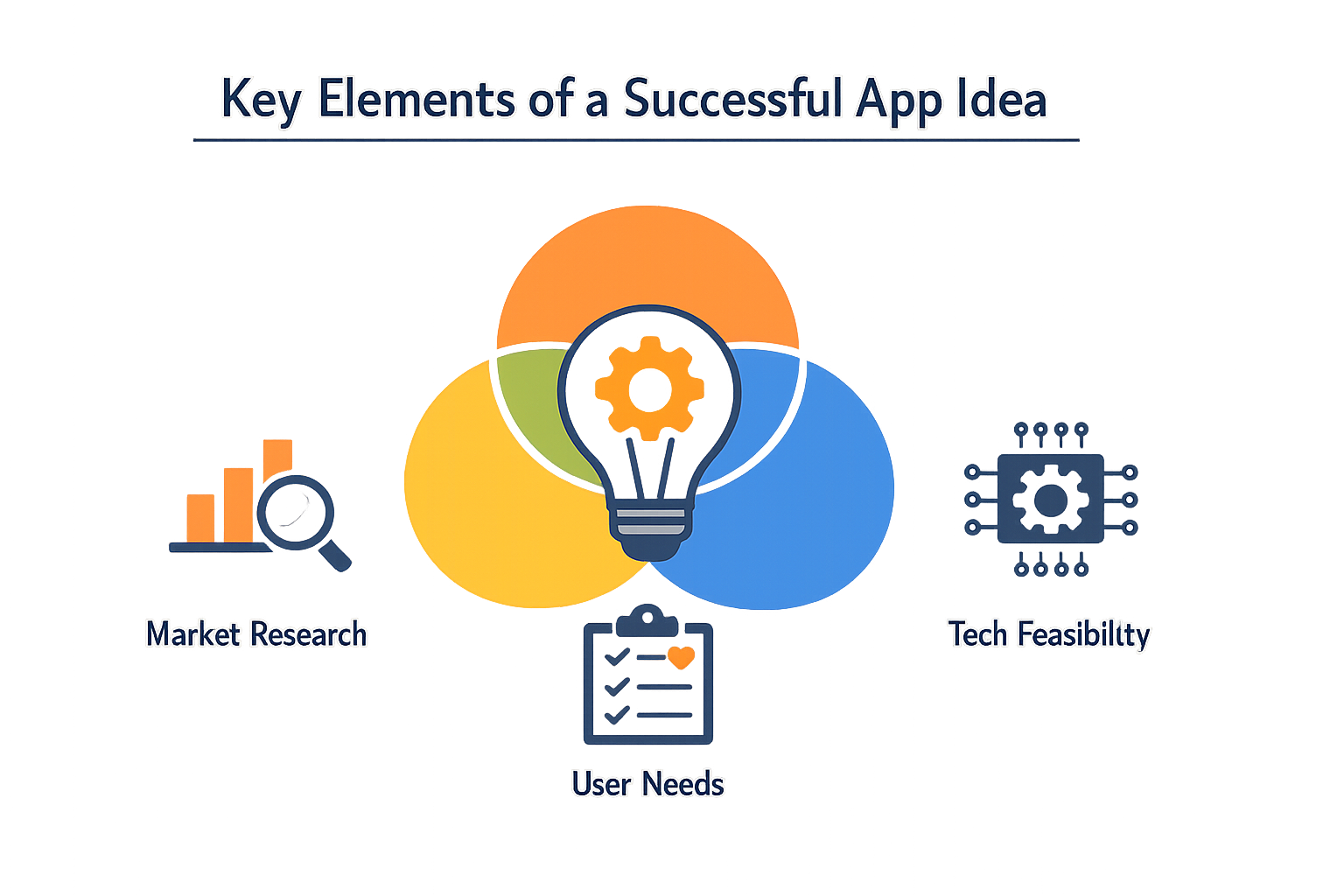
An app idea is not a feature list. It's a clear answer to a specific problem that enough people have and will pay to solve. The hardest part of building an app isn't the code; it's knowing what to build. Many developers start coding before they validate whether the problem is real or the solution is wanted.
A viable app idea has three components: a defined user, a recurring pain point, and a solution that fits how they already work. If any piece is missing, you're building on a guess. Teams often chase trends instead of aligning ideas with actual user needs or market fit, which is why most apps fail in the first year.
Why Validation Comes First
You validate an idea by talking to potential users before you write a line of code. Ask what they currently do to solve the problem, how much time or money it costs them, and whether they've tried other solutions. If they haven't looked for a fix, the pain isn't strong enough to support an app.
Market gaps appear when multiple existing apps share the same user complaints. That repeated frustration signals an unresolved issue and a potential entry point. Look for patterns in app store reviews, support forums, and Reddit threads where users describe workarounds or express disappointment with current tools.
Once you have a validated problem, the next step is choosing a framework to generate and refine your concept. If you already have a rough idea, I Have an App Idea: The Ultimate Simple Guide for Founders walks through the validation and planning steps that come next.
Framework 1: The Pain Point Method
The Pain Point Method starts with your own daily frustrations. You're already solving problems every day—most people just don't write them down. The ones that repeat are the ones worth building for.
Document What Annoys You
Carry a notes file for two weeks. Every time something takes longer than it should, write it down. No filter. The goal is volume first, patterns second.
After 14 days, you'll have 30–50 entries. Most will be noise. A few will show up three or four times. Those repeats are your signal.
Categorize by Frequency and Intensity
Sort your list into two columns: how often it happens and how much it costs you when it does. A daily 5-minute annoyance is different from a monthly 3-hour disaster, but both can be valid app ideas.
The sweet spot is high frequency, medium intensity—painful enough to pay for a fix, common enough that others feel it too.
Validate That Others Feel the Same Pain
Your frustration isn't automatically a market. Before you build anything, check if other people complain about the same thing. Search Reddit, Twitter, niche forums. If you find 10+ people describing your exact problem in their own words, you have something.
If you can't find anyone else talking about it, you might be solving a problem only you have. That's not always wrong, but it's a harder sell. When you're starting out, building your first app is easier when the demand is visible.
The best app ideas are the ones you're already working around with duct tape and spreadsheets.
How to Find App Ideas: Framework 2 – Reddit Mining for Market Gaps
Reddit hosts thousands of communities where people complain about real problems every day. Those complaints are demand signals. When multiple users in a target subreddit ask for the same thing, you have a validated gap before you write a line of code.
Why Reddit Works for Idea Discovery
Most social platforms optimize for polish. Reddit optimizes for honesty. Users post unfiltered frustrations in niche communities where they expect help, not marketing. That raw signal tells you what people actually need, not what they think they should want.
The platform's structure makes pattern recognition simple. Subreddits cluster by interest, posts accumulate engagement metrics, and search lets you filter by recency and score. You can scan six months of a 50,000-member community in an afternoon.
Step 1: Identify Target Subreddits
Pick communities where your target user already gathers. If you want to build for freelancers, start with r/freelance. For side-project builders, try r/SideProject or r/EntrepreneurRideAlong. For parents managing schedules, r/Parenting.
Subscribe to three to five subreddits in your domain. Avoid massive general communities—r/AskReddit has volume but no focus. You want concentrated pain in a defined audience.
Step 1
Map your subreddit list
Open a spreadsheet. Column A: subreddit name. Column B: member count. Column C: posts per day (estimate from the feed). Column D: your hypothesis about what problems show up there. This becomes your hunting ground.
Step 2: Search for Demand Signals
Use Reddit's search with keywords like "wish there was," "does anyone know," "looking for an app," or "how do I." Sort by top posts in the past year to surface high-engagement threads.
Look for repeated asks. One post asking for expense-splitting help is noise. Multiple posts in r/personalfinance about splitting expenses with roommates is a pattern. That pattern led someone to build a specialized expense-splitting app.
Step 3: Analyze Posts for High Engagement
Upvotes and comment counts tell you how many people share the pain. A post with 200 upvotes and 40 comments means 200+ people cared enough to click, and 40 cared enough to type. That is measurable demand.
Read the comments. Users often describe workarounds, half-solutions, or tools they tried that failed. Those gaps between what exists and what they need become your feature list. If ten comments say "I just use a spreadsheet but it breaks when we add a fourth person," you know exactly what to build and why the current solution fails.
For a practical guide on turning those insights into a buildable plan, see I Have an App Idea: The Ultimate Simple Guide for Founders.
What This Framework Delivers
Reddit mining gives you three things: a defined audience, articulated pain, and early validation. You are not guessing whether people want your app—you have written proof they asked for it. That proof becomes your first marketing copy and your feature prioritization filter.
The framework works because you let the market tell you what it needs instead of pitching what you think it should want.
How to Find App Ideas: Framework 3 — The Pain Point Method
The Pain Point Method is the most direct route to an app that people actually want. You document the things that frustrate you, categorize them by how often they happen and how much they hurt, then check if other people feel the same way.
This framework works because you're starting with real friction, not hypothetical needs. If something annoys you three times a week, it's probably annoying a few thousand other people too.
How the Pain Point Method Works
Start by keeping a running list of daily frustrations for two weeks. Write them down immediately — memory smooths over the sharp edges that make good app ideas. Note what you were doing, what went wrong, and how much time or money it cost you.
After two weeks, sort your list by frequency and intensity. The best candidates show up multiple times and cause real damage — missed deadlines, wasted hours, money left on the table. A mild annoyance that happens once a month is not an app. A $200 problem that happens twice a week is.
Step 1
Document the friction
Carry a notes file for 14 days. Every time something takes longer than it should, costs more than expected, or forces you to use a workaround, write one line: what you were doing, what broke, what it cost. Don't filter yet.
Step 2
Categorize by damage
At the end of two weeks, tag each entry with frequency (daily / weekly / monthly) and cost (time in hours or dollars lost). Sort by total damage: frequency × cost. The top five items are your shortlist.
Step 3
Validate externally
Search Reddit, Twitter, and niche forums for your top pain points. If you find threads with 50+ upvotes or replies, other people feel it too. If you find nothing, your pain might be unique to your workflow — not a market.
Why This Framework Delivers
The Pain Point Method filters out ideas that sound clever but solve nothing. If you can't name the last time the problem cost you money or time, you don't have a pain point — you have a feature request for someone else's product.
This approach also gives you natural validation criteria. When you talk to potential users, you're not pitching a concept; you're asking if they've felt the same friction. That's a much easier conversation, and the answers tell you if you're building for one person or one thousand.
For a structured next step after identifying your pain point, see What Is a PRD? A Plain-English Guide for Non-Technical Founders to turn your idea into a buildable spec.
Additional Frameworks for Finding App Ideas
The first three frameworks handle personal workflow problems, market gaps, and user complaints. The next six cover different angles: community-driven discovery, accelerator insights, and reverse engineering.
Framework 4: Mine Reddit for Wish Lists
Reddit communities like r/SomebodyMakeThis and r/vibecoding exist specifically for users to describe tools they wish existed. Browse weekly. When the same request appears three times in different threads, someone will pay for it.
Look for posts with high upvote counts and comment threads where people add variations. That's not one person's fantasy—it's a pattern.
Framework 5: Check Y Combinator's Request for Startups
Y Combinator publishes a curated list of specific problems that need solving, backed by their market research. These aren't vague suggestions—they're focused problem statements with context about why the market is ready.
Read the current list. If one aligns with your domain knowledge, you have a validated starting point without guessing.
Framework 6: Reverse Engineer Competitor Complaints
Find the market leader in a category. Read their one-star and two-star reviews on app stores and G2. The complaints that repeat across 20+ reviews are the features they won't fix.
Build the app they should have built. Your differentiation is already written.
Framework 7: Track Hacker News "Ask HN" Threads
Hacker News runs regular "Ask HN" threads where developers describe painful workflows and missing tools. Online communities like Reddit and Hacker News reveal common software problems faster than formal research.
Search for "Ask HN: What tool do you wish existed?" and similar. The replies with the most child comments indicate real frustration, not idle speculation.
Framework 8: Audit Your Browser Tabs
Open your browser. Count how many tabs are workarounds—dashboards you check manually, forms you fill repeatedly, reports you compile by hand. Each tab is a potential app.
If you do it weekly and it takes more than five minutes, automate it. If three other people in your field do the same thing, sell it. For a structured approach to turning that insight into a buildable plan, see What Is a PRD? A Plain-English Guide for Non-Technical Founders.
Framework 9: Follow the Spreadsheet
Every industry runs on shared spreadsheets that grow until they break. Find the spreadsheet everyone emails around, the one with 47 tabs and three people who understand the formulas.
That spreadsheet is your app. The structure is your data model, the tabs are your views, and the email thread is your user research.
The cheapest validation is a spreadsheet someone already maintains every week without being paid to do it.
Evaluating Your App Ideas
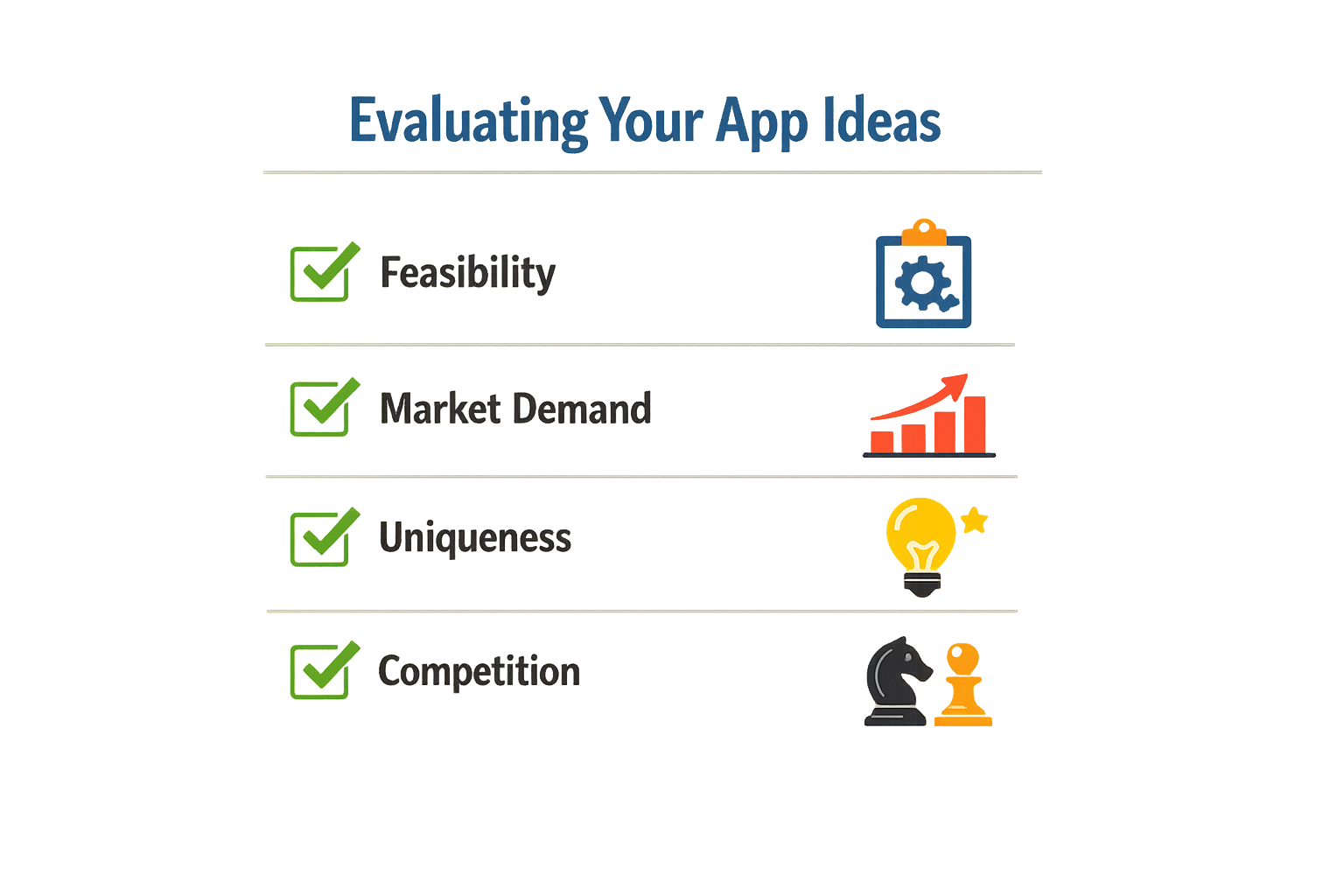
Generating ideas is the easy part. Most founders have a list of ten concepts by the end of the week. The hard part is knowing which one to build. A bad filter wastes months on something nobody wants.
The validation checklist below turns guesswork into a sequence of yes-or-no gates. If an idea fails any gate, you stop and move to the next concept.
Define the Problem
Write one sentence describing the problem your app solves. If you need two sentences, the problem is too vague. Vague problems attract vague solutions, and vague solutions don't convert users.
Test the sentence on someone outside your industry. If they nod and say "yeah, I've felt that," the problem is real. If they squint and ask clarifying questions, rewrite it.
Talk to 10 to 15 Users
Find people who experience the problem today. Ask how they currently solve it. Ask what they pay for workarounds. Ask if they've tried other tools and why they stopped using them.
Don't pitch your solution during these conversations. You're listening, not selling. If nobody admits to paying for a workaround, your idea is a vitamin, not a painkiller.
Check the Market
Search the app store for direct competitors. If you find zero competitors, that's usually a red flag, not an opportunity. It means either the market is too small or others have tried and failed.
If you find three to five competitors, that's healthy validation. Study their reviews. Look for one-star complaints that repeat across multiple apps. Those complaints are your wedge.
Smoke Test
Build a landing page describing the app as if it already exists. Drive a small amount of traffic to it—paid ads, a Reddit post, an email to your network. Measure how many people click "Get early access" or "Join the waitlist."
If conversion is below 2%, the pitch isn't landing. If it's above 5%, you have signal. This test costs $50 and two evenings, and it kills bad ideas before you write a line of code.
Scope the MVP
List every feature you think the app needs. Cross out everything except the three features that directly solve the core problem. That's your MVP.
If you can't describe the MVP in three bullet points, you're building a feature dump, not a product. Feature dumps take six months to ship and nobody uses half of them. For a structured approach to scoping, see What Is a PRD? A Plain-English Guide for Non-Technical Founders.
| Gate | Pass Signal | Fail Signal |
|---|---|---|
| Problem definition | One-sentence clarity | Requires explanation |
| User interviews | Users pay for workarounds | "Nice to have" responses |
| Market check | 3–5 competitors with complaints | Zero competitors or 50+ |
| Smoke test | 5%+ conversion | Under 2% conversion |
| MVP scope | Three core features | Ten-feature wishlist |
Run every idea through all five gates. Most ideas fail by gate three. That's the point—you want to fail fast on paper, not slow in production.
Common Mistakes in Finding App Ideas

Most bad app ideas don't fail because they're technically impossible. They fail because the person holding them skipped a step that felt optional. The mistake isn't in the idea itself—it's in how you treat it before you build anything.
Building Without Testing Demand
You think of something clever, assume other people will want it, and start building. No validation. No conversations. Just a hunch that feels strong enough to act on.
The three-part filter exists for a reason: demand (are people complaining?), market gap (is there no existing solution?), and build effort (can it be built realistically?). Skip one and you're guessing. Skip all three and you're wasting time on something that won't survive contact with users.
Chasing Trends Instead of Problems
Every year brings a new wave of "hot" categories. You see them in listicles, hear them at meetups, watch them get funded. The temptation is to pick one and retrofit your skills onto it.
That's backwards. Trends tell you where attention is, not where the unsolved problems are. If you don't understand the problem deeply—because you haven't lived it or talked to people who have—you'll build something that looks right but doesn't work.
Ignoring Your Idea Capture System
You have ideas all the time. Most of them are bad. A few are worth revisiting. But if you don't write them down in a system that's always accessible and has zero friction, you lose the good ones and remember only the loud ones.
An effective idea capture system should be always accessible, have zero friction, and include regular reviews to keep the idea list relevant. Without the review step, your list becomes a junk drawer. With it, patterns emerge—and patterns are where the real ideas hide.
For founders ready to move from idea to execution, What Is a PRD? A Plain-English Guide for Non-Technical Founders walks through the next step: turning a validated concept into a buildable spec.
Overcomplicating the First Version
You start with a simple idea, then add features to make it "competitive." Before long, you're designing something that would take a team of twelve to ship.
The mistake is thinking the first version needs to be complete. It doesn't. It needs to prove one thing: that the core problem is real and your solution moves the needle. Everything else is decoration.
Ship the smallest thing that proves the idea, not the biggest thing that impresses your peers.
Final Recommendations
Most app ideas die in a spreadsheet. The frameworks work, but only if you ship something people can touch. Start with the smallest version that proves one core assumption—whether anyone will open it twice.
Run the Revenue Math First
Before you write a line of code, multiply your most conservative market estimate by a realistic price. If the result is under $3,000/month, you're building a side project, not a business. That's fine if you know it going in, but don't pretend a $400/month ceiling will fund your next year.
Build the Audience Before the App
The single highest-leverage move is to gather people who trust you before you ask them to pay. Write about the problem for three months. Share prototypes. When you launch, you'll have day-one users who already believe the app will exist because they watched you build it.
This flips the risk model. Instead of building in silence and hoping for attention, you validate demand in public and ship to people who are waiting.
Prototype Fast, Decide Faster
Use vibe coding or a no-code tool to get a clickable version in a weekend. Show it to five people. If none of them ask when they can use it again, the idea needs work. If two do, you have signal.
The goal isn't perfection—it's learning whether the core mechanic solves the problem you think it does. Most ideas fail this test. That's why you prototype in days, not months.
The cheapest way to kill a bad idea is to build just enough to prove it won't work.
Pick One Framework and Exhaust It
Don't rotate through all nine frameworks hoping for inspiration. Pick the one that matches your situation—personal pain if you have domain expertise, audience research if you have distribution, competitor gaps if you have execution speed—and generate 20 ideas inside that frame.
Most people quit after three ideas because they feel generic. The good ones show up around idea 12, after you've cleared out the obvious stuff and your brain starts making new connections.
Conclusion
Most app ideas die in a Notes app, not in the market. Not because they were bad, but because nobody put them in front of a real person before writing code.
The nine frameworks in this guide give you structured ways to surface problems worth solving. The scratch-your-own-itch method keeps you honest about whether the pain is real. The audience-first approach lets you validate demand before you write a line. The gap-analysis and competitor-weakness frameworks help you find whitespace that already has buyer intent attached.
Picking a framework matters less than actually using one. I've watched founders sit on polished ideas for months because they never asked a stranger if they'd pay for it. The market doesn't care how elegant your concept is—it cares whether you can get someone to hand over money or time in the first week.
Start with one framework. Run it for seven days. If you surface three problems that make you annoyed enough to want a solution, you're ahead of most people who never get past the brainstorming phase. If none of the three stick, try a different framework. There's a constant demand for new and efficient solutions that meet the changing needs of users and industries—your job is to find the specific intersection where your skills and someone else's budget overlap.
If you've landed on an idea that feels solid, the next step is turning it into something you can actually show people. The complete guide for non-technical founders walks through how to go from concept to working prototype without hiring a dev team first. Speed matters more than perfection when you're trying to learn whether anyone cares.