
MVP Scope: The Ultimate Guide to Cutting Features the Easy Way
Introduction
Most founders treat MVP scope like a negotiation with themselves. They start with a tight list, then add "just one more thing" until the timeline doubles and the budget evaporates. I've watched this pattern kill more ideas than bad market timing ever did. The problem isn't ambition — it's mistaking a smaller version of your dream product for an actual test.
MVP scope is the smallest credible perimeter that can test one clear promise through one real user flow, with an acceptable cost and a defensible timeline. It's not about shipping fast and sloppy. It's about isolating the riskiest assumption in your idea and building only what proves or kills it. Everything else is noise.
The goal isn't to ship everything — it's to ship the smallest thing that proves demand.
The hard part is cutting features without gutting the idea. Most guides tell you to "focus on core value," which is true but useless. The real work is deciding what stays and what dies — and doing it before you've written a line of code or spent a dollar on design. If you're building solo or bootstrapped, your MVP scope is the difference between a working prototype in six weeks and a half-finished shell you abandon in six months.
This guide walks through the mechanics of cutting features without killing the idea. You'll learn how to identify core features, apply criteria that actually matter, and avoid the mistakes that turn MVPs into science projects. If you're trying to turn a spreadsheet into an app or validate a new SaaS idea, the scope decisions you make in the next two weeks will determine whether you ship or stall.
Learn how to effectively cut features in your MVP without losing the core idea. Explore strategies for maintaining focus on your mvp scope.
Understanding MVP Scope
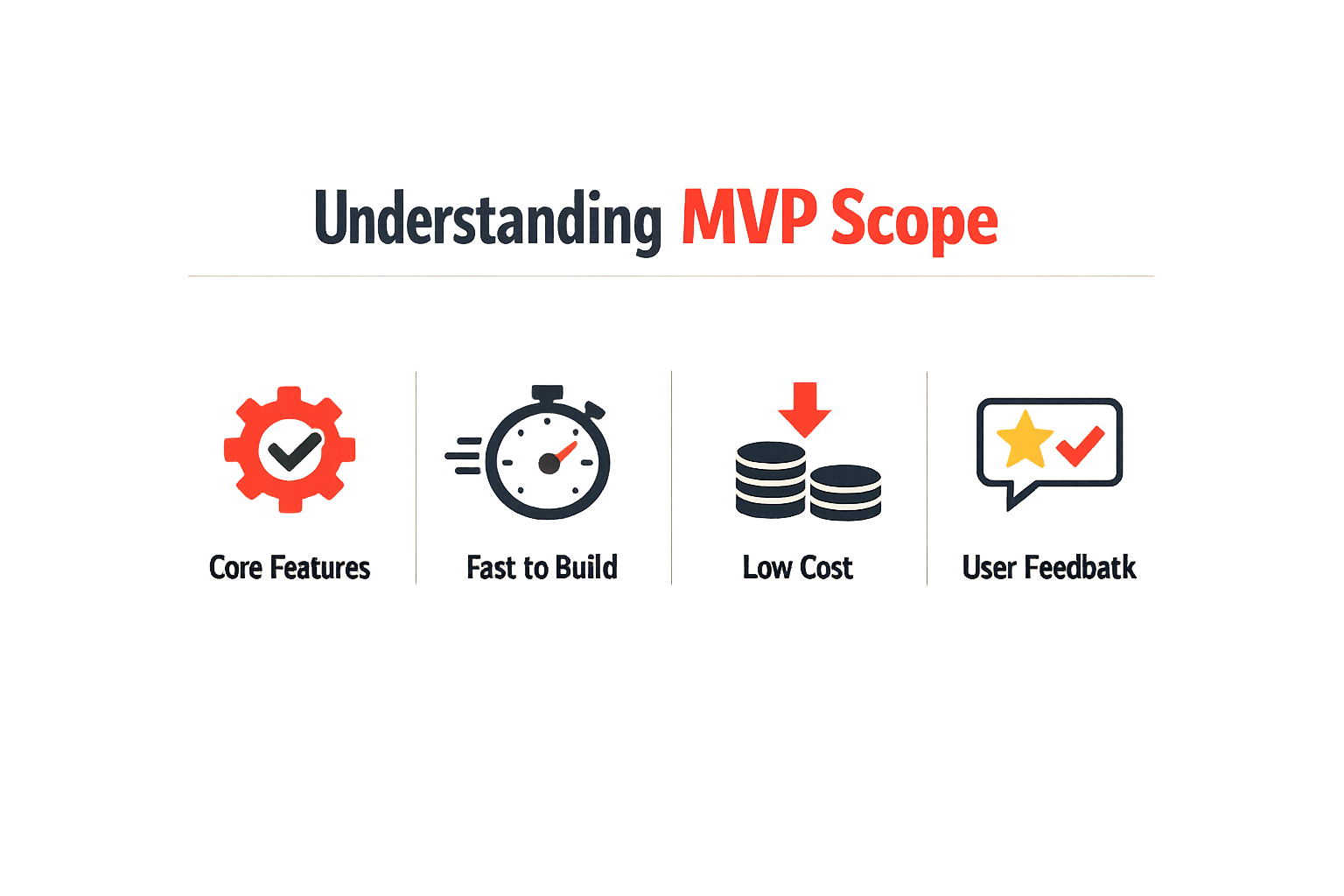
MVP scope is the smallest credible perimeter that can test one clear promise through one real user flow, with an acceptable cost and a defensible timeline. It is not a smaller version of your product. It is the smallest thing you can build that will prove or kill your riskiest assumption.
Most founders confuse scope with feature count. They cut features randomly until the list looks short, then call it an MVP. The real work is deciding which assumption you are testing and building only what that test requires. Everything else is noise.
Why MVP Scope Matters for Product Development
A tight MVP scope keeps you from spending six months on a product nobody wants. It forces you to pick one promise, one user journey, and one way to measure whether it worked. When you ship fast, you learn fast. When you learn fast, you pivot or double down before the money runs out.
Without a defined scope, teams add features because they feel safer with more functionality. The timeline stretches, the budget inflates, and the core idea gets buried under nice-to-haves. By the time you ship, the market has moved or your assumptions have expired.
The One-Flow Rule
Your MVP scope should support exactly one user flow from start to finish. If a user can sign up, complete one task, and see the result, you have enough. If they can do three different things in three different ways, you have too much.
The flow you choose should be the one that tests your riskiest assumption. If your idea depends on people paying for convenience, the flow must end at a payment screen. If it depends on network effects, the flow must include inviting others. Everything else can wait.
For founders moving from idea to build, understanding what a PRD is helps translate your scope into a document your team can execute against without constant clarification.
Acceptable Cost and Defensible Timeline
Scope is not just about features. It is about what you can afford to build and how long you can afford to wait. A three-month MVP with a clear test beats a six-month MVP with more features and no learning plan.
Defensible means you can explain the timeline to yourself, your co-founder, or an investor without flinching. If the answer is "we'll see how it goes," the scope is still too loose. Lock the features, lock the timeline, and commit to shipping on that date even if it feels incomplete.
Identifying Core Features
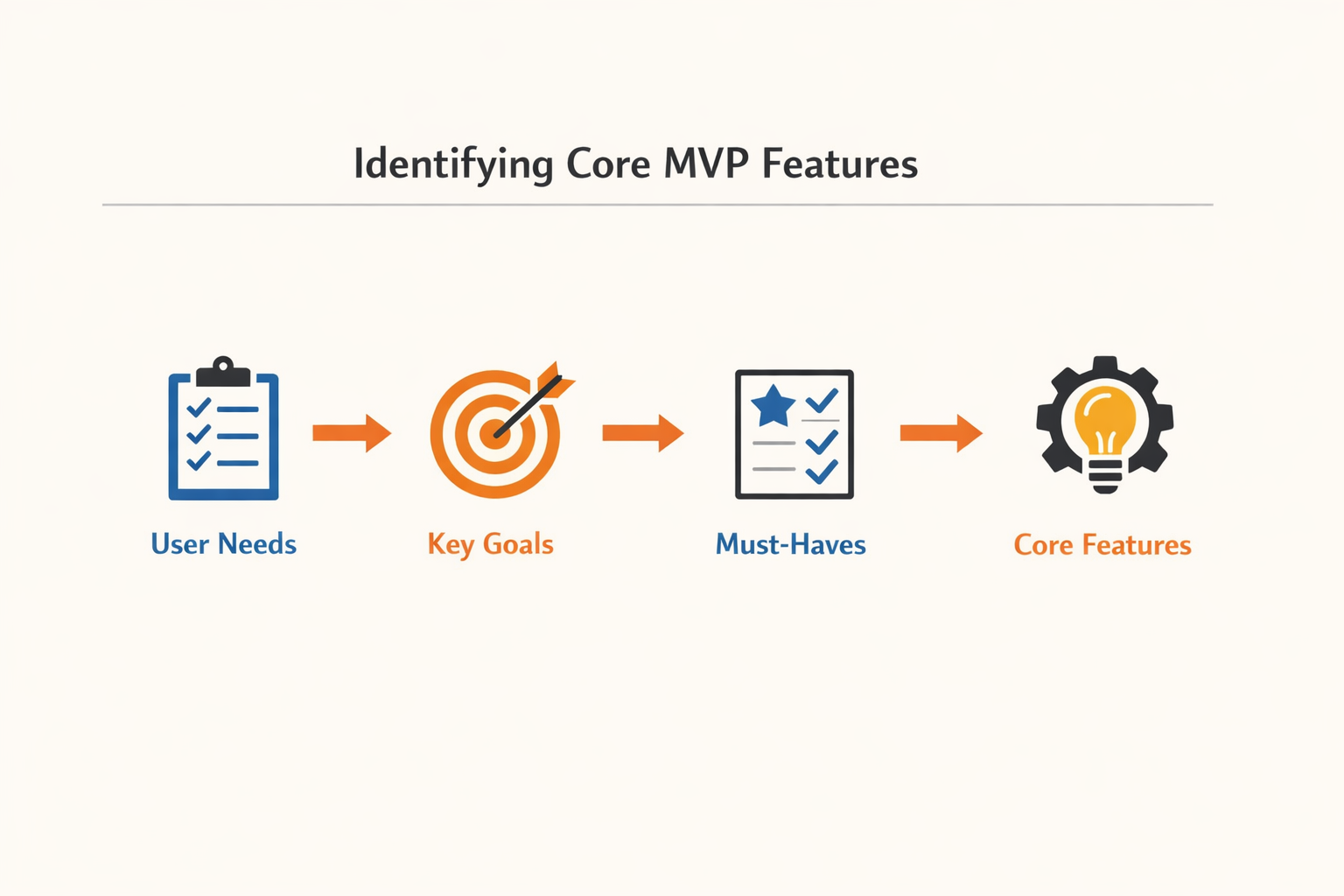
Core features are the ones that let a user reach the success moment. Everything else is decoration. The trick is asking the right question: does the user accomplish the job without this feature? If the answer is yes, it's not core.
Most founders list features by excitement, not by necessity. That's backward. Start with the user's goal, then work backward to the minimum set of actions that deliver it. If you can't draw a straight line from feature to outcome, cut it.
The MoSCoW Framework for MVP Scope
The MoSCoW method categorizes features into four buckets: Must Have, Should Have, Could Have, and Won't Have. Must-have features are the ones that make the product work at all. Should-have features improve the experience but aren't required for launch. Could-have features are nice-to-haves. Won't-have features are explicitly deferred.
This isn't a democracy. Must-have means the user cannot complete the core workflow without it. If you're building a task manager, creating and marking tasks as done is must-have. Tags, filters, and due-date reminders are should-have or could-have. Themes and integrations are won't-have until the core loop proves out.
The framework forces you to defend each feature. When someone says "we need X," you ask which category it belongs in and why. Most features collapse under that pressure.
Map the Core Workflow First
Before you classify anything, map the user's path from problem to solution. Write it as a numbered list: user logs in, user creates a thing, user edits the thing, user sees the result. That's your core workflow. Features that appear in that list are must-have. Features that don't appear are not.
If you're unsure whether a feature is core, remove it and see if the workflow still closes. If the user can still accomplish the job, the feature wasn't core. This is faster than arguing about it in Slack.
For a deeper look at structuring your product idea from the ground up, see What Is a PRD? A Plain-English Guide for Non-Technical Founders.
Prioritize by Dependency, Not by Preference
Some features unlock others. Authentication unlocks user-specific data. Data entry unlocks data display. Display unlocks export. Dependencies are must-have; everything downstream is conditional.
Draw a dependency tree. Features at the root are must-have. Features at the leaves are could-have or won't-have. If a feature has no dependencies and nothing depends on it, it's a candidate for the cutting room.
Preference is the enemy here. Founders love features that feel impressive or that competitors have. Dependency is the only honest arbiter. If the feature doesn't unlock the next step, it's not core.
Criteria for Cutting Features
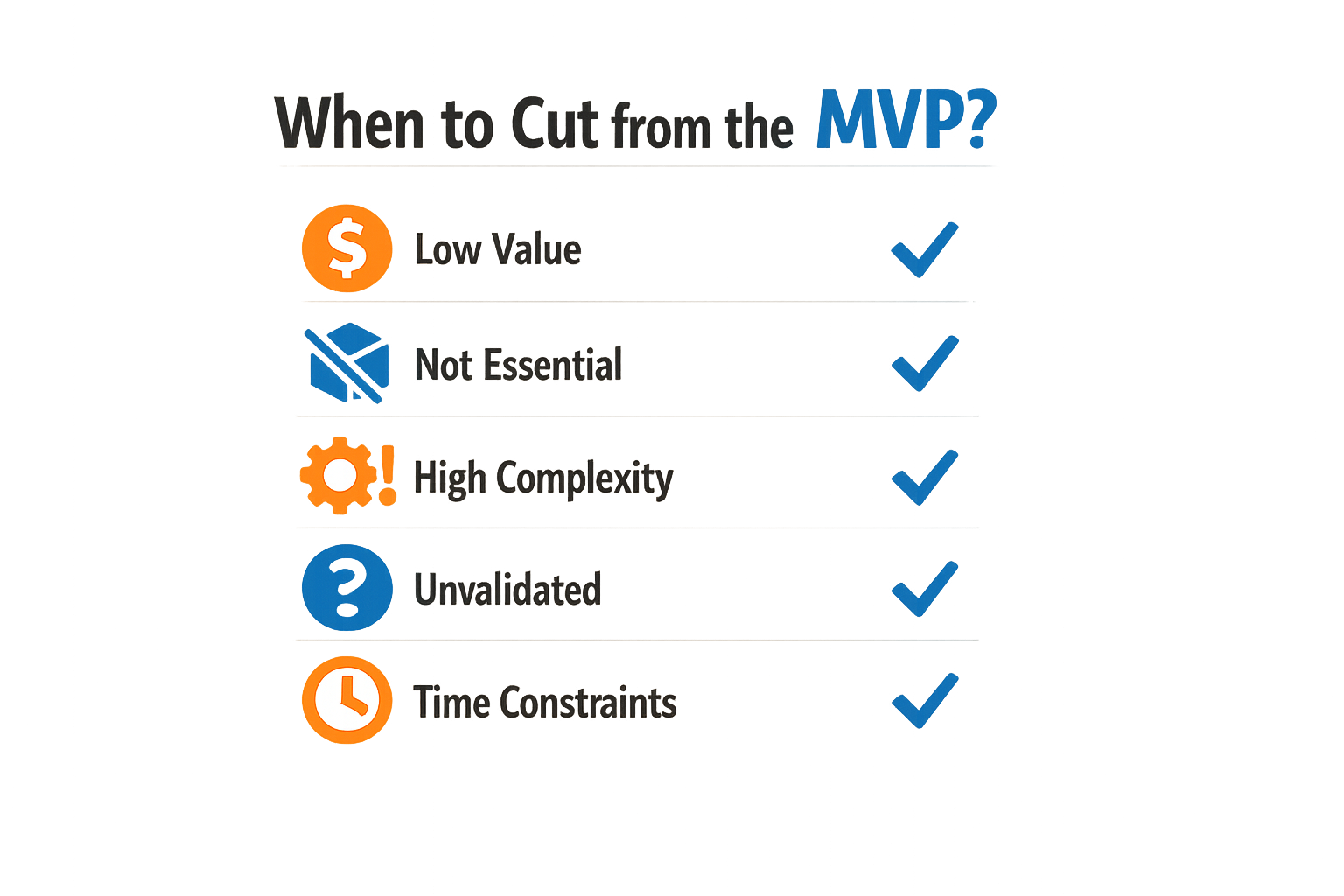
Every feature looks necessary until you ask the right question. The cut checklist is simple: does the user reach the success moment without it? If yes, defer it. That question filters out most of the nice-to-haves before they reach the backlog.
The final constraints for locking your MVP scope are numeric. Aim for 3–7 features, a 4–12 week timeline, and a budget that covers costs plus 20%. If your list is longer or your timeline stretches past three months, you're building a version-two product and calling it an MVP.
Run the Cut Checklist on Every Feature
Start with the success moment—the single action that proves the user got value. Then trace backward. Any feature that doesn't sit on that path is a candidate for removal. If a feature makes the success moment easier but not possible, it's a quality-of-life improvement, not a core requirement.
Step 1
Ask the success question
Does the user reach the success moment without this feature? If the answer is yes, move the feature to a won't-have list. Document it so the team stops debating it.
Step 2
Check the timeline
If adding the feature pushes your ship date past 12 weeks, cut it. Speed matters more than polish in an MVP. You can always add it back after you validate the core idea.
Step 3
Count the features
If your list exceeds 7 features, rank them by proximity to the success moment. Cut from the bottom until you hit 7 or fewer. The tighter the scope, the faster you ship.
Once you've locked the scope, adopt a weekly discipline: add at most 1 new feature and remove 2 existing ones. That net-negative velocity keeps scope creep from killing your timeline. If you're following a structured approach to app planning, this plain-English guide to PRDs can help you document what stays and what goes.
Use Hard Constraints to Force Decisions
Constraints clarify. A 12-week deadline forces you to choose between two features that both feel essential. A fixed budget forces you to cut anything that requires a third-party API with a steep learning curve. A team of two forces you to cut anything that needs specialized skills you don't have.
The 20% budget buffer accounts for the surprises that always show up—API rate limits, unexpected hosting costs, a design revision that takes longer than planned. Without it, you'll cut features mid-sprint because you ran out of runway.
Testing and Feedback
The real test of your MVP scope happens when someone who isn't you tries to use it. Everything before that is speculation. You cut features to ship faster, but shipping without a feedback loop just moves the guessing game from your desk to production.
Test the Cut, Not Just the Product
Most founders test whether the product works. Fewer test whether the cuts worked. The question isn't "Does this button click?" — it's "Does the user notice what's missing, and does it stop them?" If you removed notifications and nobody asks where they are, you cut correctly. If you stripped export and three users bounce in the first session, you cut wrong.
Track confusion, not just completion. When users pause, backtrack, or ask "How do I…?" for something you removed, that's signal. Not every missing feature deserves to come back, but patterns of confusion tell you which cuts broke the user's mental model.
Use the Backlog as Proof, Not a Junk Drawer
Scope cuts fail when they feel arbitrary. Telling a user "We'll add that later" without context sounds like an excuse. Telling them "We parked it to test demand for the core loop first" sounds like a plan. The difference is whether your backlog reflects learning or just postponed decisions.
Tie every cut to a hypothesis you can test. "We removed bulk upload because we think users will start with one record to learn the flow." Now you can measure: do they? If 80% of users immediately try to import a CSV, your hypothesis was wrong and the feature moves up. If they don't, it stays parked. For strategies on maintaining product coherence during cuts, see Vibe Coding: The Complete Guide for Stress-Free Development.
The goal isn't to ship everything — it's to ship the smallest thing that proves demand.
Feedback Channels That Actually Close the Loop
In-app feedback widgets collect dust. Users don't stop mid-task to fill out forms. Better: watch session replays for the first ten users, then talk to three of them. Ask what they expected to happen, not what they liked. Expectations reveal which cuts violated assumptions.
Set a two-week window. If a cut doesn't generate confusion or requests in that span, it's validated. If it does, decide: was the feature wrong, or was the explanation wrong? Sometimes a tooltip fixes what looks like a missing feature.
Balancing Features and Core Idea
The hardest part of MVP scope isn't cutting features — it's cutting them without breaking the thing you're trying to prove. Every feature you remove changes the shape of the product. Remove too many and you're left with a toy. Keep too many and you never ship.
The goal isn't to ship everything — it's to ship the smallest thing that proves demand. That line matters because it reframes the question. You're not asking "what can we build?" You're asking "what must we prove?"
Define One Complete Workflow
The MVP must deliver core value end-to-end, focusing on one complete workflow rather than a broad feature list. Pick the single path a user takes from problem to solution. If you're building project management software, that might be: create task, assign it, mark it done. Not dashboards, not reports, not integrations — just the loop that solves the problem once.
Write it as a sentence: "A user can [action] so that [outcome]." If you need two sentences, you have two MVPs.
Every feature outside that workflow is noise until you prove the workflow matters. You can always add reporting after people use the thing enough to need reports.
What Stays vs. What Waits
MVPs are as much about constraints as they are about features. The "won't build" list is as important as the "will build" list. For each feature on your original spec, ask: does removing this break the core workflow? If the answer is no, it waits.
Some features feel essential but aren't. User profiles with avatars and bios? Probably not. A way to log in and see your own data? Yes. The difference is whether the feature serves the proof or serves polish.
The cheapest way to learn what users need is to ship without it and count how many ask for it.
Track what you cut. When five users ask for the same missing feature, you know what to build next. When nobody asks, you saved weeks.
Keep the Idea Recognizable
Cutting features can't mean losing the idea. If someone asks "what does this do?" and your answer doesn't match the problem you started with, you cut too much. The core idea is the reason the product exists. Features are just how you deliver it.
For a more structured approach to defining what stays in scope, see What Is a PRD? A Plain-English Guide for Non-Technical Founders.
Test this by describing your MVP in one sentence to someone outside your team. If they understand the value without a feature list, your scope is clean. If they ask "but how do you…?" about something fundamental, you cut into bone.
Case Studies
Most MVPs that survive first contact with users share one trait: they shipped a core loop and nothing else. The goal isn't to ship everything — it's to ship the smallest thing that proves demand. These examples show what that looks like in practice.
Two-Sided Marketplace: Request → Match → Transaction → Rating
A two-sided marketplace core loop could be: request → match → transaction → rating. Everything else — advanced search, saved favorites, multi-currency support — waits until the loop closes reliably. If users can't complete one transaction without friction, adding filters won't save you. The first version proves people will pay; the second version makes paying easier.
Step 1
Ship the loop first
Build request intake, match logic, payment rails, and a rating prompt. If any step breaks, the loop dies. Test the loop with ten transactions before you add a single feature.
Step 2
Defer the nice-to-haves
Saved searches, notification preferences, bulk actions — all deferred. Users tolerate missing conveniences if the core transaction works. They don't tolerate a broken transaction with great UX around it.
SaaS Tool: One Workflow, One Export
Early SaaS MVPs often ship one workflow and one export format. If the tool is a reporting dashboard, it generates one report type as a PDF. If it's a scheduling assistant, it books one calendar and sends one reminder. The second workflow and the CSV export come after the first ten paying customers prove the concept. Cutting features here means cutting entire use cases, not just polish.
Content Platform: Publish and View
A content platform MVP handles publish and view. Comments, likes, shares, notifications — all deferred. If the core idea is "people will pay to read this content," prove that first. If they won't pay to read it, adding social features won't change the answer. The MVP tests the content hypothesis, not the engagement hypothesis.
For more on identifying your core idea early, see What Is a PRD? A Plain-English Guide for Non-Technical Founders.
Common Mistakes to Avoid
Cutting features sounds simple until you're staring at a list you spent three weeks writing. Most founders make the same errors: they cut the wrong things, keep too much, or panic and slash everything that made the idea interesting. The data is ugly—42% of startups fail because there was no market need for what they built, which means they either kept features nobody wanted or cut the ones that mattered.
Keeping Features Because They're Easy
The first mistake is keeping a feature because it's cheap to build. Easy features pile up fast. You convince yourself each one is harmless because it only takes a weekend, but you end up with twelve weekends of cruft and no time left for the hard feature that actually solves the problem. If a feature doesn't directly prove your core hypothesis, it doesn't belong in the MVP—even if you could build it in an afternoon.
Cutting Features Because They're Hard
The opposite trap: you cut a feature because it's technically difficult, even though it's the only reason a user would pay. This is how you end up with a beautiful shell that does nothing useful. If the hard feature is the core value exchange, you don't have an MVP without it—you have a demo. Scope the hard feature down to its simplest proof, but don't delete it to make your life easier.
Death by a Thousand Nice-to-Haves
Another common failure is the "just one more" spiral. You cut ten features, then add back five because they feel small. The average software product wastes 80% of its features—rarely or never used—because teams can't hold the line. Every feature you add is a surface you have to test, document, and support. If you're not sure whether a feature is essential, it isn't. When in doubt, cut it and add it back later if users scream.
The expensive mistake isn't cutting too much—it's keeping too much and never learning what mattered.
Ignoring the Feedback Loop
The final mistake is cutting features in a vacuum. You make all your scope decisions up front, ship the MVP, and then realize you cut the one thing users actually needed. The fix is to cut aggressively but plan to iterate fast. Your first cut won't be perfect, so build the MVP in a way that lets you add features back in days, not months. If you can't ship a small change in under a week, your MVP scope is probably still too big.
For a deeper look at how to structure your build so you can move fast after launch, see Vibe Coding for Beginners: The Ultimate Easy Weekend Guide.
Who Should Choose What
The feature-cutting decision is not a democracy. The person who owns the risk decides what ships. If you're the solo founder writing the checks, you make the call. If you're a technical co-founder with equity on the line, you split the decision with your business partner. Advisors and early users inform the choice — they don't vote on it.
This matters because committees kill MVPs. When five people have equal say, the scope grows to accommodate everyone's pet feature. The smallest thing that proves demand gets buried under consensus-driven bloat. One person must have final authority to say no.
The Founder's Job
You decide which assumption is riskiest. You define the one behavior that proves or kills the idea. You draw the line between core and nice-to-have. No one else can do this work for you — they don't carry the same downside if the product fails.
If you're non-technical, your job is not to spec every button. It's to articulate the user problem and the success metric. The builder (whether that's a co-founder, contractor, or AI tool) translates that into working software. You retain veto power over scope creep, but you don't micromanage implementation.
The Technical Partner's Job
If you're the builder, you enforce feasibility. You translate "I want users to do X" into "here's the smallest version of X we can ship in two weeks." You push back when a feature requires infrastructure the MVP doesn't need. You propose cuts that preserve the core behavior but drop the surrounding polish.
You also own the quality floor. If shipping a feature means the app breaks under normal use, you cut it or delay launch. The business partner decides what to prove; you decide how much you can ship without technical debt that kills iteration speed.
When to Bring in Users
Early users inform priorities — they don't set them. Show a working prototype to three people who match your target. Ask what they'd pay for, not what they'd like to see. If two out of three say they'd use the core feature weekly, you have signal. If they all ask for the same missing piece, consider it — but only if it fits the riskiest-assumption test.
Do not run a survey before you have a prototype. People are terrible at predicting their own behavior. They'll tell you they want ten features, then ignore the product when you ship all ten. What Is a PRD? A Plain-English Guide for Non-Technical Founders covers how to translate user feedback into a scope document without letting feature requests derail the plan.
When to Ignore Advisors
Advisors with domain expertise can spot a fatal flaw you missed. Advisors without skin in the game will suggest features that sound good in a slide deck but don't move the core metric. Listen to the former, ignore the latter.
If an advisor says "you need feature Y or no one will take you seriously," ask: does Y prove demand, or does it just make the demo prettier? If it's the latter, cut it. The goal isn't to ship everything — it's to ship the smallest thing that proves demand.
An MVP is the smallest thing you can build that will prove or kill your riskiest assumption, not just a smaller version of your product.
Conclusion
Defining your MVP scope comes down to one question: what's the smallest thing you can ship that proves someone will pay for it? Everything else is a distraction dressed up as product vision.
The process is simple. Start with the user's problem, not your feature list. Identify the one action that delivers value. Cut everything that doesn't directly support that action. Test with real users before you write another line of code. When someone asks for a feature, ask what problem it solves — if the answer is vague, the feature stays out.
Most founders fail because they confuse activity with progress. They add features to feel productive, then wonder why nobody uses the product. The goal isn't to ship everything — it's to ship the smallest thing that proves demand.
I've seen this pattern repeat: founders who cut ruthlessly ship faster, learn faster, and pivot cheaper when they're wrong. The ones who protect every feature end up with a bloated product nobody wants. Your MVP scope is a forcing function. It makes you choose what matters.
If you're still sketching ideas on napkins, start with a simple guide that walks through turning an app idea into something shippable. If you've already cut your scope and you're ready to build, the next step is execution — not more planning.
Ship the minimum. Prove it works. Add features only when users pay for them. That's the entire playbook.
Related reading
AI PRD Generator: The Ultimate Easy Way to Create PRDs
How to Create an App Without Coding: The Ultimate Easy Guide