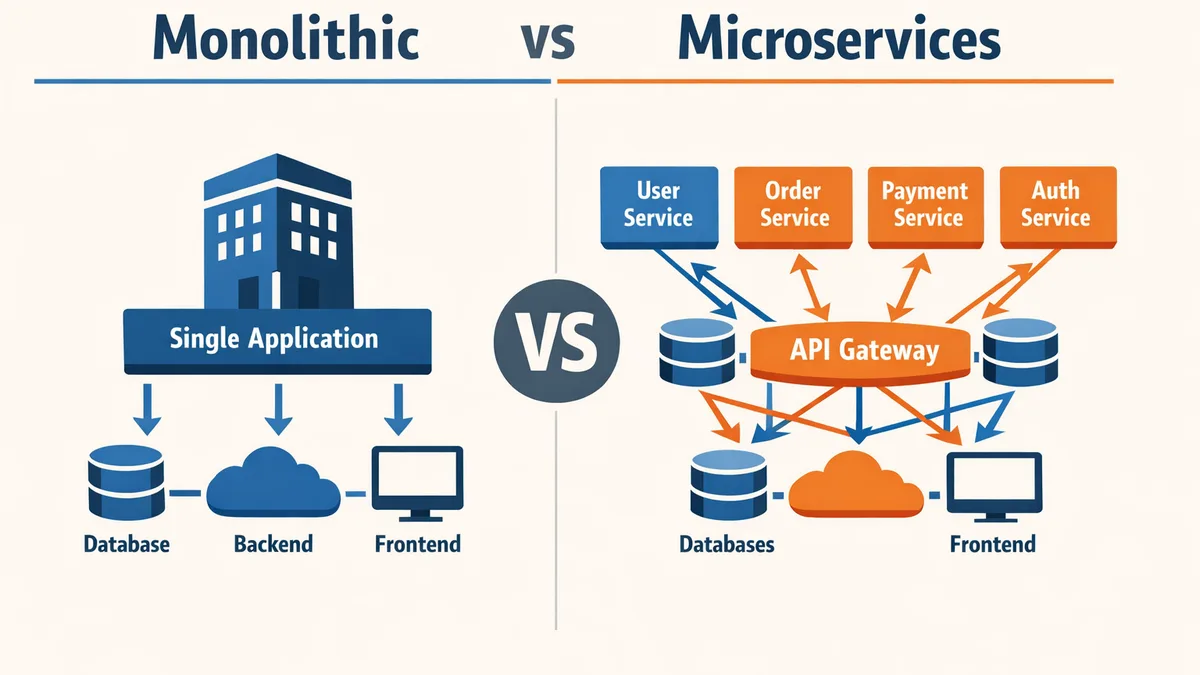
Monolithic Architecture vs Microservices: Choosing Your App
Top takeaways
- Monolithic vs Microservices is a decision about team capacity and deployment velocity, not technical purity
- Monolithic architecture bundles all application logic into a single unified platform, while microservices split functionality into independent services
- Microservices enable faster MVP shipping and easier iteration on product-market fit, but add coordination overhead
- Most solo founders and small teams start monolithic and extract services only when a clear bottleneck appears
- Modern AI build tools support both patterns, but microservices require more explicit interface definitions upfront
Introduction
Monolithic vs Microservices is the skeleton your product hangs on. Pick wrong and you spend months untangling dependencies when you need to move fast. Pick right and new features slot in without rewriting half the codebase.
I've shipped products both ways. Monolithic architectures let you prove an idea exists before you architect for scale. Microservices let you replace a broken piece without touching the rest—but only if your team can manage the coordination tax.
The Monolithic vs Microservices decision isn't about which pattern is better in the abstract. It's about which failure mode you can afford right now. A monolith that works beats a microservices mesh that's half-deployed. A service boundary that's wrong costs more to fix than a monolith that grew too big.
This guide walks through the tradeoffs, the warning signs that you picked wrong, and the migration path when your architecture stops fitting your team. No doctrine—just the mechanics of what breaks and when. For a broader view of planning decisions that feed into architecture choices, see App Development Plan: Dev Plan Guide for Non-Technical Founders (2025).
The best architecture is the one your team can actually deploy on the timeline that keeps the company alive.
What Makes Monolithic vs Microservices a Hard Choice?
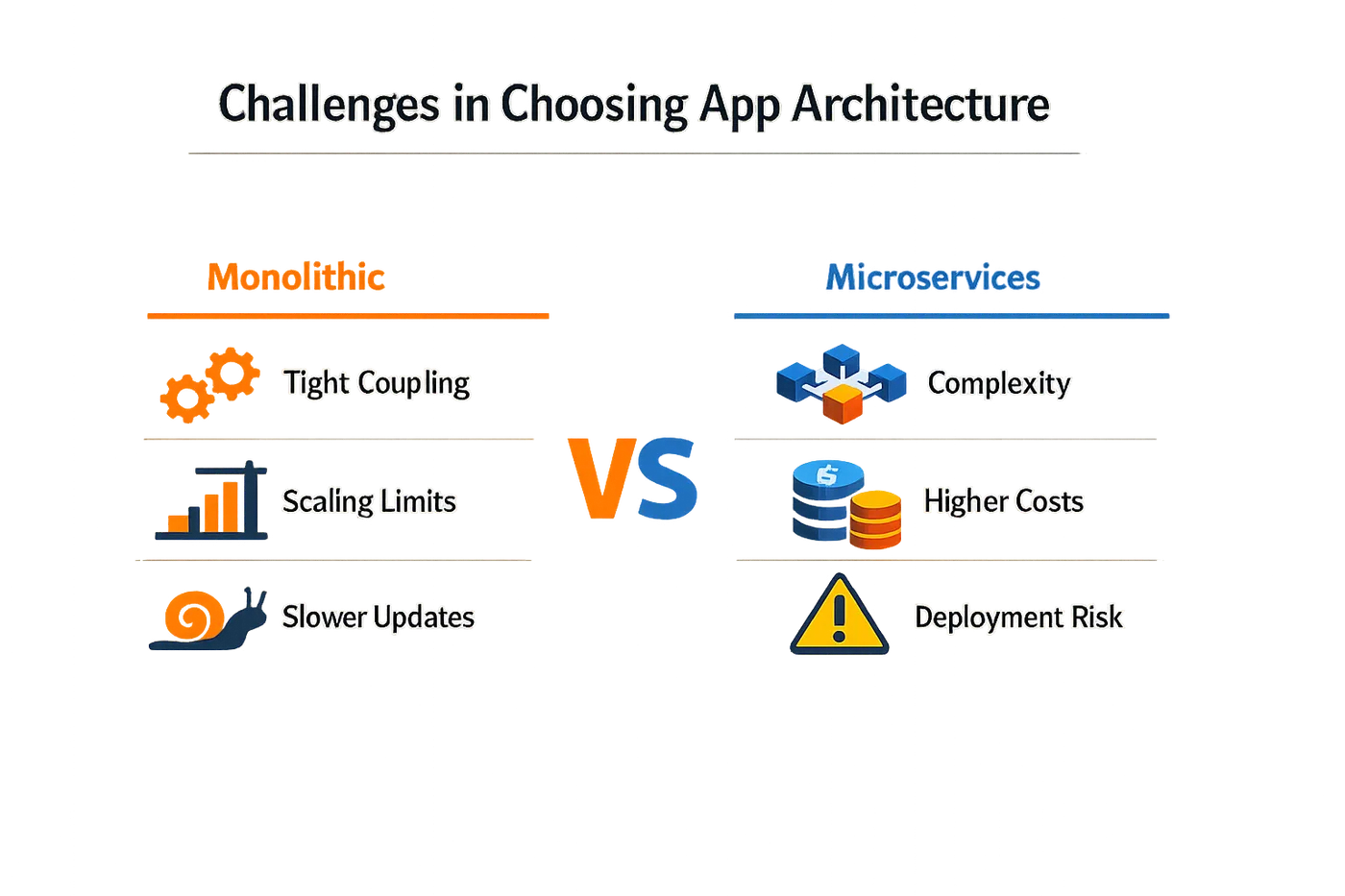
You need to ship a product. The architecture decision sits between you and your first deploy. Most founders treat this as a technical purity question — it isn't. It's an operational question about what breaks when you scale and who fixes it.
Monolithic vs Microservices isn't a theology debate. It's a constraint-matching exercise. The wrong choice costs you months of rework or thousands in infrastructure you don't need yet. The right choice lets you move fast now and refactor later when the revenue justifies it.
The Real Tradeoffs
A monolith puts all your code in one deployable unit. One repo, one build, one server process. You change the checkout flow, you redeploy the whole app. A microservices architecture splits functionality into independent services — each with its own deploy cycle, database, and failure mode.
The monolith ships faster at the start. No network calls between modules, no service mesh, no distributed tracing. You write features in hours instead of days. The microservices setup front-loads complexity: you need container orchestration, API contracts, and a way to debug across service boundaries before you write your first user-facing feature.
But monoliths accumulate technical debt in predictable ways. After your tenth feature, the codebase becomes a dependency graph you can't reason about. A bug in the payment module takes down your entire app. Scaling means replicating the whole binary even when only one endpoint is under load.
Microservices let you scale and deploy independently — in theory. In practice, you need the tooling and the team discipline to make that independence real. Without both, you get a distributed monolith: all the latency and operational overhead of microservices with none of the decoupling benefits.
When the Decision Actually Matters
If you're a solo founder or a two-person team, the answer is almost always monolith. You don't have the人力 to maintain service contracts and debug cross-service failures. Your competitive advantage is iteration speed, and microservices kill that until you have revenue and headcount.
If you're running a team with clear domain boundaries — payments, inventory, notifications — and each domain has an owner, microservices start to make sense. The operational cost is real, but so is the ability to let each team ship without coordinating deploys. For more on structuring early product work, see App Development Plan: Dev Plan Guide for Non-Technical Founders (2025).
The cheapest architecture is the one that lets you ship this week and refactor next quarter when you know what actually scales.
The failure mode isn't picking the wrong pattern. It's picking microservices because they sound sophisticated, then spending three months on infrastructure instead of talking to users. Or picking a monolith and never carving out the high-load paths that justify a separate service.
Modern tooling doesn't eliminate the tradeoff — it shifts where the complexity lands. Frameworks and build tools can make monoliths cleaner or microservices easier to deploy, but they don't change the fact that one pattern optimizes for speed now and the other optimizes for independence later.
How to Choose Between Monolithic vs Microservices
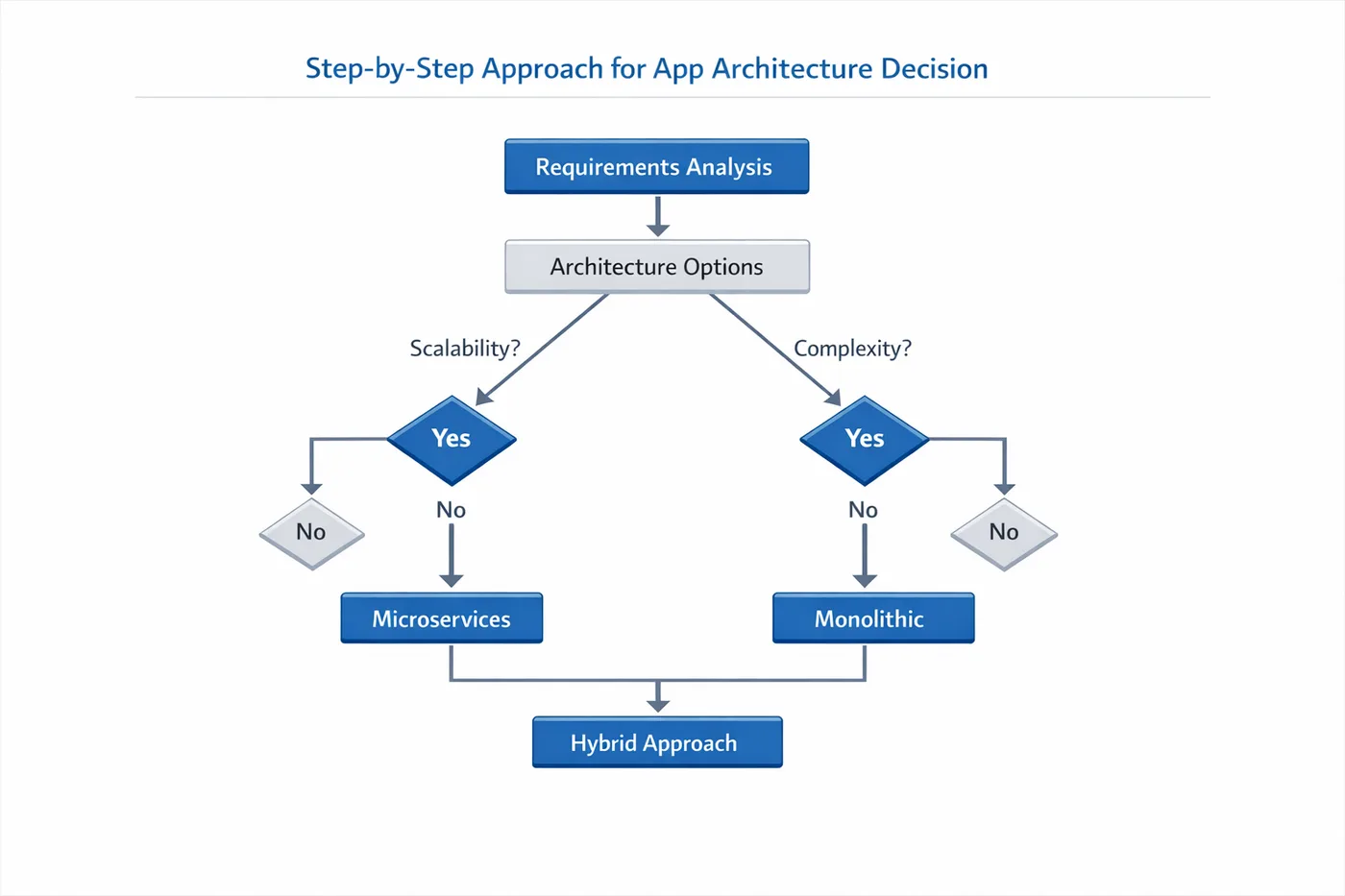
Choosing between Monolithic vs Microservices requires a structured evaluation of your current constraints and future needs. The following steps guide you through that decision.
Step 1: Define trust boundaries and enumerate resources
Start by mapping every resource your application will expose. List each user type, the data they access, and the operations they perform. This exercise surfaces complexity early. A monolith handles authorization in one place; microservices push that logic to each endpoint, which means you need clear boundaries before you write code.
Step 1
Inventory users and resources
Enumerate user types, exposed resources, and operations (read, write, update, delete). For every user-resource pair, document what operations are allowed. This inventory becomes your authorization matrix and reveals whether centralized or distributed access control fits your team's capacity.
If your matrix is simple—three user roles, ten resources—a monolith keeps authorization logic in one service. If you see dozens of roles with context-dependent rules (time of day, network location, resource state), you may need attribute-based access control distributed across services.
Step 2: Assess your team's operational capacity
Microservices demand tooling for service discovery, distributed tracing, and centralized logging. If you lack experience running multiple production services, a monolith buys you time to build that muscle. A solo founder or two-person team rarely has bandwidth for orchestrating ten microservices.
Ask: do we have CI/CD pipelines that can deploy independent services without manual steps? Can we monitor latency and error rates per endpoint? If the answer is no, start with a monolith and extract services only when a clear boundary emerges.
Step 3: Model workflows and state transitions explicitly
Both architectures require explicit workflow validation. In a monolith, you enforce state transitions in a single service. In microservices, each service validates its own state, which means you need a shared understanding of valid transitions or a central orchestrator.
For example, an ecommerce checkout flow—create cart, add items, submit payment—must reject out-of-order requests. A monolith checks the cart state in one database transaction. Microservices require either a saga pattern or event sourcing to maintain consistency across cart, inventory, and payment services.
Step 2
Map state transitions
Draw a finite state machine for each critical workflow. Identify which service owns each state. If multiple services must coordinate to complete a transition, document the rollback path. If rollback logic is complex, a monolith simplifies recovery.
Step 4: Plan for multi-tenancy and cross-organizational access
If your application serves multiple customers with isolated data, microservices offer cleaner tenant separation. Each service can enforce tenant boundaries independently. A monolith requires careful schema design to prevent cross-tenant leaks, but it keeps authorization logic centralized.
Attribute-based access control (ABAC) supports multi-tenancy better than role-based access control (RBAC) when you need fine-grained rules. If your access decisions depend on attributes like organization, location, or time, plan for an identity provider (IdP) that issues tokens with those claims. Microservices consume those tokens at each endpoint; a monolith consumes them once at the API gateway.
Step 5: Establish input validation and request limits
Regardless of architecture, every endpoint must validate input and enforce size limits. In a monolith, you configure one framework. In microservices, you configure each service independently, which multiplies the risk of misconfiguration.
Set request size limits and reject oversized payloads with HTTP 413. Log validation failures—hundreds of failed validations per second signal an attack. A monolith centralizes these logs; microservices require a log aggregator to correlate events across services.
Step 6: Evaluate third-party component risk
Both architectures depend on libraries and frameworks. Microservices multiply the attack surface because each service may pull different dependencies. A monolith has one dependency tree; microservices have one per service.
Incorporate dependency scanning into your CI pipeline. Subscribe to vulnerability feeds and maintain a process for patching. If your team cannot track CVEs across ten services, a monolith reduces that burden to one codebase.
For more on planning application structure before you write code, see PRD Sections Explained: What to Include with Examples.
Tips and Tricks
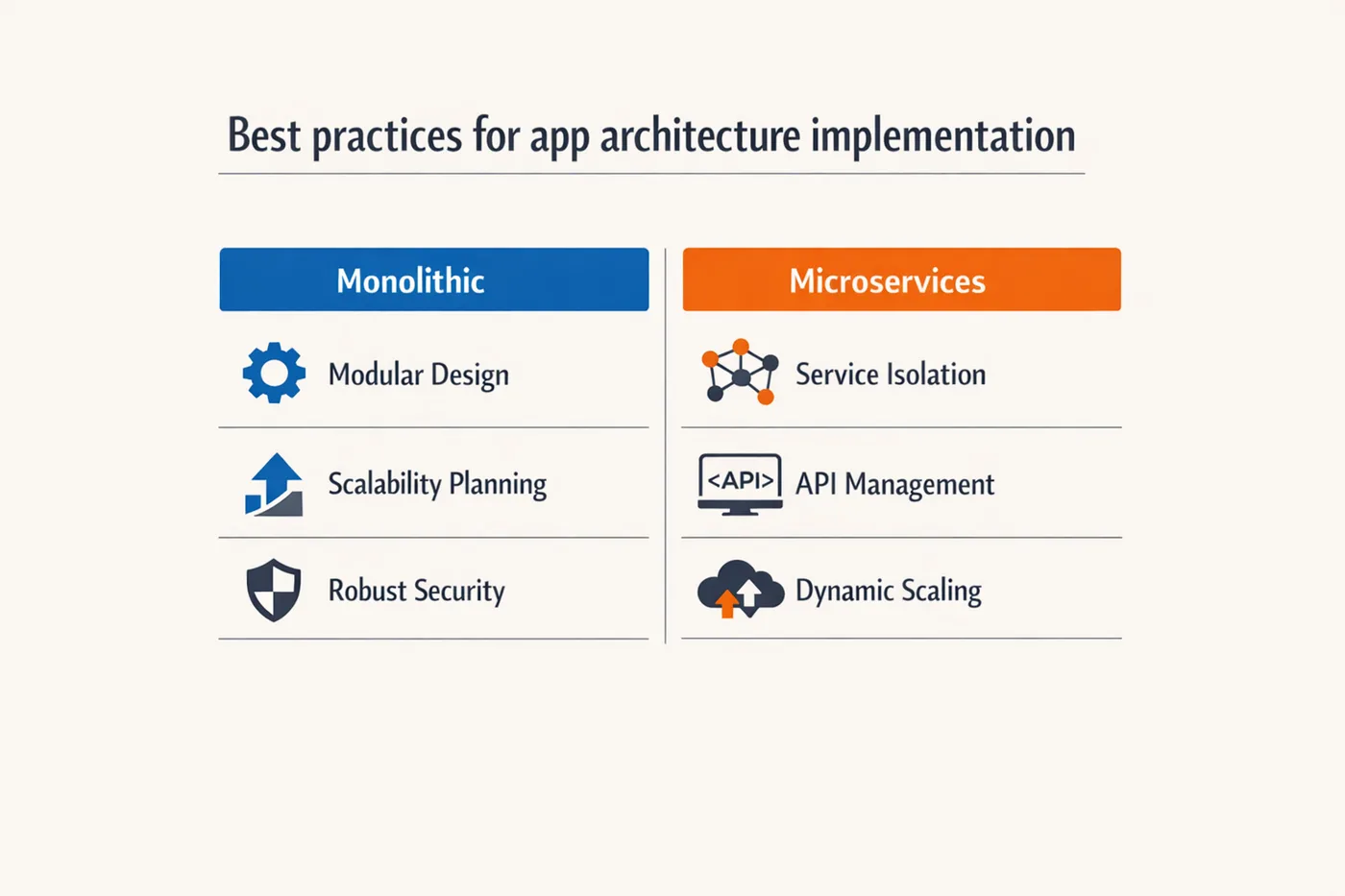
Architecture decisions don't end at choosing Monolithic vs Microservices. Implementation determines whether your choice pays off or becomes technical debt.
Plan Trust Boundaries During Design
Define trust boundaries before writing code. Enumerate user types, exposed resources, and permitted operations for each combination. A customer portal user needs read access to their own orders; a warehouse operator needs write access to inventory updates. Map these explicitly.
For attribute-based systems, consider context beyond role. A sales rep might access customer data from the office network during business hours but not from a home connection at midnight. Document these boundaries in your PRD sections so they survive handoffs.
Implement Defense in Depth
No single framework enforces proper access control alone. Layer your defenses. Use framework-level guards, application-layer checks, and database constraints. If your API gateway fails open, the service layer should still reject unauthorized requests.
Misconfiguration is the most common failure mode. Frameworks ship with general-purpose defaults that assume you'll customize them. Read the security configuration guide for every library you adopt. Subscribe to vulnerability feeds and run dependency checks in CI.
Even robust, popular frameworks contain authorization vulnerabilities — assume any third-party component could be or become compromised.
Choose Modern Tooling That Fits Your Pattern
Monolithic apps benefit from integrated toolchains. Next.js with Tailwind handles UI and backend logic in one deployment. Microservices need orchestration: container registries, service meshes, distributed tracing. Match your tools to your architecture, not the other way around.
For solo founders, the tooling tax matters. A monolith lets you ship with fewer moving parts. Microservices demand more operational muscle but pay off when different services scale independently or when you need to swap out a single component without redeploying everything.
Test Authorization Logic Explicitly
Write tests that verify access control, not just happy paths. Confirm that User A cannot read User B's data. Confirm that expired tokens fail. Confirm that privilege escalation attempts return 403, not 500. These tests catch regressions when you refactor or add features.
In microservices, test inter-service authorization separately. A billing service should reject requests from the marketing service even if both are authenticated. Trust boundaries between services are as critical as boundaries between users and your app.
Conclusion
The Monolithic vs Microservices decision shapes every downstream choice you make — from how fast you ship to how many engineers you need on payroll. A monolith gives you one codebase, one deploy, one place to look when things break. Microservices give you independent deploys and the ability to scale pieces separately, but you pay for that with coordination overhead and distributed-system failure modes.
I've shipped both. The monolith got the first version live in weeks; the microservices version came later when the team grew and the product had real scale problems to solve. Starting monolithic let me focus on product-market fit instead of infrastructure. When the architecture needed to change, the revenue was there to fund the migration.
If you're a solo founder or a small team, start monolithic. Ship fast, learn what users actually need, and defer the complexity tax until you have the revenue and the team to justify it. If you're already at scale with clear service boundaries and independent team ownership, microservices make sense — but only if you can afford the tooling, the monitoring, and the operational discipline they demand.
The right architecture is the one that gets you to the next milestone without burning your runway. Choose based on your team size, your release cadence, and whether you have the capital to run a distributed system correctly. Everything else is just preferences.
For more on planning your first build, see What Is an App Blueprint? Why Founders Need One.
FAQ
What is the main difference between Monolithic vs Microservices?Monolithic architecture packages all application components into a single deployable unit with one codebase and one deployment cycle. Microservices split the application into independent services, each with its own codebase, database, and deployment pipeline.
When should I choose a monolith over microservices?Choose a monolith if you're a solo founder or small team (fewer than 5 engineers), need to ship quickly, lack experience running distributed systems, or are still validating product-market fit. Monoliths minimize operational overhead and let you iterate faster.
When do microservices make sense?Microservices make sense when you have clear service boundaries, multiple teams that need to deploy independently, specific components that require different scaling characteristics, or parts of the system that change at very different rates.
Can I migrate from a monolith to microservices later?Yes. Start with a well-structured monolith that enforces module boundaries. Extract services one at a time when you identify clear bottlenecks—high-traffic endpoints, frequently changing features, or components that need independent scaling. Gradual migration reduces risk.
What are the operational costs of microservices?Microservices require container orchestration (Kubernetes or similar), service discovery, distributed tracing, centralized logging, API gateway management, and inter-service authentication. You also need the team expertise to debug failures across multiple services and manage deployment coordination.
Related reading
Architecture Diagram Guide: Visualizing Your App's Structure