
How Automation Engineers Reduce Your App's Technical Debt
Top takeaways
- Technical debt accumulates when teams prioritize speed over maintainability, creating compounding costs in every future sprint
- Automation engineers reduce technical debt through systematic testing, continuous refactoring, and infrastructure-as-code practices
- The right automation strategy catches regressions early, documents system behavior, and makes refactoring economically viable
- Most technical debt isn't intentional—it's the residue of decisions made under incomplete information
- Automation engineers provide the safety net that lets teams clean up debt without breaking production
Introduction
Automation engineers reduce technical debt by making refactoring safe and measurable. Technical debt is the gap between what your codebase is and what it needs to be to support the next six months of work. Every shortcut, every "we'll fix it later," every undocumented integration adds to the balance. The interest compounds in slower velocity, more bugs, and eventually a rewrite conversation no founder wants to have.
This pattern is common in SaaS development. You ship fast to validate the market, then the prototype becomes the product, and suddenly you're maintaining code that was never meant to last. The question isn't whether you'll accumulate debt—you will. The question is whether you have the systems to pay it down before it chokes your runway.
Automation engineers reduce technical debt by building test suites that catch regressions, automating deployments so fixes ship without drama, and creating feedback loops that surface problems before they metastasize. When you can refactor with confidence, debt becomes manageable. When you can't, it becomes existential.
How Automation Engineers Reduce Technical Debt
The mechanics are straightforward. Automated tests document expected behavior and catch breaks. CI/CD pipelines enforce quality gates before code reaches production. Infrastructure-as-code makes environments reproducible, eliminating "works on my machine" debt. Monitoring and alerting surface performance regressions the day they ship, not three months later when a customer escalates.
This isn't about perfection. It's about creating enough visibility and guard rails that you can make incremental improvements without fear. A good automation engineer doesn't eliminate technical debt—they make it visible, quantifiable, and addressable within normal sprint work. That's the difference between debt that grows and debt that shrinks.
For founders working through their first app development plan, understanding how automation engineers operate is the difference between a codebase that scales and one that collapses under its own weight. The investment in automation infrastructure pays for itself the first time you ship a major refactor without a production incident.
Understanding Technical Debt
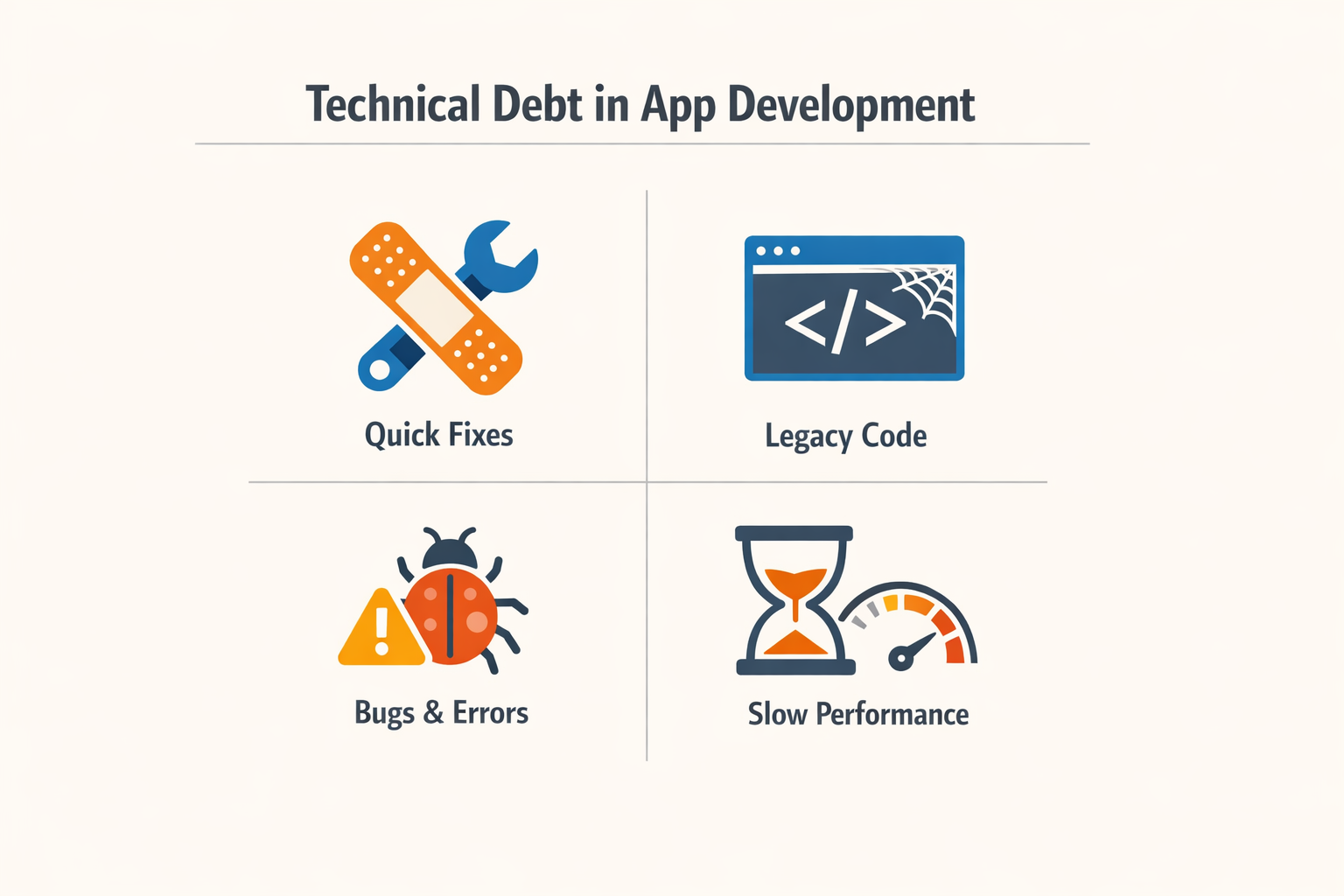
Technical debt is the gap between what your code should be and what it is. Every shortcut, every "we'll fix it later," every workaround that ships because the deadline is Thursday — that's debt. It accrues interest. The longer it sits, the harder it gets to change anything without breaking something else.
Most founders see technical debt as a necessary evil of moving fast. That's half right. Speed creates debt, but so does ignorance. When you don't know what good code looks like, you can't tell the difference between a tactical shortcut and a structural mistake. Both slow you down eventually, but one you planned for and one you didn't.
The Real Cost of Technical Debt
Technical debt shows up in three places: velocity, reliability, and onboarding. Your team takes longer to ship features because they're navigating around old decisions. Your app breaks in ways that surprise you because the code is brittle. New engineers take weeks to understand what should be simple because the architecture doesn't match the docs.
The hidden cost is optionality. When your codebase is fragile, you can't pivot. You can't test new ideas quickly. You're stuck maintaining what you have instead of building what you need. For a solo founder or small team, that's the difference between iterating toward product-market fit and being trapped in maintenance mode.
Where Technical Debt Comes From
Debt accumulates in predictable ways. Duplicated logic across files. Hard-coded values that should be config. Tests that don't exist or don't run. Dependencies that haven't been updated in two years. Code that works but nobody understands why.
AI-generated code adds a new vector. An agent can produce code that compiles, passes your tests, and still be wrong. It might miss edge cases. It might duplicate logic that already exists somewhere else in your codebase. It might follow patterns that look right but create security holes.
The problem isn't the tool — it's the review process. If you don't know what to look for, you can't catch the subtle errors. If you're moving fast and trusting the output because it looks clean, you're building debt you don't know you have. When you discover it later, it's expensive to fix because other code now depends on it.
Technical Debt vs. Strategic Trade-offs
Not all imperfect code is debt. Sometimes you ship something quick because the alternative is not shipping at all. That's a trade-off. You know what you're doing, you document it, and you plan to revisit it. Technical debt is what happens when you don't do those three things.
The distinction matters because it changes how you manage it. Strategic trade-offs are tracked, prioritized, and addressed when the time is right. Technical debt is discovered, debugged, and fixed under pressure when it finally breaks something important. One is planned. The other is a surprise.
For more on planning these trade-offs early, see App Development Plan: Dev Plan Guide for Non-Technical Founders (2025).
How Do Automation Engineers Reduce Technical Debt?
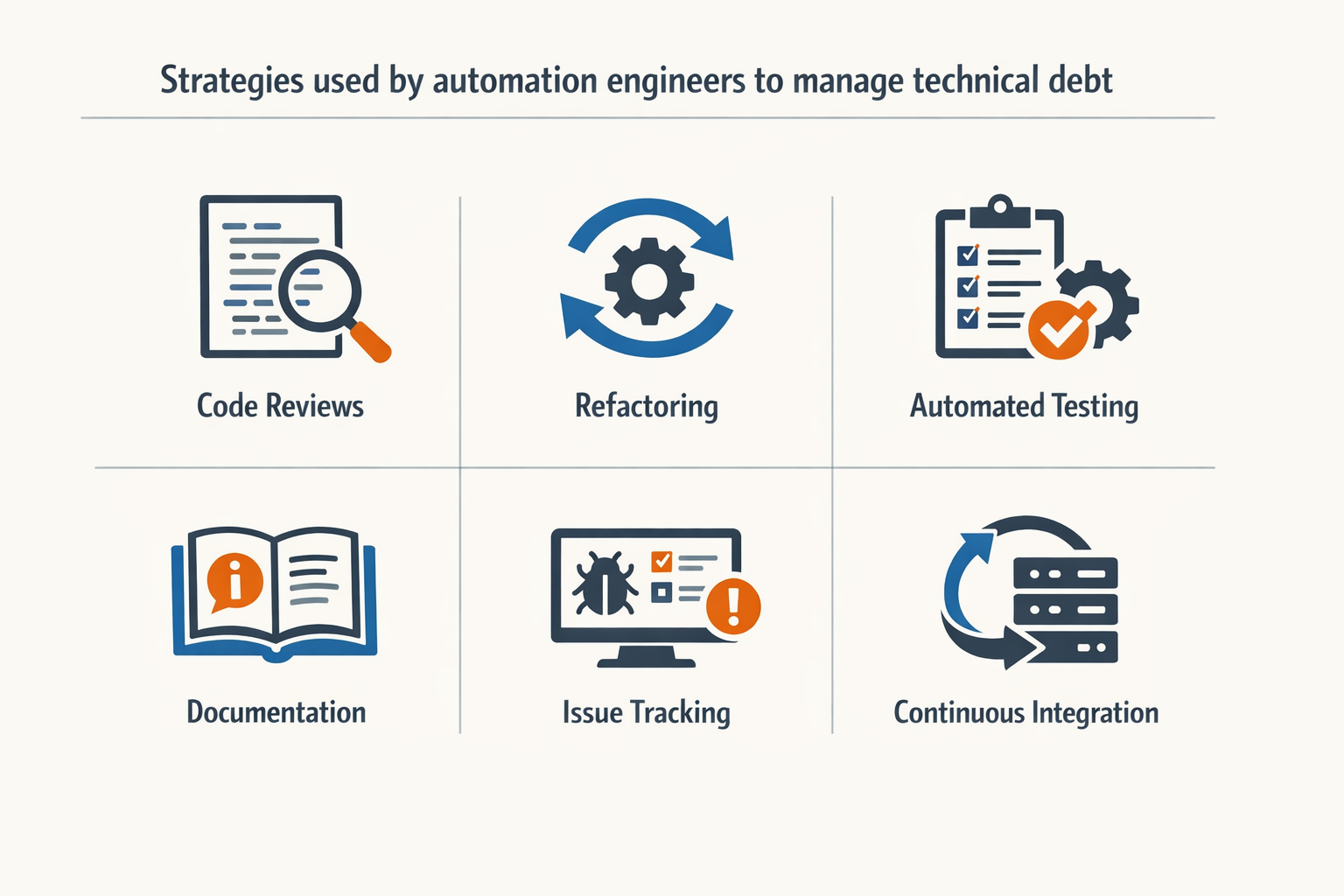
Automation engineers reduce technical debt by enforcing constraints that make bad patterns harder to introduce than good ones. The strategies that work are structural — they change what gets reviewed, how code enters the codebase, and which risks get caught before they compound.
Break Changes Into Reviewable Units
Large code changes are where technical debt hides. When a pull request touches dozens of files, edge cases slip through and duplicated logic goes unnoticed. Automation engineers reduce technical debt by breaking changes into smaller pieces that are easier to review — both for humans and for agents. Smaller diffs surface problems early, when fixing them is cheap.
Set a hard line on how many files or lines a single PR can touch. When a change exceeds that threshold, split it into sequential merges. Each piece should compile and pass tests independently.
Coding agents can produce a lot of code, and that also means they can produce tech debt. Moving fast is great, but you want to keep your quality bar high. Your standards for what gets merged should be the same whether the code was written by hand or by an agent. Run automated checks for duplicated logic, missing error handling, and deviations from existing patterns before the PR reaches a human reviewer.
AI-generated code can look correct but be subtly wrong. It might follow existing patterns, compile, and pass tests you wrote, but still miss edge cases, have security issues, or duplicate logic that exists somewhere else in your codebase. Tag agent-written code in the PR description so reviewers know to check for these failure modes.
Prevent Security Debt During Development
Security vulnerabilities are technical debt with teeth. The longer they sit in the codebase, the more expensive they become to fix. Automation engineers reduce this class of debt by running scans before code reaches production.
Lovable helps reduce common application security risks during development and before publishing by preventing common security mistakes and identifying potential vulnerabilities through automated analysis. Quick scans catch dependency issues and configuration problems. Deep scans review application code for logic-specific risks like access control bypasses and injection points. Both run before you publish, when fixing findings costs minutes instead of days.
Use Structural Patterns That Resist Debt
The best way automation engineers reduce technical debt is by making risky patterns impossible to write. Parameterized queries prevent SQL injection. ORMs enforce schema constraints. Type systems catch mismatched data before runtime. These aren't optional enhancements — they're the foundation.
Applications should be built or re-written using parameterized queries, stored procedures, or an Object Relational Mapper (ORM) to reduce technical debt. Starting from the ground up to determine access rights for application accounts is more effective than trying to remove excessive rights later. When you design permissions correctly the first time, you don't accumulate the debt of overprivileged roles scattered across your infrastructure.
Automate What You Can Measure
Automation engineers reduce technical debt by turning subjective judgments into measurable checks. Code coverage, cyclomatic complexity, dependency freshness — if you can quantify it, you can gate on it. Set thresholds that block merges when metrics regress. The CI pipeline becomes a ratchet: quality can improve, but it can't slide backward without an explicit override.
For a structured approach to planning these automations, see App Development Plan: Dev Plan Guide for Non-Technical Founders (2025).
The best automation catches mistakes before they become archaeology.
What Tools Do Automation Engineers Use to Reduce Technical Debt?
Run Deep Scans Before Every Deploy
Quick scans catch surface-level issues. Deep scans review your application logic, permissions, and data flow. The Deep scan identifies access control problems, unauthenticated endpoints, unsafe input handling, leaked secrets, and payment logic vulnerabilities that basic checks miss. Run it before you publish.
Automate Security Fixes During Development
Automated security tools work best when you use them continuously, not just before launch. Lovable's automated security scanners and remediation tools let you fix findings as you build. Free automated fixes handle common patterns without consuming build credits. Use them to address issues the moment scans flag them.
Run Quick scan or Deep scan in the Security view while you're still iterating. Findings are cheaper to fix when the code is fresh in your head.
Use Try to fix all or fix individual findings from the Security view. The first 10 fixes per 24 hours are free and shared across all your projects.
Inspect findings grouped by security area. Understand severity and review the evidence before deciding to fix or ignore.
Understand What Automation Cannot Replace
Automated tools identify common security issues. They do not guarantee complete security. If your app handles sensitive data or performs critical functions, you need a professional security review. Automation helps you ship faster, but it does not replace judgment. Know the difference.
Automated scans surface patterns; humans decide whether those patterns matter in context.
Track Dependency Vulnerabilities Separately
The Security view shows dependency vulnerabilities alongside application code findings. Dependencies introduce technical debt when you ignore their update cycles. Review dependency issues in the same workflow as your code issues. Address both before they compound.
Integrate Security Checks Into Your Build Process
Security tooling works when it's part of the workflow, not bolted on afterward. If you're building with vibe coding examples, automated scans let you catch issues without deep security expertise. Run scans before every publish. Fix findings before they reach production. Treat security checks the same way you treat build errors.
When planning your product spec vs PRD, include automation requirements from the start. The earlier you integrate automated checks, the less debt you accumulate. For detailed guidance on structuring these requirements, review PRD sections explained.
Conclusion
Automation engineers reduce technical debt by building systems that catch problems before they compound. The tools and practices covered here — automated testing, continuous refactoring, dependency monitoring, and deployment pipelines — turn one-time fixes into repeatable processes. When you automate the grunt work, you free up cycles to ship features instead of firefighting legacy code.
Solo founders often ship MVPs fast, then hit a wall when the prototype becomes the product. The debt piles up in silence: brittle tests, manual deploys, dependencies three years stale. An automation engineer doesn't rewrite your app; they instrument it so you know what breaks, when, and why. That visibility is the difference between controlled growth and a codebase you're afraid to touch.
The ROI is simple. Every hour you spend debugging production could have been an hour building the next feature. Every sprint blocked by a flaky deploy could have been a sprint iterating on user feedback. Automation engineers reduce technical debt by making the invisible visible and the manual automatic. If you're planning your next build or trying to scale what you've already shipped, start with the app development plan that includes automation from day one.
Technical debt isn't optional. How you manage it is.
FAQ
How do automation engineers reduce technical debt in legacy systems?
Automation engineers reduce technical debt in legacy systems by first adding characterization tests that document existing behavior, then incrementally refactoring sections covered by those tests. They prioritize the code paths that change most frequently, so the ROI is immediate.
What's the difference between technical debt and bugs?
Bugs are unintended behavior that breaks current functionality. Technical debt is code that works today but makes future changes harder or riskier. Automation engineers reduce technical debt by creating test coverage that lets you fix both safely.
Can automation engineers reduce technical debt without slowing feature development?
Yes. Automation engineers reduce technical debt by embedding quality checks into the existing development workflow—automated tests run on every commit, scans happen before every deploy. The work happens in parallel with feature development, not instead of it.
How long does it take automation engineers to reduce technical debt significantly?
Timeline depends on debt volume and team size. Most teams see measurable improvements within 4-6 weeks once automation engineers establish baseline test coverage and CI/CD pipelines. Automation engineers reduce technical debt incrementally, sprint by sprint.
Do automation engineers reduce technical debt faster than manual code reviews?
Automation engineers reduce technical debt faster because automated checks run on every change, catching issues immediately. Manual reviews happen once per PR and miss patterns that span multiple files. The combination of both is most effective.