Product Spec vs PRD: What's the Key Difference?
Introduction
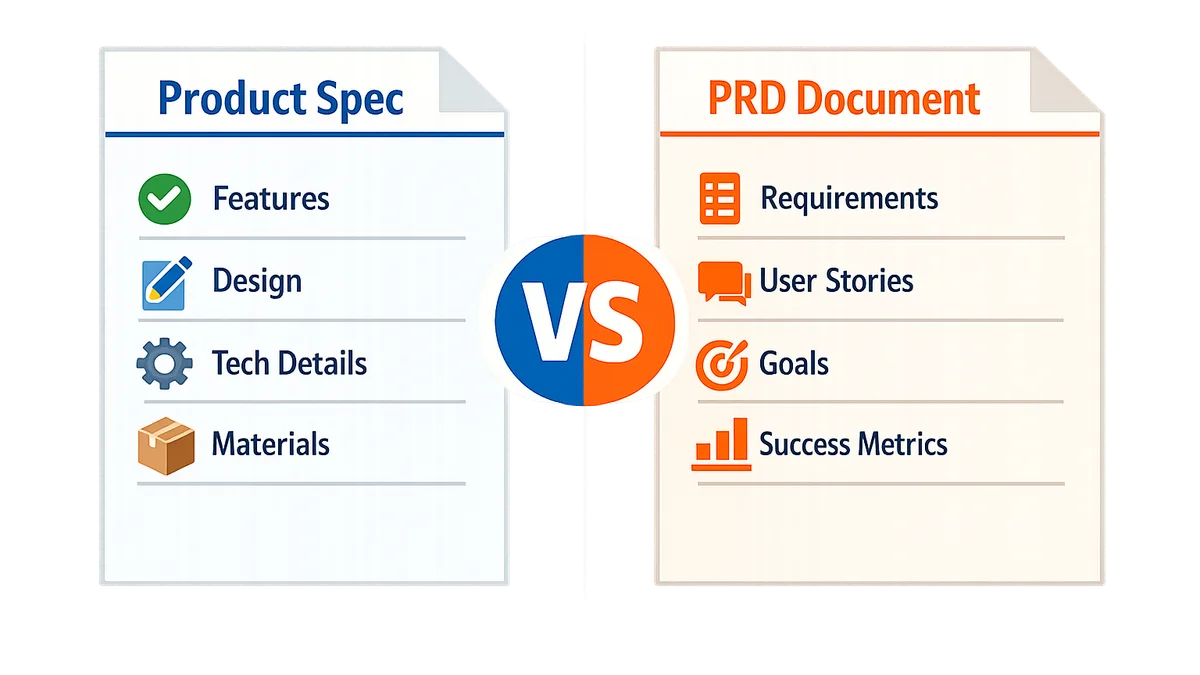
Product Spec vs PRD is not a subtle distinction. One tells you what to build and why. The other tells you how to build it. Mix them up and your team wastes time building the wrong thing or arguing over scope.
I've written both as a solo founder. Early on, I conflated them. I'd dump technical constraints into a requirements doc, then wonder why engineers kept asking "but what does the user actually need?" The reverse happened too—vague product goals in a technical spec meant rework when reality hit.
The confusion is common because both documents plan work. But they operate at different altitudes. A PRD (Product Requirements Document) answers strategic questions: who needs this, what problem does it solve, how do we measure success. A Product Spec answers tactical ones: which APIs, what data model, how does the system behave under load.
This guide breaks down the practical differences. You'll see when each document matters, what goes in each, and how they work together without overlap.
Problem Statement
You're staring at two documents with overlapping content and nobody can tell you which one you actually need. One team calls it a Product Spec. Another insists it's a PRD. The engineering lead wants "technical requirements," the PM wants "user stories," and you're left wondering if these are different names for the same thing or if you're missing a step.
The confusion compounds when you try to hand off work. A vague spec means the developer builds the wrong thing. A PRD that skips implementation details means engineering stops mid-sprint to ask clarifying questions. Both documents claim to define "what we're building," but they operate at different altitudes and serve different readers.
When the Wrong Document Costs You
I've seen founders write a single 3-page "spec" and hand it to an AI coding tool, only to get back a half-functional prototype that technically matches the words but misses the intent. The tool built what was written, not what was needed. The gap between a high-level product vision and executable technical instructions is where most vibe-coding projects stall out.
The inverse problem hits larger teams: a 40-page PRD with user flows, success metrics, and competitive analysis lands on an engineer's desk with no clear "build this component first" guidance. The engineer wants a PRD for Cursor that maps directly to implementation steps, not a strategy document.
The cheapest fix is the one you catch in the plan, not the one you patch after the build.
Most teams don't have a naming problem—they have a scoping problem. They conflate "what the product does for users" with "how the system implements that behavior." A Product Spec answers the first question. A PRD bridges both, but leans toward the second. When you use the wrong document at the wrong stage, you either under-specify for builders or over-specify for stakeholders, and both paths lead to rework.
Product Spec vs PRD: How to Choose the Right Document
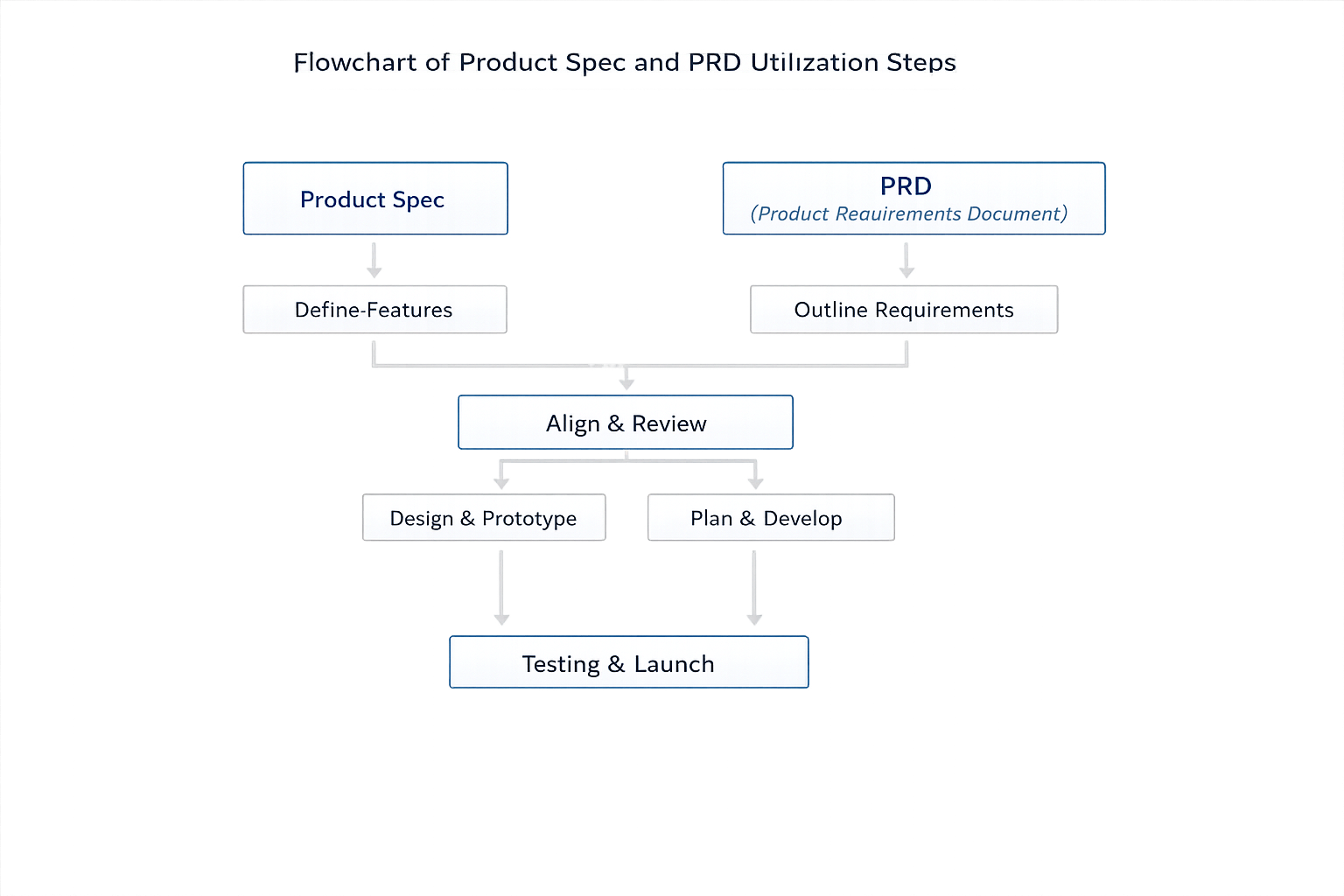
Differentiating between a Product Spec and a PRD isn't academic — it's operational. Each document serves a distinct phase in product development, and using the wrong one at the wrong time creates rework. Follow these steps to clarify which document you need and how to deploy it.
Step 1: Identify Your Current Phase
Step 1
Determine where you are in the product lifecycle
Before you write anything, ask: are you defining what to build or how to build it? If stakeholders are still debating feature priority or business value, you're in PRD territory. If engineers need implementation details for an agreed feature, you need a Product Spec.
The PRD answers strategic questions — why this feature exists, who it serves, what success looks like. The Product Spec answers tactical questions — which API endpoints, what data models, how error states render. If you're unclear on requirements, explore before committing to scope.
Step 2: Draft the PRD First
Step 2
Write the PRD to align stakeholders
Start with the PRD even if you're solo. List the problem, the user, the success metric, and the acceptance criteria. Keep it to two pages. This forces you to articulate why before you get lost in how.
A PRD is a forcing function. If you can't explain the feature's value in plain language, the spec won't save you. I've written PRDs for one-person projects and caught scope creep in my own head before a line of code shipped.
Step 3: Convert PRD Decisions Into Product Spec Details
Step 3
Translate requirements into technical specifications
Once the PRD is approved, extract the technical implications. Each user story becomes a spec section. Each acceptance criterion becomes a testable condition. The Product Spec inherits the PRD's scope but adds schema definitions, endpoint contracts, and UI states.
The spec is where "users can filter by date" becomes "GET /api/items?start_date=YYYY-MM-DD&end_date=YYYY-MM-DD returns JSON array sorted ascending by created_at." The PRD gave you permission to build it; the spec tells the build tool what to generate.
Step 4: Maintain Both Documents Separately
Step 4
Keep PRD and Product Spec in sync but distinct
When requirements change, update the PRD first. Then cascade changes to the Product Spec. Never edit the spec directly and assume the PRD will catch up — that's how you ship features nobody wanted.
Different teams consume these documents differently. Product and business stakeholders read the PRD. Engineers and QA read the spec. Merging them creates a document nobody trusts. Keep them separate, link them explicitly, and version them together.
Step 5: Use the Right Document at Each Handoff
Step 5
Match the document to the audience and decision point
Show the PRD during kickoff and feature review. Hand the Product Spec to engineers at sprint planning. Use the PRD to justify roadmap priority. Use the spec to estimate story points and write test cases.
The PRD is your contract with stakeholders; the Product Spec is your contract with the compiler.
If a stakeholder asks "why are we building this?" point to the PRD. If an engineer asks "what does this button do when the API times out?" point to the spec. Using the wrong document wastes time and erodes trust in both.
Tips and Tricks
Creating effective Product Specs and PRDs requires discipline. The difference between a document that ships and one that collects dust is specificity.
Write for the reader who skims
Most people scan headers and bullet points. Front-load decisions. If someone reads only your headings and the first sentence of each section, they should know what you're building and why. Dense paragraphs bury the lead.
Scope the plan before you build
For larger changes, spend extra time creating a precise, well-scoped plan. Vague requirements produce vague implementations. When I write a PRD for an AI coding tool, I list every screen state, every error condition, and every edge case I can think of. The more specific the input, the less rework later. How to Vibe Code: A Step-by-Step Workflow Guide shows how detailed planning reduces iteration cycles when working with AI tools.
Standardize your document structure
Standardizing and centralizing your approach to specs and PRDs makes them easier to maintain and reference during incidents or handoffs. Use the same section headings across all documents. When a developer opens a PRD, they should know exactly where to find acceptance criteria without scrolling. Consistency reduces cognitive load.
Separate what from how
A PRD describes what the product does and why it matters. A Product Spec describes how it works. If you're writing acceptance criteria that reference database schemas, you've drifted into spec territory. Pull it out into a separate document or section. Keep the PRD focused on user outcomes.
The PRD answers "what problem are we solving?" The spec answers "how do we solve it?"
Version your documents
Every time you change scope, increment the version number and note what changed. When a stakeholder asks why a feature shipped differently than expected, you can point to version 1.3 where the requirement was updated. Versioning creates an audit trail. It also forces you to acknowledge when you're changing direction mid-flight.
Test your spec by building from it
The best validation for a Product Spec is handing it to someone who wasn't in the planning meetings and seeing if they can build the feature. If they come back with ten clarifying questions, your spec wasn't clear enough. Rewrite it. A good spec should be executable without a Slack thread.
For a deeper dive into writing PRDs that work with AI coding tools, see PRD for Cursor: The Ultimate Guide to Stress-Free AI Specs.
Keep a decision log
Every time you make a tradeoff—cutting a feature, choosing one approach over another, deferring a requirement—write it down in the document. Future you will forget why you made that call. Future teammates never knew. A decision log in the PRD or spec saves hours of re-litigating settled questions.
Conclusion
Product Spec vs PRD isn't about picking sides. It's about knowing which document solves the problem in front of you. A product spec locks down the what and how before anyone writes code. A PRD frames the why and the who before anyone commits to building.
I've watched solo founders burn weeks building features nobody asked for because they skipped the PRD. I've also seen teams argue in circles during implementation because the spec was vague. Both documents exist to prevent different flavors of waste.
Use a PRD when you need alignment on vision, user problems, and success metrics. Use a product spec when you need developers to build the right thing without constant clarification. In practice, you'll often need both — the PRD first to justify the work, the spec second to execute it cleanly.
The moment you treat these documents as bureaucracy instead of tools, they stop working. Keep them short, concrete, and tied to decisions you actually need to make. If a section doesn't change how someone works, delete it.
For a deeper look at how PRDs fit into the full product development cycle, see What Is a PRD? Product Requirements Documents, Explained. If you're comparing multiple document types, PRD vs BRD vs MRD: The Ultimate Simple Decoder Guide clarifies when each serves your team best.
Frequently asked questions
What is the main difference between Product Spec vs PRD?
A PRD defines what to build and why — the user problem, business goals, and success metrics. A Product Spec defines how to build it — the technical implementation, APIs, data models, and system behavior. The PRD is strategic; the Product Spec is tactical.
When should I write a PRD instead of a Product Spec?
Write a PRD when you need stakeholder alignment on feature priority, user needs, or business value. Write a Product Spec when engineers need implementation details for an already-approved feature. In most cases, the PRD comes first to justify the work, then the Product Spec guides execution.
Can I combine Product Spec vs PRD into one document?
You can, but it creates confusion. Product and business stakeholders need the PRD's strategic context. Engineers and QA need the Product Spec's technical detail. Merging them forces both audiences to wade through irrelevant information. Keep them separate, link them explicitly, and version them together.
How detailed should a Product Spec be compared to a PRD?
A PRD should be 2-4 pages of high-level requirements, user stories, and success criteria. A Product Spec should be detailed enough that a developer who wasn't in planning meetings can build the feature without asking clarifying questions. Include API contracts, schema definitions, error states, and edge cases.
Do I need both documents for small projects?
Even solo founders benefit from writing a lightweight PRD to clarify why before diving into how. I've caught scope creep in my own head by forcing myself to articulate the user problem in plain language before writing a single line of code. For AI-assisted development, a clear Product Spec prevents the tool from building the wrong thing.