
Product Spec vs PRD: Key Differences Explained
Top takeaways
- Product specs and PRDs serve different purposes in the development cycle
- Understanding the distinction prevents scope creep and miscommunication
- Each document targets different stakeholders with different information needs
- Choosing the wrong format costs time in rework and alignment meetings
- Clear documentation reduces build failures and wasted sprints
Introduction
You sit down to plan a feature. Someone asks for a product spec. Someone else wants a PRD. You wonder if they mean the same thing.
They don't. Product spec vs PRD is a distinction that burns hours in misaligned builds and rework loops. I've shipped features with both document types. The difference matters when you're trying to move from idea to working code without rebuilding twice.
A product spec typically describes what the product does—features, behavior, constraints. A PRD (Product Requirements Document) explains why you're building it, who needs it, and what success looks like. One is a blueprint for engineers. The other is a strategic brief for the team. Use the wrong one and your developer builds the right thing for the wrong reason, or the wrong thing entirely.
Most teams treat them as interchangeable until a feature ships that meets the spec but misses the user need. That gap is expensive. Understanding when to write each document—and what goes in it—cuts down on clarifying questions, scope drift, and post-launch surprises. Learn more about planning workflows in Cursor Vibe Coding: From Idea to Working App.
This guide walks through the practical differences, when to use each, and how to avoid the traps that waste your build budget.
What Is the Product Spec vs PRD Confusion Costing Your Team?
Teams use "product spec" and "PRD" interchangeably. They're not the same document. The confusion costs time — engineers wait for details that live in a different file, PMs duplicate work across two docs, and stakeholders argue about which one is canonical.
The mix-up happens because both documents describe what you're building. A product spec might detail API endpoints and data schemas. A PRD outlines user problems and success metrics. When you call both "the spec," nobody knows which lens you're using.
The Cost of Unclear Requirements
Unclear requirements force teams to explore scope mid-build. You start coding, hit an edge case, and realize the document doesn't answer it. Now you're context-switching between Slack, the doc, and your IDE. The work stalls. Research from the Project Management Institute shows that poor requirements account for 47% of project failures, with rework consuming 30-50% of total development costs.
This pattern repeats when the planning artifact doesn't match the task. A technical spec without user context leaves engineers guessing at intent. A PRD without implementation constraints lets PMs promise features that triple the timeline. Both gaps create the same symptom: rework.
What Happens When You Skip the Distinction
You end up with a 40-page hybrid doc. The first half reads like a PRD: market context, user stories, success metrics. The second half is a technical spec: database schemas, API contracts, error states. Engineers skip to page 20. PMs never read past page 15. Nobody owns the middle.
Or you write a thin PRD, call it done, and engineers immediately ask for a spec. Now you're writing two docs anyway, but the second one is rushed and inconsistent with the first. The vibe-coding workflow fails when the agent gets conflicting instructions from overlapping docs.
The fix isn't writing better docs. It's writing the right doc for the phase you're in, then knowing when to write the next one.
How Do Product Spec vs PRD Documents Differ in Practice?
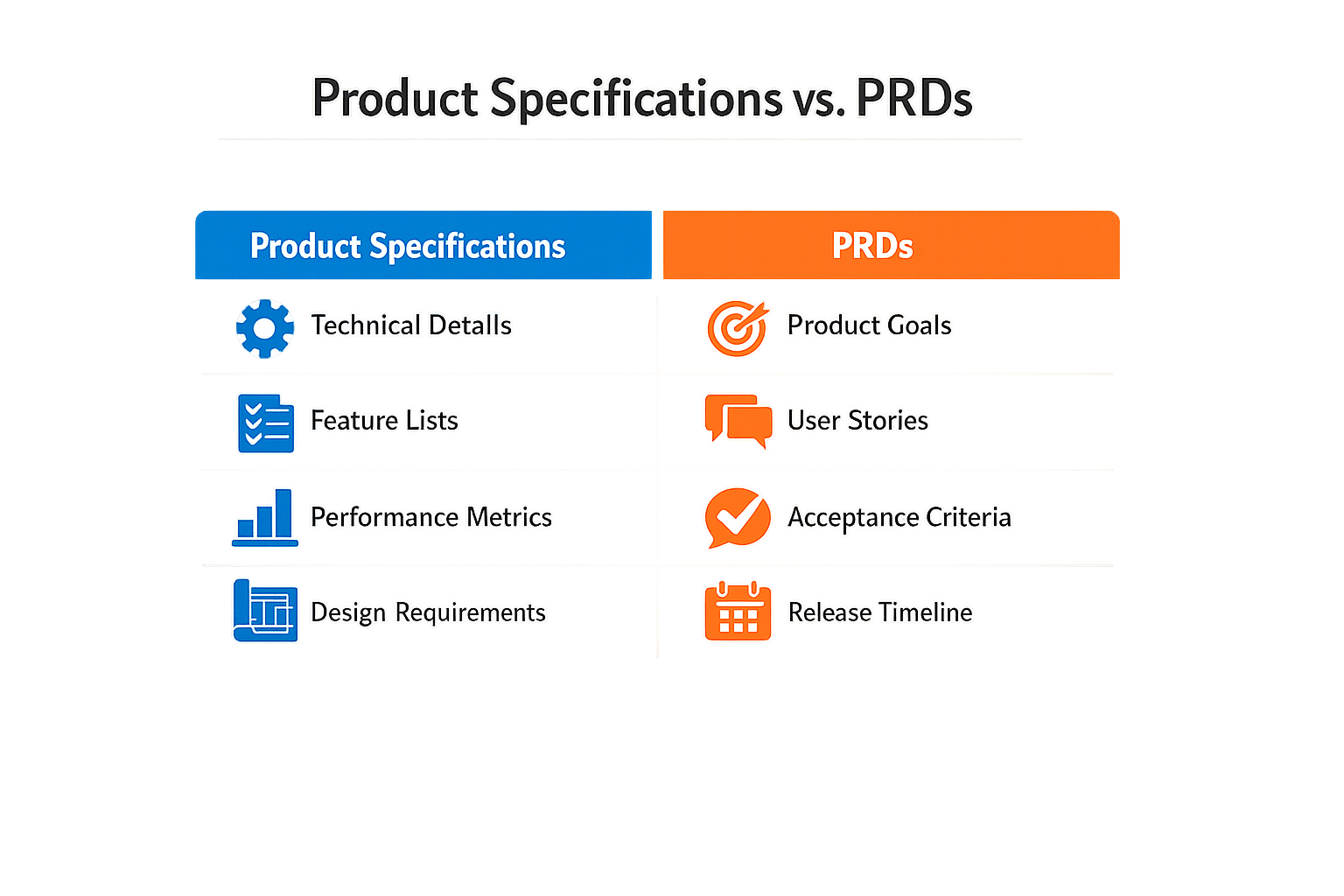
The difference between a product spec and a PRD comes down to scope and audience. A product spec describes what you're building — features, behaviors, technical constraints. A PRD describes why you're building it and what success looks like.
Product Spec: The Blueprint
A product spec is the technical blueprint. It lists features, user flows, edge cases, and implementation details. Engineers read it to understand what to build. Designers read it to understand what to design.
Specs answer: What does this button do? What happens when the user hits submit? What's the validation logic? They're precise, narrow, and focused on behavior.
Step 1
Start with feature boundaries
Define the exact scope of what you're building. List every screen, interaction, and state change. No hand-waving — if you can't describe it in concrete terms, you can't spec it.
Step 2
Document edge cases and error states
Write down what happens when things go wrong. Network failure, invalid input, empty states. Engineers need these spelled out or they'll make assumptions you don't want.
Step 3
Include technical constraints early
Call out performance requirements, browser support, API limits. Better to surface these in the spec than discover them mid-build.
PRD: The Strategy Document
A PRD is the strategy document. It explains the problem you're solving, the user you're solving it for, and how you'll measure success. Product managers write it. Stakeholders read it to decide whether to fund the work.
PRDs answer: Why does this matter? Who asked for it? What metrics will move? They're broad, context-heavy, and focused on outcomes.
| Aspect | Product Spec | PRD |
|---|---|---|
| Purpose | Define implementation details | Define problem and success criteria |
| Audience | Engineers, designers | Stakeholders, product team |
| Focus | What and how | Why and who |
| Precision | High technical detail | High strategic context |
| Length | 5–20 pages typical | 2–10 pages typical |
When You Need Both
Small projects can collapse both into one document. Larger initiatives need both — the PRD to get buy-in, the spec to guide execution.
If you're using AI tools like Cursor for vibe coding, the spec becomes even more critical. The agent needs explicit instructions. Vague requirements produce vague code. For cost planning around these workflows, see how much it costs to vibe-code an app.
The PRD sets direction. The spec removes ambiguity. Both serve the same goal: shipping something users want that actually works.
Tips and Tricks
Creating effective product specs and PRDs requires practice. These techniques reduce rework and keep teams aligned.
Start with scope constraints
Define what you won't build before listing what you will. A PRD that says "mobile app with user profiles" is vague. One that says "iOS only, no Android; profiles limited to name, email, avatar" gives engineers boundaries. Constraints prevent scope drift.
For product specs, declare technical non-negotiables early. If you need sub-200ms API response times or must integrate with a legacy system, state it in the first section. Engineers price unknowns into their estimates; clarity saves buffer.
Refine plans when output misses the mark
When a build doesn't match expectations, revert and fix the plan rather than patching the result. This applies to PRDs and specs alike. If your spec produced the wrong component library choice, the problem lives in the requirements — not in the code. Go back, add precision, run again. Learn more about why vibe-coded apps break and how to fix them.
For larger changes, spend extra time creating a precise, well-scoped plan. Vague requirements force exploration cycles that burn days. A tight spec with clear acceptance criteria closes the loop in one pass.
Use templates but customize them
PRD templates exist for a reason — they remind you to cover user stories, success metrics, and edge cases. Product spec templates ensure you document APIs, data models, and deployment steps. But templates are scaffolding, not scripture.
Strip sections that don't apply. A three-feature MVP doesn't need a phased rollout plan. A backend spec for a cron job doesn't need UI wireframes. Tailor the structure to the problem size.
Version your documents and track changes
PRDs evolve as you learn from users. Product specs change when you discover a library doesn't support a required feature. Save plans to your workspace for future reference and team sharing. Versioned documents create an audit trail that explains why decisions were made.
When a stakeholder asks "why did we drop that feature," you point to PRD v2.3 with the rationale. When an engineer asks "why this database," the spec shows the comparison table from two months ago.
Link specs to PRDs explicitly
Every product spec should reference the PRD section it implements. Every PRD should list which specs cover its requirements. This two-way link catches gaps. If a PRD user story has no corresponding spec, you found missing work. If a spec has no PRD justification, you might be building the wrong thing.
For vibe-coding workflows, this linkage matters even more — AI agents need clear pointers to context. Understanding these fundamentals helps whether you're choosing between Cursor vs Claude Code or planning security checks for non-technical founders.
Conclusion
The product spec vs PRD distinction matters because each document serves a different moment in the build cycle. PRDs define what you're building and why it matters to users. Product specs translate that vision into concrete implementation details engineers can execute against.
I've shipped features where the PRD was a single paragraph and the spec was twelve pages of API contracts and state machines. I've also seen teams waste weeks building the wrong thing because they skipped the PRD and jumped straight to implementation details. Both documents earn their keep when you use them at the right time.
Most solo founders don't need both on day one. Start with a lightweight PRD that answers the core questions: what problem are you solving, who has it, and how will you know the solution works. Add technical specs when the build gets complex enough that you're losing track of edge cases or when you need to hand work to someone else.
The best product specs and PRDs share one trait: they get shorter and more precise as you learn what actually matters. Your first PRD will be verbose. Your tenth will be a page of hard decisions and open questions. That compression is the point — clarity compounds.
If you're planning your first vibe-coded prototype, understanding these documents helps you structure your prompts and catch scope creep before it derails the build. Learn more about building apps with vibe coding workflows.
FAQ
What is the main difference between a product spec vs PRD?A product spec is a technical blueprint that describes what you're building—features, behaviors, and implementation details. A PRD (Product Requirements Document) is a strategic document that explains why you're building it, who needs it, and what success looks like.
When should I write a PRD vs a product spec?Write a PRD first to establish the problem, user need, and success metrics. Write the product spec after stakeholder buy-in to guide engineering execution with technical details and edge cases.
Can I combine a product spec and PRD into one document?Small projects can combine both, but larger initiatives benefit from separate documents. A hybrid doc often becomes too long, with engineers skipping strategy sections and PMs ignoring technical details.
Do vibe-coding workflows need product specs or PRDs?Vibe-coding with AI tools like Cursor works best with detailed product specs. AI agents need explicit instructions about features, edge cases, and technical constraints to generate reliable code.
How long should a product spec vs PRD be?Product specs typically run 5–20 pages with high technical detail. PRDs are usually 2–10 pages focused on strategic context. Length varies based on project complexity.