
Clean Architecture Principles for Scalable Applications
Top takeaways
- Clean architecture principles separate business logic from frameworks and UI, making applications easier to test and maintain
- Proper layering reduces coupling between components, allowing teams to swap implementations without rewriting core logic
- Applications built with clean architecture scale more predictably because dependencies flow inward toward stable business rules
- Small, focused modules under 200 lines stay readable and prevent technical debt from accumulating in monolithic files
- Separation of concerns at the service and database level minimizes blast radius when things break
Introduction
Clean architecture principles define how you organize code so the parts that change frequently don't break the parts that stay stable. The core idea: business rules sit in the center, frameworks and databases live at the edges, and dependencies point inward.
I've shipped SaaS products where the first version worked fine at 100 users, then fell apart at 1,000 because every feature touched every other feature. Clean architecture prevents that by drawing clear boundaries between what your app does and how it does it. When you need to swap a database, add a new API client, or refactor the UI, you change one layer without touching the others.
Most codebases drift toward chaos because developers optimize for speed today instead of maintainability tomorrow. You add a feature by editing the nearest file, and six months later nobody knows which function owns which responsibility. Clean architecture forces you to decide where each piece of logic belongs before you write it. That friction pays off when you need to build an app that survives contact with real users.
What Clean Architecture Principles Actually Mean
Clean architecture is a set of rules about dependency direction. Outer layers—UI, databases, third-party APIs—depend on inner layers. Inner layers never depend on outer layers. Business logic doesn't import framework code. Domain models don't know what database you're using.
This structure makes testing straightforward. You test business rules without spinning up a database. You test API handlers by mocking the service layer. You replace implementations without rewriting tests.
The architecture works because stable code sits in the middle and volatile code sits at the edges. Your business rules—the logic that defines what your application is—change slowly. Your UI framework, your database vendor, your deployment platform—those change faster. By making the volatile parts depend on the stable parts, you minimize how often core logic needs to be rewritten.
Why Scalability Depends on Architecture
Scalability isn't just about handling more requests per second. It's about adding features without exponentially increasing complexity. Clean architecture makes that possible by isolating changes.
When each service lives in its own file and validates inputs at its boundary, you know exactly where to look when something breaks. When database access is confined to a repository layer, you can optimize queries without touching business logic. When UI components stay under 200 lines and compose instead of prop-drilling, you can refactor the interface without risking the backend.
Applications that ignore these principles hit a wall. Every new feature requires changes in five places. Tests break when you upgrade a library. Developers spend more time debugging interactions than building features. Clean architecture avoids that by making dependencies explicit and one-directional.
Problem Statement
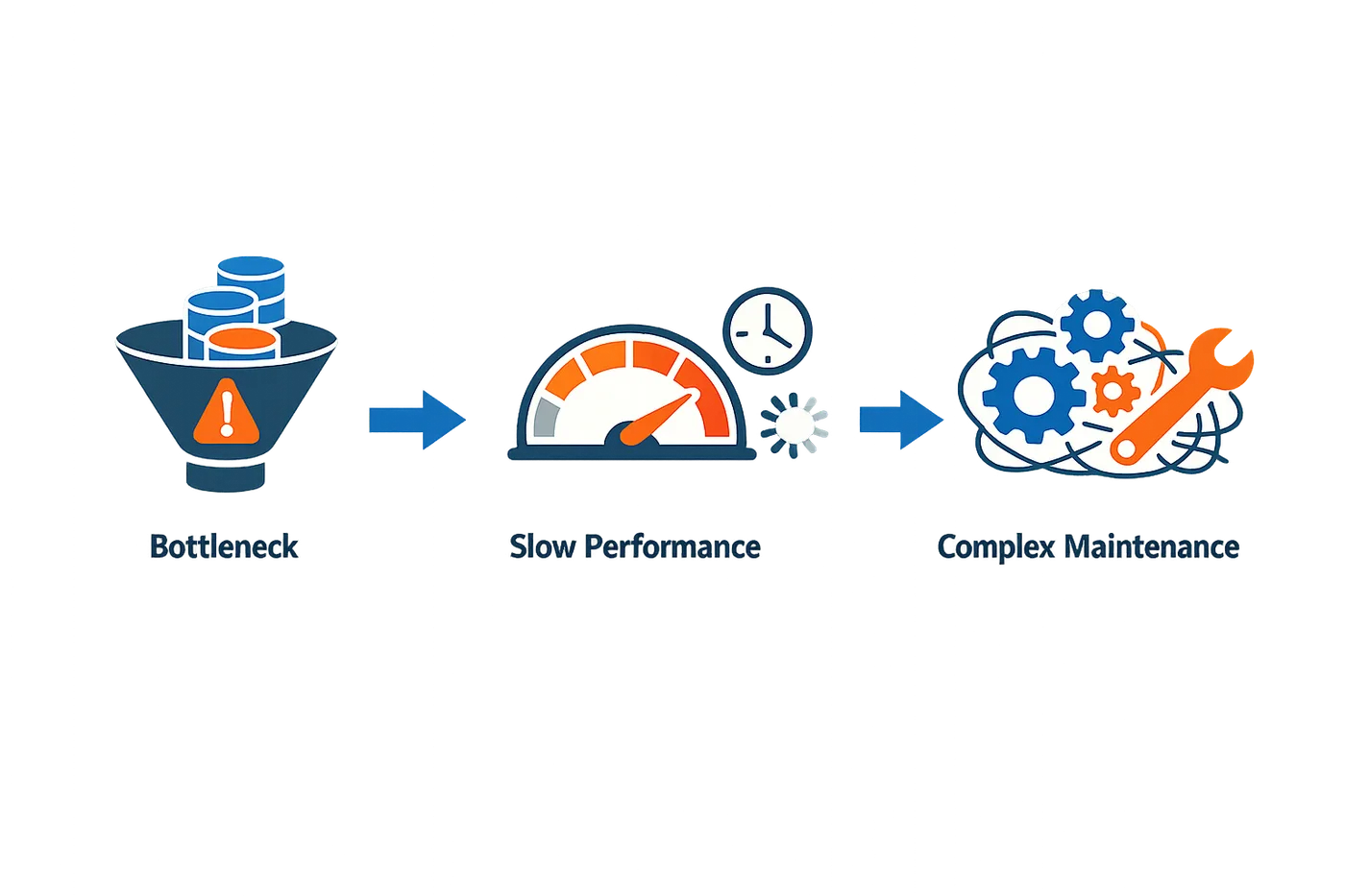
Most applications start with a tight coupling between UI, business logic, and data layers. Components reach across boundaries. A form handler calls the database directly. A button click fires an API request inline. The code works — until it doesn't scale.
When you thread data through multiple layers of components, changes ripple unpredictably. A single field addition touches five files. Testing becomes expensive because every unit test needs a live database or a mocked HTTP client. Swapping out a dependency — say, moving from REST to GraphQL — requires rewriting half the codebase.
Tight Coupling Blocks Growth
Without clear boundaries, every feature adds friction. Business rules leak into UI components. Database schemas dictate API contracts. When roles and permissions logic lives in the same file as rendering logic, you can't test authorization without mounting a component tree.
Multi-tenant systems expose the problem faster. Role-based access control (RBAC) becomes cumbersome when different organizations need access to the same resources. Each new tenant requires custom rule sets, and pre-provisioning identities for cross-organizational requests adds operational overhead that doesn't scale.
Stateful APIs and Workflow Failures
Stateful session management in APIs introduces replay and impersonation risks. When workflow state isn't validated server-side, attackers invoke endpoints out of order — skipping approval steps or bypassing payment flows. Traditional access control checks fail to detect these issues because each endpoint may be individually authenticated but the overall state transition isn't enforced.
Third-party components compound the risk. Even well-maintained libraries can introduce authorization vulnerabilities. A misconfigured framework or a missing validation rule opens a path around your access controls, and the failure mode is silent until an audit or breach surfaces it.
Configuration Drift and Hidden Defaults
General-purpose frameworks ship with defaults that don't match your security requirements. Developers assume the library handles authorization, but the framework expects explicit configuration. The gap between what the tool provides and what the application needs becomes a vulnerability — and it's invisible in code review because nothing is obviously wrong.
When business logic, UI, and data access share the same file, every change becomes a regression risk.
Without architectural boundaries, teams can't work in parallel. Frontend engineers wait for backend changes. Backend engineers can't refactor without coordinating UI updates. The entire system moves at the speed of its most tangled dependency.
Solution Steps for Implementing Clean Architecture
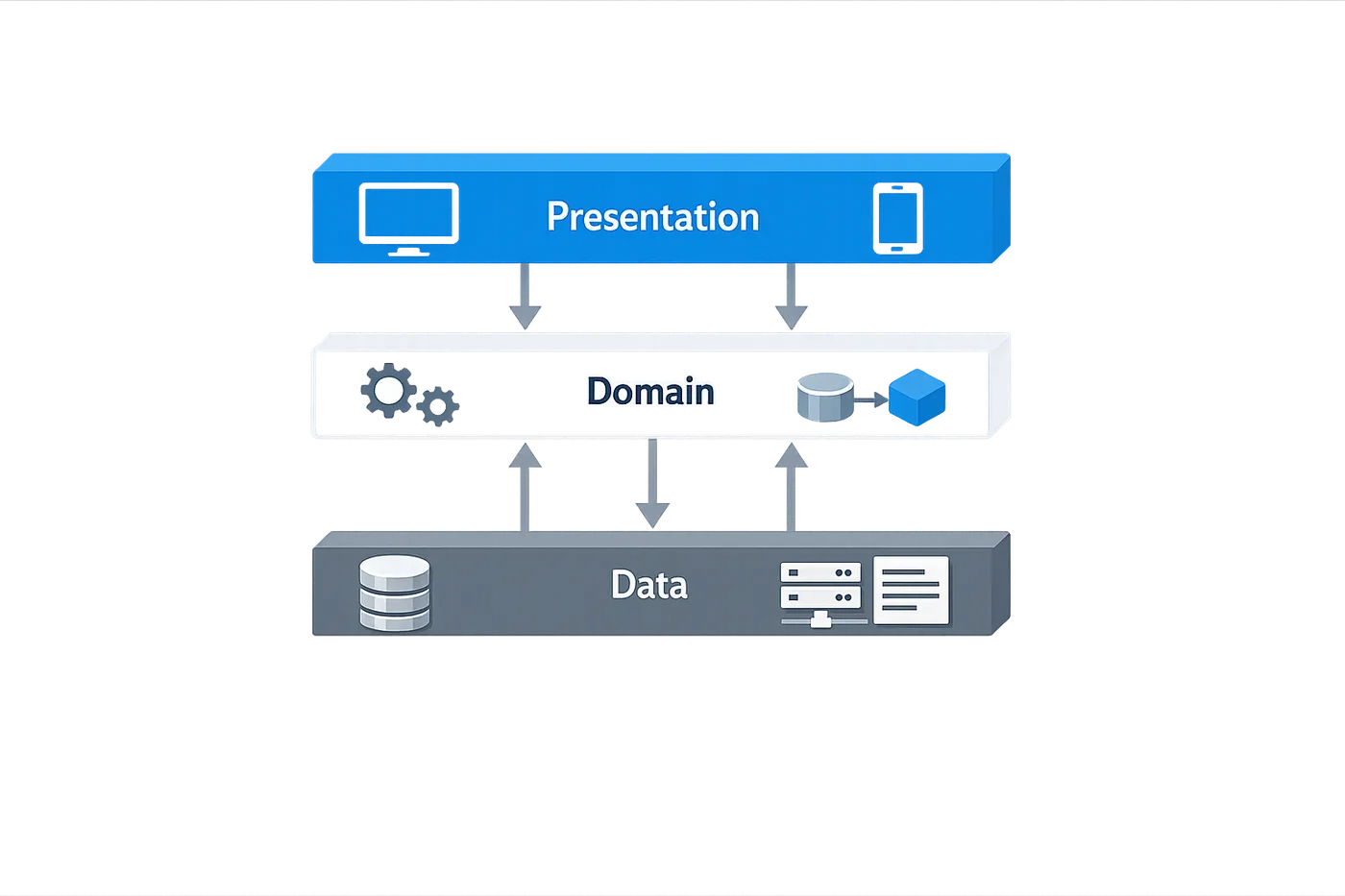
Implementing clean architecture principles requires deliberate structural choices at the service, component, and data layers. The steps below outline a practical sequence for organizing code so dependencies point inward and boundaries remain enforceable.
Step 1: Define Service Boundaries
Step 1
Isolate each service in its own file
Define each service in its own file under src/services/. This enforces separation of concerns and prevents cross-service coupling. A service owns one domain responsibility and exposes a stable interface to the rest of the application.
When a service file grows beyond 200 lines, extract helper functions or sub-workflows into separate modules within the same directory. Keep the main service file focused on orchestration and boundary enforcement.
Step 2: Validate Inputs at the Boundary
Step 2
Validate all inputs before internal processing
Always validate inputs at the service boundary before passing data to internal functions. This prevents invalid state from propagating through the application and makes debugging faster when failures occur.
Return structured error objects with a code and message field. Never throw raw strings. Structured errors let calling code handle failures uniformly and log diagnostic context without parsing exception text.
Step 3: Enforce Component Size Limits
Step 3
Keep components under 200 lines
Keep components under 200 lines. Extract subcomponents into the same directory when a file grows beyond that threshold. Smaller components are easier to test, easier to reason about, and easier to replace when requirements shift.
Prefer composition over prop drilling. Pass children or render props instead of threading data through multiple layers. This reduces coupling between parent and child components and makes the component tree more flexible.
Step 4: Separate Database Access by Application
Step 4
Use dedicated database accounts per application
Designers of web applications should use different database user accounts for each application to enhance access control and reduce privileges. Each DB user should have select access to only what it needs and write access as needed. This limits the blast radius if one application is compromised.
Avoid using the same owner or admin account in web applications to connect to the database. Granular access control at the database layer is a defense-in-depth measure that complements application-layer boundaries.
Step 5: Co-locate Related Artifacts
Co-locate styles in a module CSS file next to the component. Co-locate tests, fixtures, and type definitions in the same directory as the module they describe. When related files live together, refactoring becomes local and safe.
If you are building from scratch or require low risk tolerance, use parameterized queries, stored procedures, or an Object Relational Mapper (ORM) that builds queries for you. These tools enforce the boundary between application logic and data access, preventing injection attacks and accidental schema coupling.
Tips and Tricks for Applying Clean Architecture Principles
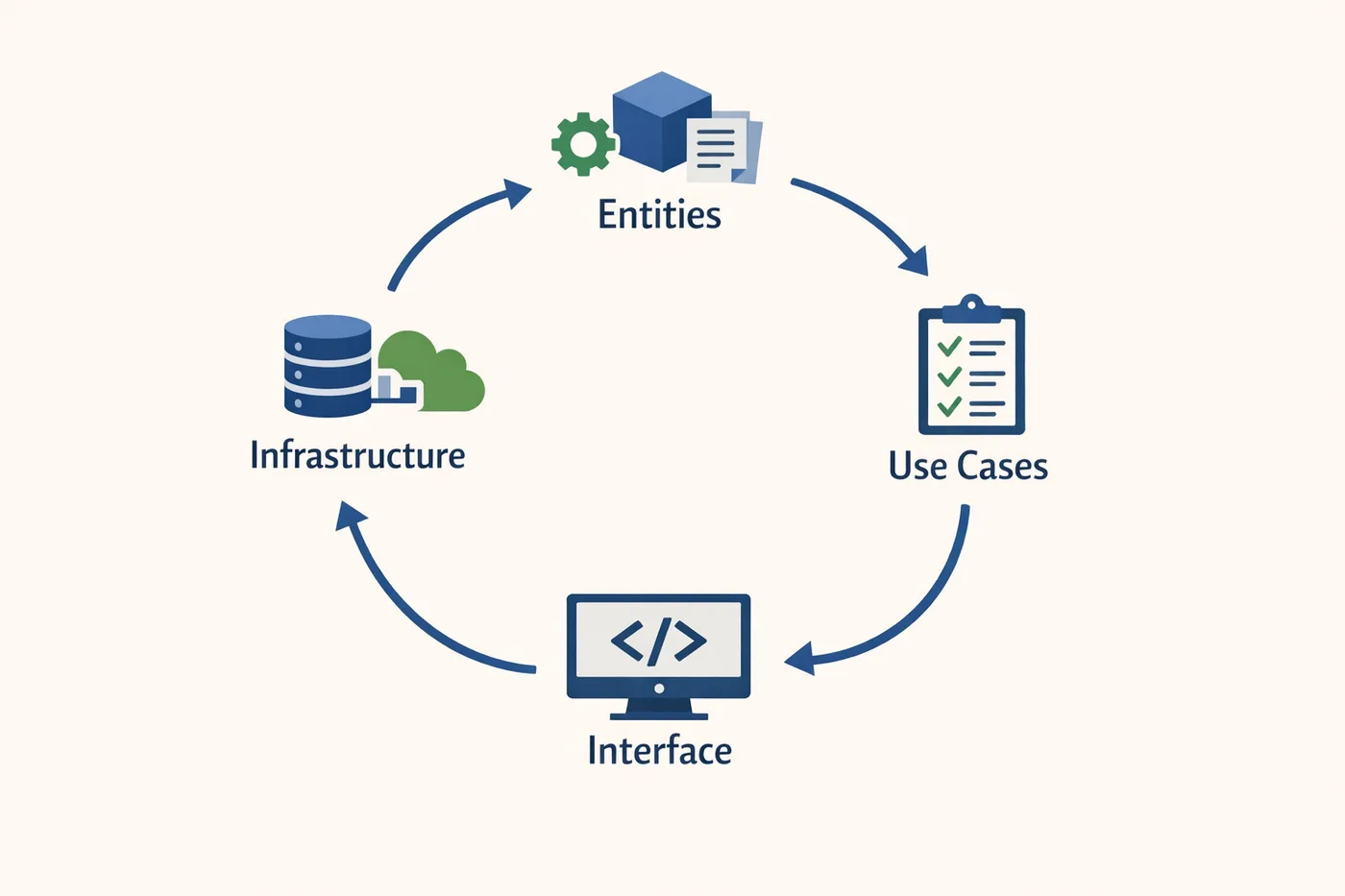
Clean architecture principles look simple on paper. Applying them under deadline pressure is a different story. I've shipped enough prototypes-turned-production to know where the theory breaks and where shortcuts compound.
Keep Components Under 200 Lines
When a file grows beyond 200 lines, extract subcomponents into the same directory. This threshold forces you to identify reusable pieces before a component becomes a maintenance burden. Co-locate styles in a module CSS file next to the component rather than scattering them across a global stylesheet.
Prefer Composition Over Prop Drilling
Pass children or render props instead of threading data through multiple layers. Prop drilling creates tight coupling between parent and child components, making it harder to reuse logic in different contexts. Composition keeps each layer independent and testable.
For example, instead of passing five props down three levels to configure a button, pass a configured button component as a child. The intermediate layers don't need to know what they're rendering.
Step 1
Break large changes into reviewable chunks
If a change is too large to review comfortably, split it into smaller pieces. This applies whether you're writing code by hand or using AI tools. Smaller diffs catch subtle bugs that get lost in 500-line pull requests.
Validate Inputs at Service Boundaries
Define each service in its own file under a consistent directory structure. Always validate inputs at the service boundary before passing data to internal functions. Return structured error objects with a code and message field—never throw raw strings. This pattern makes error handling predictable across your application.
When you're unsure about implementation details, read the relevant source files before proposing changes. AI-generated code can look correct but miss edge cases or duplicate logic that exists elsewhere in your codebase. Your standards for what gets merged should be the same whether the code was written by hand or by an agent.
Implement Defense in Depth for Access Control
Do not depend on any single framework or library to enforce proper access control. Misconfiguration is a major source of broken authorization. For all but the simplest use cases, frameworks must be customized with additional logic to meet your app's unique requirements.
During the design phase, enumerate the types of users accessing the system, the resources exposed, and the operations each user type can perform. For every combination of user type and resource, determine what operations are allowed based on role and other attributes. A Sales Representative may need database access from the internal network during working hours, but not from home at midnight.
Standardize the interaction with different secret management solutions so they remain maintainable in the event of an incident.
Standardize Secrets Management Across Teams
Secrets used by DevOps teams may be consumed differently than secrets stored by marketers or SRE teams. Poorly maintained secrets often result from mismatched needs between secret consumers and producers. Standardizing doesn't mean forcing every team onto one tool—cloud-native teams might use the cloud provider's solution while private cloud teams use a third-party option. The key is standardizing how teams interact with these solutions.
For a detailed look at planning work that supports these architectural decisions, see PRD Sections Explained: What to Include with Examples.
Conclusion
Clean architecture principles deliver measurable returns when you apply them consistently. The separation of concerns, dependency inversion, and testability patterns outlined here reduce coupling, contain blast radius when requirements shift, and let you swap infrastructure without rewriting business logic. I've watched teams cut integration test cycles by 40% once they stopped tangling database calls into domain logic.
The upfront cost is real. You write more files, draw more boundaries, and resist the shortcut that puts SQL in the controller. But the payoff shows up when you need to migrate from Postgres to DynamoDB, replace a payment gateway, or add a second client interface without touching core workflows. Systems built this way survive their initial assumptions.
Start small: enforce dependency rules in one module, write tests that don't boot the database, separate what the app does from how it talks to the outside world. These habits compound. For a structured approach to planning systems that scale, see our App Development Plan: Dev Plan Guide for Non-Technical Founders (2025). Clean architecture isn't a silver bullet, but it's the difference between refactoring a feature and rewriting the application.
Learn Clean Architecture Principles for Scalable Applications and how they enhance software design and scalability.
Related reading
Platform Engineering: Building Foundations for Scalable Products