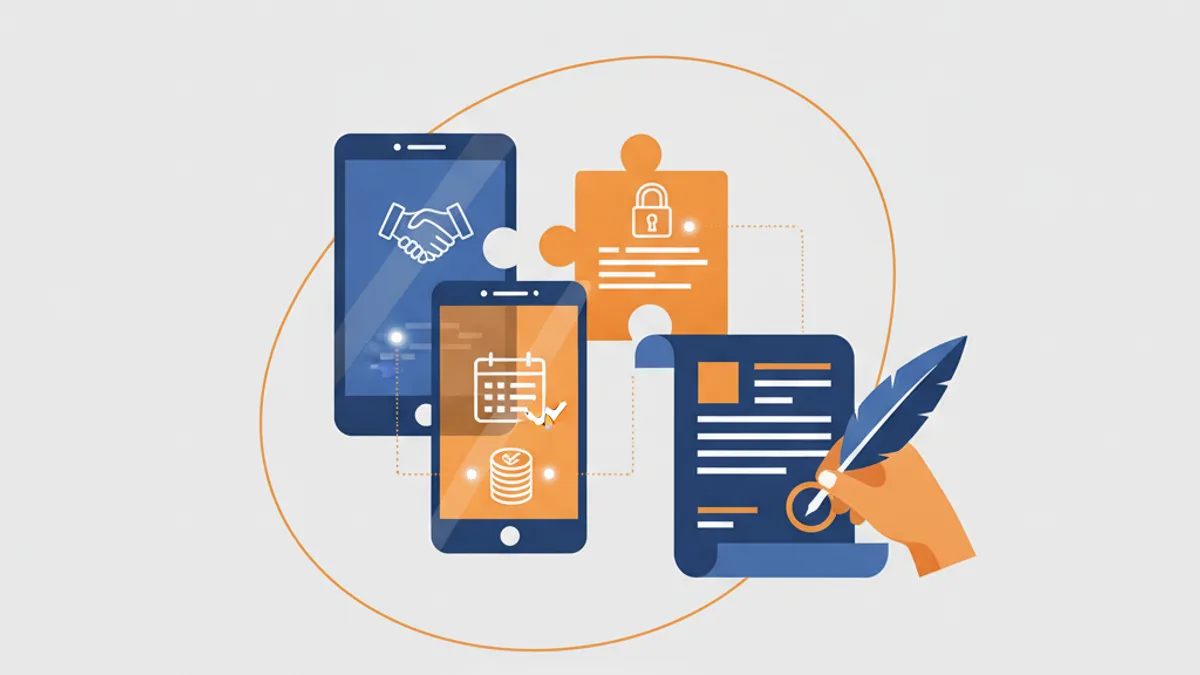
What to Include in Your App Development Contract
Top takeaways
- A detailed app development contract protects your ownership rights and defines deliverables clearly
- Without written terms, disputes over code ownership and project scope cost time and money
- Essential contract elements include IP assignment, payment terms, and change-order procedures
- Clear documentation prevents scope creep and ensures both parties understand expectations
- The contract should specify who owns the code and what happens if the relationship ends
Introduction
I've seen founders lose control of their own product because they started building without a contract. One client came to me after their developer disappeared with the only copy of the codebase — no agreement, no recourse, just a restart from zero.
An app development contract is not paperwork for lawyers. It is the operating manual for your build. It defines who owns what, who pays when, and what happens if someone walks away. When you hire a developer or agency to build your app, the contract is the only artifact that survives a dispute.
Most first-time founders skip the contract or sign a template without reading it. They assume good intentions prevent problems. Good intentions do not survive missed deadlines, budget overruns, or disagreements about what "done" means. The contract exists because intentions are not enforceable.
The stakes are higher than most people realize. If the contract does not explicitly assign intellectual property to you, the developer may own the code they write. If it does not define acceptance criteria, you may pay for work that does not meet your needs. If it does not include a termination clause, you may be locked into a relationship that is not working. For more on building the right foundation, see How to Build Engineering Capabilities for Your Software Project.
This guide walks through the provisions that matter. You will learn what to include, what to negotiate, and what red flags to watch for when reviewing a developer's standard terms.
Problem Statement
Without a proper app development contract, you expose yourself to scope creep, missed deadlines, and unclear ownership of the final product. I've seen founders hand over deposits to developers who vanished mid-project because nothing was written down about deliverables or timelines. When the handshake deal falls apart, you have no recourse.
Ambiguous Deliverables and Acceptance Criteria
Most disputes start with a simple question: what exactly did the developer promise to build? Without written acceptance criteria, "done" means different things to each party. The developer considers a feature shipped when it compiles; you consider it shipped when it handles edge cases and passes user testing. That gap costs weeks of rework and burns trust on both sides.
Security and Compliance Gaps
Apps that handle user data require security measures and compliance reviews. Automated tools identify common vulnerabilities, but they cannot guarantee complete security. For apps handling sensitive data or critical functionality, a professional security review is necessary — and your contract should specify who pays for it and when it happens. Skipping this conversation up front means discovering compliance gaps after launch, when fixes are expensive and reputational damage is real.
No Change Control Process
Every project evolves. You will want to add features, adjust workflows, or respond to user feedback. Without a written change control process, every revision becomes a negotiation. The developer quotes new timelines and costs on the fly; you have no baseline to judge whether the quote is reasonable. This friction slows iteration and makes it hard to build engineering capabilities that scale beyond the first release.
Intellectual Property Ownership Uncertainty
Who owns the code, designs, and data models when the project ends? In the absence of a written assignment, the developer may retain rights to reuse components in other clients' projects — or claim ownership outright. You cannot sell, license, or refactor an app you do not legally own. Clarifying IP ownership in the contract is not paranoia; it is the minimum step to protect your ability to operate the business you are building.
Solution Steps: What to Include in Your App Development Contract
A working contract covers five areas: what gets built, who owns it, how security gets handled, what happens when things break, and how changes get priced. Miss one and you're negotiating from a weak position six months in.
Scope and Deliverables
Define end-to-end development expectations. The contract should specify that the vendor delivers both UI and backend logic, not mockups you'll need to implement yourself. List every screen, API endpoint, database schema, and integration point. If you're expecting a working product, say so — "fully functional application" means different things to different shops.
Include acceptance criteria for each deliverable. "Login works" is not testable. "User can authenticate via email/password, receive a session token valid for 24 hours, and access protected routes" is.
Step 1
Enumerate user types and resources
List every category of user who will touch the system, every resource they'll access, and every operation they might perform. A Sales Rep accessing customer records from the office is a different security profile than the same Rep accessing from home at midnight. Your contract should require the vendor to map these scenarios during design.
Intellectual Property and Code Ownership
State who owns the code when the project ends. Most founders assume they own what they paid for — most vendors assume they retain rights to reuse components. The contract must say explicitly: "All code, designs, and documentation created under this agreement become the sole property of Client upon final payment."
If the vendor uses their own libraries or frameworks, carve those out specifically. You want ownership of your application code, not a fight over whether a utility function counts as vendor IP.
Security Requirements and Responsibilities
Security is not an add-on. The contract should require the vendor to meet security standards appropriate for your use case, especially if you handle sensitive data or perform critical functions. Specify which frameworks and tools are acceptable — modern stacks like Next.js and Tailwind come with better security defaults than legacy options.
Require the vendor to document their security testing process. Automated scans catch common issues, but they don't replace a real review. If you're in a regulated space, state that explicitly and require evidence of compliance.
Change Management and Pricing
Define how scope changes get priced. Fixed-price contracts need a change-order process with rate cards. Time-and-materials contracts need spending caps and weekly burn reports. Either way, the contract should specify the unit of work (hour, story point, sprint) and the rate.
Include a process for handling discovered requirements. When you realize three months in that you need an admin panel, the contract should say whether that's included or how much it costs to add.
For more on managing technical decisions during development, see How Automation Engineers Reduce Your App's Technical Debt.
Step 2
Set testing and validation gates
Require tests that validate the permissions and access controls defined in the design phase. The contract should specify that after deployment, the vendor will periodically review user permissions to prevent privilege creep — users accumulating more access than their role requires.
Maintenance, Support, and Warranties
State what happens after launch. A 30-day warranty period is standard — bugs found in that window get fixed at no charge. After that, define support terms: response times, availability windows, and hourly rates for fixes.
If you're expecting ongoing maintenance, put it in the contract. "Reasonable support" means nothing when your app is down and the vendor is on vacation.
Tips and Tricks for Drafting Your App Development Contract
A contract is only as good as the process that feeds it. Start with enumeration. List every user type, every resource they touch, and every operation they perform. That exercise surfaces assumptions early — before they become change orders.
Build Flexibility Into Project Management
Development modes shift. A project that starts as a web app might add a mobile component or pivot to a different architecture. Write the contract to accommodate mode changes without triggering renegotiation. Define what constitutes a scope change (new deliverables, new user types) versus a refinement within scope (switching from one framework to another to meet the same spec). The clearer that line, the fewer disputes you face mid-build.
Request Changes Incrementally
Ask for one change at a time. Review the result before requesting the next. That cadence keeps the project on rails and makes it easier to pinpoint when something breaks. In the contract, define the change-request process: how you submit requests, how the developer acknowledges them, and how long each review cycle takes. If the contract says "client may request changes," but doesn't say how or when, you'll spend half your time negotiating process instead of building product.
Require Version Control and Restore Points
Every change should be saved as a version you can restore. That's not optional. The contract should require the developer to maintain a version history with timestamps and descriptions, and to provide you access to that history. If a deploy goes sideways, you need the ability to roll back without waiting for the developer to dig through backups. Specify the version-control system (Git, for example) and the cadence of commits.
A contract that doesn't mandate version control is a contract that assumes nothing will ever go wrong.
Address Security and Privilege Enforcement Early
Failure to enforce least privileges jeopardizes sensitive resources. During design, enumerate user types, resources, and operations. For every combination, determine what operations that user must be able to perform. Write those determinations into the contract as acceptance criteria. If the spec says a Sales Representative can access customer records from the internal network during business hours but not from home at midnight, the delivered app must enforce that. Test it. The contract should require the developer to create tests that validate those permissions and to run those tests before each milestone delivery.
Plan for Third-Party Component Vulnerabilities
Even robust libraries have authorization vulnerabilities. The contract should require the developer to maintain a process for detecting and responding to vulnerable components. Specify tools (Dependency Check, for example) and require the developer to subscribe to relevant vulnerability feeds. If a critical CVE drops mid-project, you need a defined process for patching it without derailing the schedule. Write that process into the contract: how vulnerabilities are reported, how quickly they're assessed, and who pays for the remediation work.
Review Permissions for Privilege Creep
After deployment, permissions drift. Users accumulate privileges they no longer need. The contract should require periodic permission reviews — monthly or quarterly, depending on the app's sensitivity. Define what counts as privilege creep and who's responsible for auditing it. If the developer built the authorization layer, they should provide tooling to audit it. If you're managing users post-launch, the contract should require the developer to document how to run those audits yourself.
For more on managing complexity after the contract is signed, see How Automation Engineers Reduce Your App's Technical Debt.
Conclusion
A comprehensive app development contract is not optional. It is the single document that determines whether you own what you paid for, whether the developer ships on time, and whether you can enforce any of it when things go sideways.
I've seen founders skip the contract phase to save a week. They lose months in rework when the developer interprets "done" differently, or when they discover the code is encumbered by a GPL dependency they can't strip out. The contract is not ceremony. It is the specification for the business relationship.
Your contract must define scope, milestones, payment terms, IP ownership, confidentiality, and termination rights. Each clause serves a specific function: scope prevents drift, milestones create accountability, IP ownership ensures you can sell or license the product, confidentiality protects your competitive position, and termination rights give you an exit when performance fails.
The best contracts are boring. They state facts, assign responsibilities, and describe consequences. They do not need to be long, but they must be complete. A two-page contract that covers these elements will protect you better than a ten-page template that omits IP assignment.
Before you sign anything, read it. If a clause is unclear, rewrite it or ask the developer to rewrite it. If the developer resists putting a verbal promise in writing, that promise does not exist. The contract is the relationship — everything else is optimism.
If you need additional guidance on structuring your development process, see our App Development Plan: Dev Plan Guide for Non-Technical Founders (2025) for a step-by-step framework that complements a strong contract.
Get the contract right before the first line of code is written. You will not regret the time spent. You will regret the time you did not spend.