NDA Best Practices When Hiring App Developers
Top takeaways
- NDAs protect your app concept, technical architecture, and business logic from unauthorized disclosure when working with external developers
- A properly structured NDA establishes clear boundaries around what information stays confidential and for how long
- Implementing NDA best practices early in the hiring process reduces legal risk and prevents costly disputes over intellectual property
- Effective NDAs balance protection with practical enforceability, avoiding overly broad terms that courts may not uphold
- The right NDA framework lets you share technical details confidently during developer evaluation and onboarding
Introduction
When you hire app developers, you hand over your product vision, technical specifications, and often proprietary business processes. I've seen founders skip the NDA step to move faster, then watch their core feature set appear in a competitor's app six months later. An NDA is not paperwork theater — it's the legal boundary that lets you share what developers need to know without giving away what makes your app defensible.
The challenge is that most NDA templates either say too much or too little. Overly broad agreements scare off experienced developers who've seen abusive clauses. Weak agreements leave gaps that let contractors reuse your architecture or share your data model with their next client. The goal is a document that protects your intellectual property while signaling you understand how professional development relationships work.
NDA best practices when hiring app developers start with knowing what you're protecting. Your app's codebase, API design, database schema, third-party integrations, and user acquisition strategy all qualify as confidential information. So do your financial projections, customer lists, and any proprietary algorithms. The NDA should cover these categories explicitly, not rely on vague language about "business information."
Timing matters. Present the NDA before you share technical details, not after the developer has already seen your PRD. This means having a signed agreement in place before the first substantive conversation about your app's architecture. For more context on structuring these early planning documents, see our App Development Plan: Dev Plan Guide for Non-Technical Founders (2025).
The sections that follow walk through the specific risks of skipping NDAs, the steps to create an enforceable agreement, and the tactical details that separate a useful NDA from a legal liability. I'll also cover what to do when a developer pushes back on your terms and how to handle confidentiality across distributed teams.
What Makes an NDA Enforceable
An enforceable NDA requires three elements: clear definition of confidential information, reasonable scope and duration, and mutual obligations when appropriate. Courts throw out NDAs that try to claim ownership of general industry knowledge or that impose indefinite restrictions. Your NDA should specify what information is covered, how long the confidentiality obligation lasts, and what happens if the agreement is breached.
Most app development NDAs use a one-way structure where the developer agrees not to disclose your information. Two-way (mutual) NDAs make sense when the developer will also share proprietary tools or methodologies. Either way, the agreement must allow the developer to use general skills and knowledge gained during the project — you can't prevent them from building apps in the future, only from reusing your specific IP.
Problem Statement
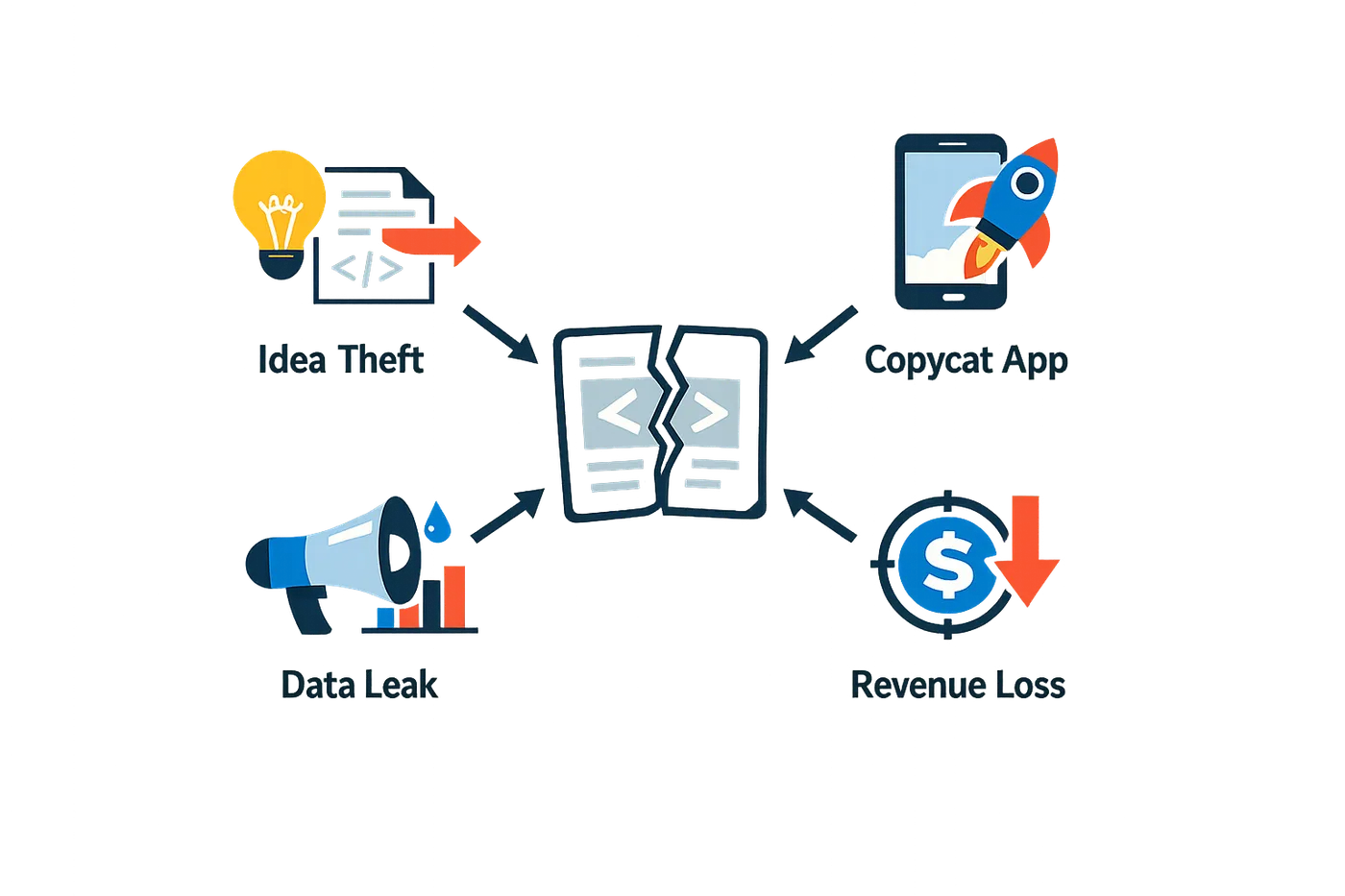
Hiring app developers without an NDA exposes your business logic, user data schemas, and competitive positioning before you ship. The risk is not hypothetical. Developers cycle through clients. What you describe in a kickoff call can surface in another founder's product three months later.
Uncontrolled Access Creates Exploitable Gaps
Without an NDA, you cannot legally restrict what a contractor does with information you share during discovery, design reviews, or handoff. A developer who sees your authentication flow, your pricing tiers, or your integration roadmap is free to reuse those patterns elsewhere. You may have invented nothing patentable, but you still lose first-mover advantage when a competitor launches the same feature set because their contractor recognized a proven model.
Permission boundaries matter in code and in contracts. Security frameworks enforce least privilege: each service account gets only the access it needs, nothing more. The same principle applies to information disclosure. When you grant a developer access to your full technical stack without a binding confidentiality obligation, you are operating in a default-permit posture. Every conversation, every Figma file, every API spec becomes fair game.
Intellectual Property Leakage Is Gradual, Not Dramatic
Most IP loss does not happen through a single catastrophic breach. It accumulates through small, repeated exposures: a developer mentions your novel onboarding flow in a Slack channel with another client, a designer repurposes your wireframe structure for a pitch deck, a contractor includes your API design in a portfolio case study. Each incident is minor. Together, they erode the competitive moat you are building.
You cannot rely on goodwill or professionalism to protect proprietary information. Developers work on multiple projects. Memory is fallible. A pattern you explained in March may reappear in June on a different client's roadmap, not out of malice but because the developer internalized it as a general best practice. Without a written obligation to treat your information as confidential, there is no legal or practical mechanism to prevent this drift.
Third-Party Risk Compounds When Contractors Subcontract
Many contractors subcontract portions of the work—backend to one specialist, frontend to another, DevOps to a third. If your primary contractor is not bound by an NDA, their subcontractors certainly are not. Your database schema, your user acquisition costs, your feature prioritization—all of it can propagate through an uncontrolled chain of disclosure. Each additional party increases the surface area for leakage, and you have zero visibility into who is seeing what.
Security hygiene in software development includes tracking which accounts have access to which resources and auditing that access over time. The same discipline applies to information sharing. If you cannot name every person who has seen your technical specifications, and you cannot point to a signed agreement binding each of them to confidentiality, you are operating with unmanaged risk.
Every unsigned conversation with a developer is a permission grant you cannot revoke.
The absence of an NDA does not feel dangerous during the honeymoon phase of a project. The risk materializes later: when a competitor launches a feature you described six months ago, when a contractor's portfolio suddenly includes screenshots that look suspiciously like your unreleased UI, when you discover your unique data model has become an industry pattern. By then, the damage is done, and you have no legal foundation to pursue remedy.
How Do You Implement NDA Best Practices When Hiring Developers?
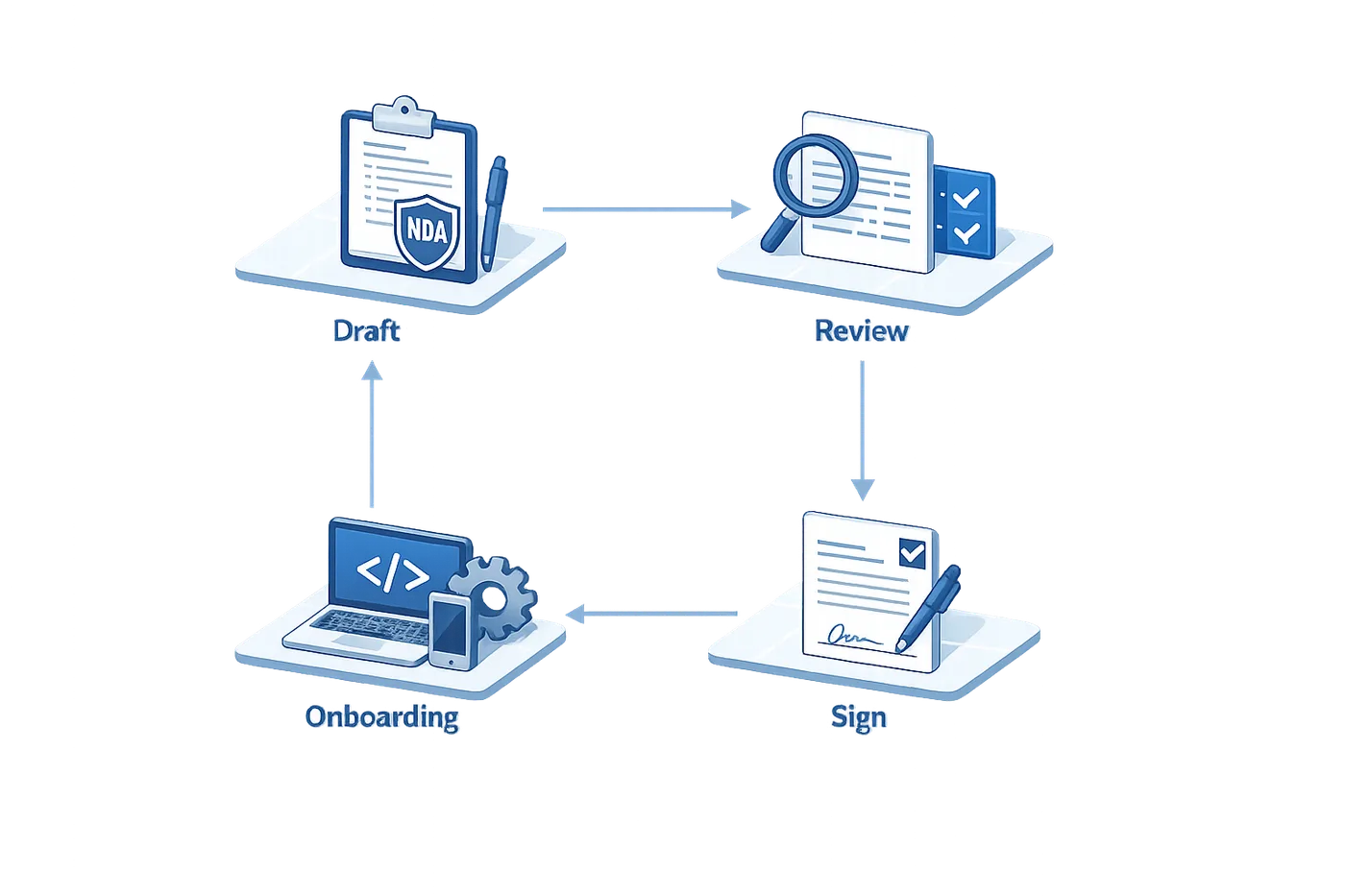
An NDA that works is one you can actually enforce. The steps below build that kind of agreement.
Define What You're Protecting
Start by listing what stays confidential. App concepts, user flows, API schemas, business logic, customer data structures — write them down. Generic language like "proprietary information" gives you nothing in court. Name the assets.
Ensure your NDA covers both the development of the app and the protection of intellectual property throughout the process. If a developer sees your payment integration spec on Monday and your competitor launches the same flow on Friday, vague language won't help you.
Step 1
Inventory your confidential materials
Before you send the NDA, catalog what the developer will see: wireframes, database schemas, third-party API keys, customer interview transcripts. This list becomes Exhibit A. If it's not on the list, it's not covered.
Step 2
Set clear access boundaries
Different developers need different access. A UI contractor doesn't need your AWS root credentials. A backend engineer doesn't need your full customer list. Segment access by role, then document those segments in the NDA.
Designers of web applications should use different database user accounts for each application to enhance access control and reduce privileges. Each developer gets only what they need to do their job — nothing more.
Step 3
Specify the confidentiality period
Most NDAs run two to five years after the relationship ends. Pick a duration that matches your product cycle. If your app's competitive advantage expires in 18 months, a ten-year NDA is theater. If you're building infrastructure that won't change for a decade, two years is too short.
Establish Permitted Disclosures
No NDA is absolute. Developers need to show code to their own legal counsel, disclose under subpoena, or share with their own contractors. Define those exceptions up front. A common carve-out: information the developer already knew, information that becomes public through no fault of theirs, or information they develop independently.
Write the exceptions narrowly. "The developer may disclose to necessary subcontractors" is fine if you add "provided those subcontractors sign equivalent NDAs within five business days."
Include Return-or-Destroy Provisions
When the engagement ends, confidential materials come back or get deleted. Specify the method: certified mail for physical documents, certified deletion for digital files. Set a deadline — usually 10 to 30 days after termination.
For engineering consulting partners, this step matters even more. A consultant who keeps your schemas can reuse patterns across clients. Deletion certificates close that loop.
Specify Remedies and Jurisdiction
Money damages rarely cover the harm from a leaked app concept. Add injunctive relief language: you can get a court order to stop the breach without proving dollar damages first. Name the jurisdiction and venue where disputes get resolved. If you're in California and your developer is in Texas, pick one forum now.
Arbitration clauses are common but not universal. Arbitration is faster and private; court is slower but creates public precedent. Choose based on whether you want the dispute hidden or documented.
Mutual vs. Unilateral NDAs
A unilateral NDA protects only your information. A mutual NDA protects both parties. Most client-developer relationships use unilateral agreements because the information flow is one-way. If the developer is sharing proprietary tooling or methods with you, consider mutual terms.
Mutual NDAs take longer to negotiate. Only go mutual if the developer is actually disclosing something worth protecting.
Tips and Tricks for NDAs
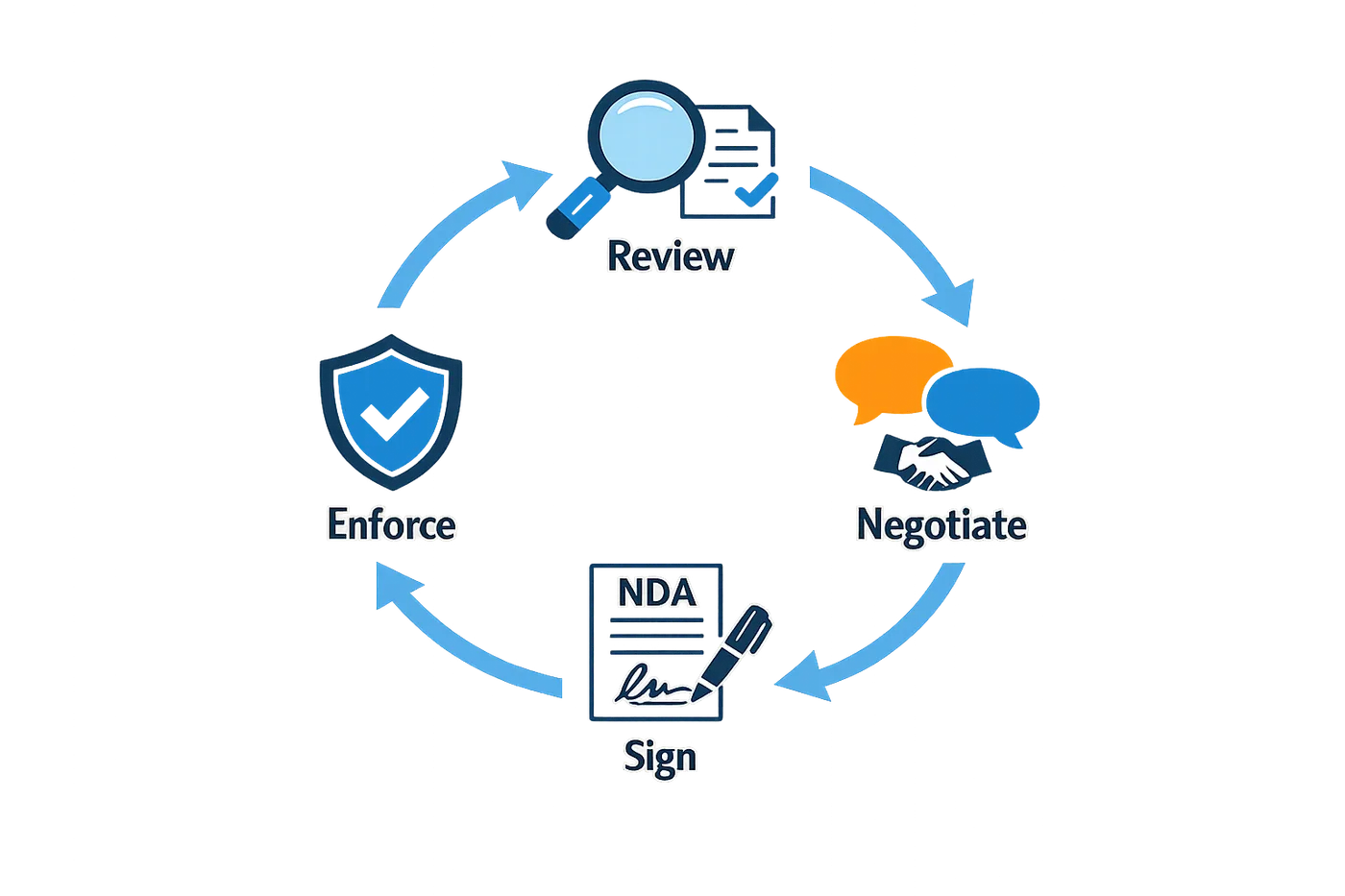
Negotiating an NDA is table stakes. Enforcing one depends on what you build into the engagement before the first commit.
Scope the NDA to What Actually Matters
Don't protect everything — protect what you can prove is yours and what a developer will actually touch. If your idea is "Uber for dog walkers," the NDA doesn't cover the concept; it covers your user research, your go-to-market spreadsheet, and the API keys you hand over. An NDA that tries to lock down public knowledge or obvious implementations won't survive a fight and signals you don't know what's confidential.
List specific assets: wireframes, customer lists, third-party credentials, proprietary algorithms. If the developer never sees your financial model, leave it out. Tight scope makes enforcement cheaper and keeps the developer from walking away before you start.
Tie Confidentiality to Access Control from Day One
The NDA says the developer can't share your secrets. Your repository permissions say whether they can even see them. When you grant a contractor admin access to your entire codebase, your production database, and your AWS root account, the NDA becomes a hope, not a control.
Each developer gets select access to what they need and write access only where the task requires it. If they're building a feature that touches user profiles, they don't need billing table access. If they're styling the front end, they don't need API keys. Least privilege isn't paranoia — it's the difference between a contained leak and a full dump.
An NDA without access control is a lawsuit you'll file after the damage is done.
Modern platforms let you enforce this without overhead. Separate database users per application component, environment-specific secrets, and role-based repository access all reduce what any one person can exfiltrate. The NDA covers intent; your infrastructure covers opportunity.
Audit What Leaves Your Environment
Developers move fast. They clone repos to personal machines, screenshot error messages for Slack, and paste stack traces into ChatGPT. Most of this is normal work. Some of it violates your NDA by accident.
Log what crosses boundaries: repository clones, database exports, API calls from non-approved IPs. If a developer pulls your entire user table at 2 a.m. from a coffee shop, you want to know before they post it on GitHub. Audit trails also prove you took reasonable steps to protect confidentiality, which matters if you ever enforce the NDA in court.
Identify unauthenticated endpoints and abusable routes before the developer starts. If your staging API lets anyone trigger a password reset email without a token, that's not an NDA problem — that's an architecture problem that makes the NDA irrelevant.
Negotiate Remedies That Actually Work
Most NDAs say "the disclosing party may seek injunctive relief." That's accurate and useless. Injunctions take weeks; by then your competitor has your feature list. Add a liquidated damages clause: a fixed dollar amount per breach, high enough to hurt but defensible as a reasonable estimate of harm. Contractors who know a single leak costs them $25,000 think twice before forwarding your deck.
Include a clawback: if confidential information appears in their portfolio, their GitHub, or a case study within the NDA term, they pay the damages and remove it within 48 hours. This works better than threatening to sue, which you probably won't do for a $5,000 contract.
For high-stakes projects, require the developer to carry errors and omissions insurance that covers data breaches. It won't prevent leaks, but it gives you a funded recovery path that doesn't depend on the developer's bank account.
Secure the Handoff When the Contract Ends
The NDA doesn't expire when the developer stops working. It expires when the confidentiality obligation does — usually one to three years after the last disclosure. That means you need a clean break: all credentials revoked, all local copies deleted, and a signed certificate of destruction.
Send a checklist on the developer's last day: repository access removed, API keys rotated, local clones wiped, and any physical documents returned. If they took screenshots or saved Slack threads, the NDA still applies, but you want those gone too. The certificate of destruction isn't enforceable proof, but it's a dated record that they acknowledged the obligation.
For platform engineering projects where the developer built foundational systems, rotate every secret they touched. Even with an NDA, a former contractor who still has your database password is a risk you don't need. When building engineering capabilities for your software project, treat credential rotation as a standard offboarding step.
Conclusion
NDA best practices when hiring app developers come down to three things: clarity about what's confidential, realistic scope limits, and enforcement you can actually execute. A mutual NDA signed before the first technical conversation sets the baseline. Definitions matter more than word count — spell out what constitutes confidential information and what doesn't. Carve out prior knowledge, publicly available data, and independently developed work or you'll spend more time arguing exceptions than building product.
I've handed NDAs to offshore teams, onshore contractors, and solo freelancers. The ones who push back on mutual confidentiality or ask for unlimited disclosure rights are telling you something. Listen to that signal. The best developers I've worked with sign a clean two-way NDA without negotiation because they understand the stakes on both sides.
Enforcement starts with documentation. Log what you share, when you share it, and who has access. If you can't produce a disclosure record six months later, your NDA is decoration. Pair confidentiality obligations with clear IP assignment clauses so there's no ambiguity about who owns the code. And remember: an NDA protects information, not ideas — if your concept relies entirely on secrecy rather than execution, the NDA won't save you.
Modern collaborative workflows and development tools make it easier to maintain confidentiality while moving fast. The right tooling reduces the surface area for leaks without slowing down iteration. Whether you're working with a full engineering consulting partner or a solo contractor, the NDA is the first contract you sign and the last line of defense if things go wrong. Make it count.
FAQ
What is the ideal length for an NDA confidentiality period?Most app development NDAs set confidentiality periods between two and five years after the relationship ends. Match the duration to your product's competitive lifecycle: shorter for fast-moving consumer apps, longer for infrastructure or enterprise platforms.
Should I use a mutual or unilateral NDA when hiring developers?Use a unilateral NDA when only you are sharing confidential information. Choose a mutual NDA if the developer will also disclose proprietary tools, methodologies, or code libraries. Most client-developer relationships require only unilateral protection.
Can an NDA prevent a developer from working on similar projects?No. An enforceable NDA restricts disclosure and use of your specific confidential information but cannot prevent a developer from using general skills, industry knowledge, or working in the same domain. Courts will not uphold overly broad non-compete clauses disguised as NDAs.
When should I present the NDA during the hiring process?Present the NDA before sharing any technical details, product roadmaps, or business strategies. Have it signed before the first substantive conversation about your app's architecture, not after the developer has already reviewed your specifications.
What happens if a developer refuses to sign my NDA?A developer who refuses to sign a reasonable NDA is signaling either inexperience or unwillingness to protect your IP. Experienced professionals understand confidentiality obligations and sign clean NDAs without pushback. Consider it a red flag and find another candidate.