
Failed App Ideas: 12 Surprising Mistakes and Ultimate Lessons
Introduction
Most app ideas die quietly. The graveyard is full of polished interfaces, clever features, and months of work that nobody wanted. The pattern repeats: a founder builds what they assume users need, launches to silence, then wonders what went wrong.
The numbers are blunt. 85% of new mobile applications fail within their first year, and over 90% of app ideas never reach 1,000 downloads. The culprit is rarely bad code—it's bad planning. Developers build solutions to problems that don't exist, or exist but aren't painful enough to justify a download.
I've watched this play out in my own projects and in dozens of founder conversations. The gap between what you think users want and what they'll actually pay attention to is where planning either saves you or sinks you. If you're considering turning an app idea into reality, understanding why most fail is cheaper than learning it firsthand.
This article walks through the planning mistakes that consistently kill app ideas, the case studies that illustrate them, and the validation steps that catch these errors before you commit resources. The goal is simple: help you avoid building something nobody downloads.
Discover failed app ideas and learn about the planning mistakes that led to their downfall.
Understanding Failed App Ideas
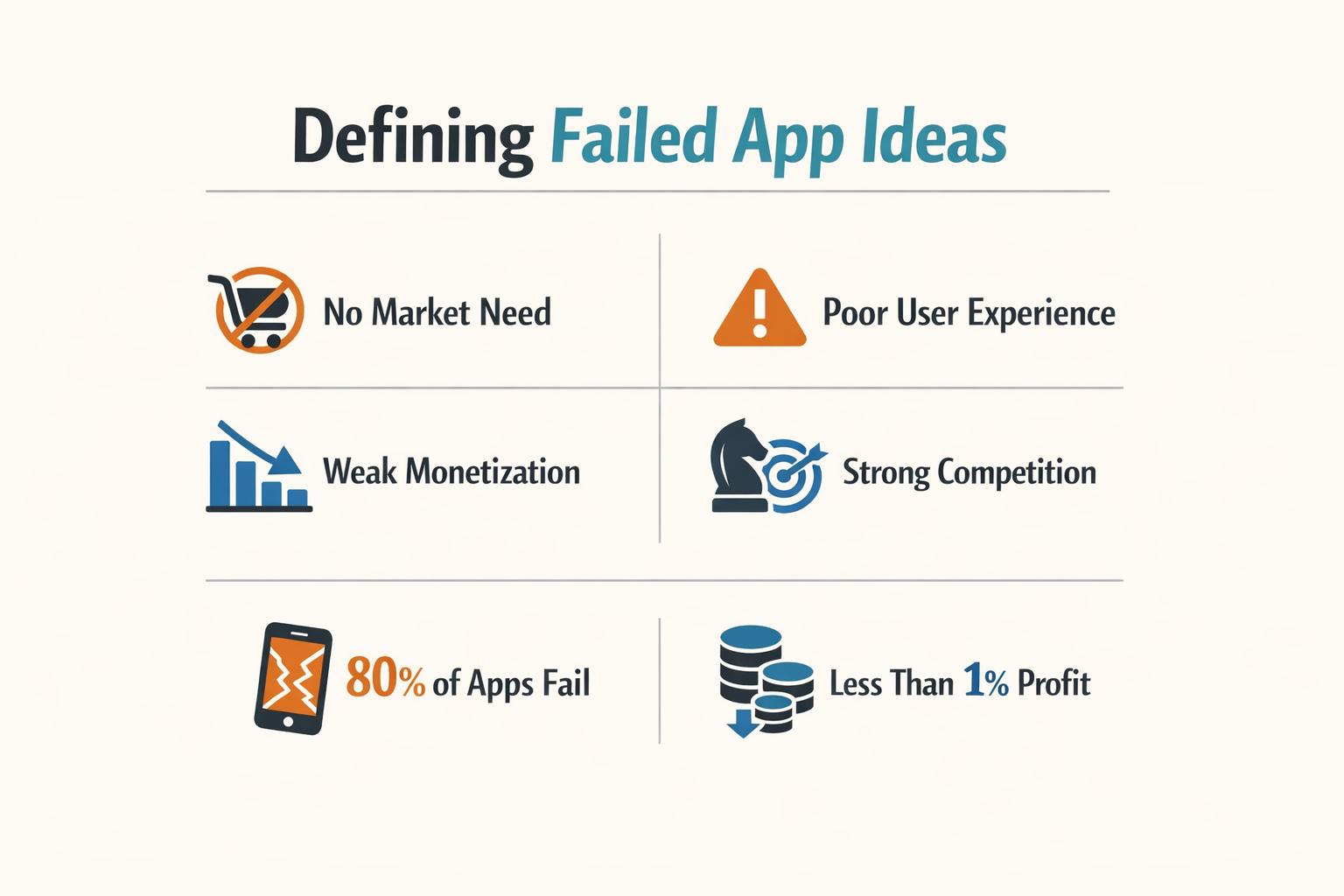
A failed app idea is not just an app that never launched. It's an app that shipped but nobody used, or one that burned budget without proving the core premise. Over 90% of app ideas fail, and most apps never reach 1000 downloads. The failure happens before the first user ever sees a screen.
The definition is simple: if the app doesn't solve a problem people will pay to fix, it failed. Design quality, tech stack, and feature count are secondary. The number one killer of apps is no market need, not bad design. An app can be beautiful and still die in the store.
Common Characteristics of Failed Apps
Failed apps share patterns. They solve problems the founder has, not problems a market segment will pay to fix. They launch without talking to users first. They assume distribution is easy because the App Store exists.
Another pattern: the idea requires behavior change without offering a 10x improvement. Users don't switch apps for marginal gains. If your idea needs people to learn a new workflow for a small benefit, it's already on thin ice. For founders figuring out their first steps, I Have an App Idea: The Ultimate Simple Guide for Founders walks through the validation framework that catches these issues early.
Failed apps also tend to skip the boring work. No competitor analysis. No pricing research. No prototype testing with strangers. The founder builds in a vacuum, then wonders why launch day is silent.
The cheapest way to fail is on paper — validate the idea before you validate the code.
Most failed app ideas aren't bad concepts. They're good concepts aimed at the wrong audience, priced incorrectly, or launched without distribution. The idea itself is rarely the problem. The planning is.
Common Planning Mistakes Behind Failed App Ideas
Most app failures trace back to decisions made before the first line of code. Seventy percent of app failures stem from poor planning, not development. The work you skip at the start compounds into problems you cannot fix later.
Vague Problem Definitions
Nearly 37 percent of analyzed ideas are too vague to evaluate. When you cannot articulate the exact problem your app solves in two sentences, you have a planning problem. Vague ideas produce vague requirements, which produce apps that solve nothing well.
The symptom shows up when you pitch the app and people nod politely but never ask how much it costs. If potential users cannot immediately picture themselves using it, your problem statement is still abstract.
Missing Go-to-Market Plans
Over 25 percent of app ideas have no go-to-market plan. Building the app is the middle of the process, not the end. Without a distribution strategy, your app sits in a store nobody visits.
The mistake looks like this: founders spend six months on features and zero hours on how the first hundred users will hear about it. No plan for acquisition means no users, which means no feedback, which means you are iterating in a vacuum.
Skipping Demand Validation
Validate demand before you build. If potential customers are not willing to pay for a service, no amount of polished UI will fix the problem. Validation does not mean asking friends if they like the idea—it means finding strangers who will pre-pay or commit time.
The fastest validation is a landing page with a price and a signup form. If you cannot get fifty email addresses from cold traffic, you have a demand problem, not a marketing problem. For more on turning early validation into a working build, see I Have an App Idea: The Ultimate Simple Guide for Founders.
The cheapest way to fail is on a landing page, not in production.
Ignoring Competitive Context
Many founders build without checking what already exists. The issue is not that competition disqualifies an idea—it is that ignoring competition means you cannot differentiate. If you do not know why someone would switch from the incumbent, you are guessing.
Competitive research is not about copying features. It is about identifying what existing solutions do poorly and whether your approach fixes that specific gap. If your answer is "ours will be better," you have not done the research.
Underestimating Scope
Founders routinely estimate three months for work that takes twelve. The planning mistake is not bad math—it is listing features without dependencies. Every feature has integration cost, edge cases, and maintenance overhead that first-time builders miss.
The fix is to build the smallest possible version that demonstrates value, then expand. If you cannot describe your MVP in one paragraph, it is not minimal.
Case Studies of Failed Apps
Real failures teach more than hypotheticals. Three apps with different problems show how planning errors compound.
The $200K Project Management App
A SaaS founder skipped research and launched a project management app. The result: $200K burned. No validation, no user interviews, no competitive analysis. The market already had entrenched players solving the same problems better. The founder built features users didn't want and missed the ones they needed.
The planning error: assuming demand without evidence. Market research isn't optional when competitors already own the space.
The Hobbyist Social Network
A social networking app for hobbyists lost 40% of its active user base within six months. The team relied on traditional A/B testing instead of predictive analytics. They optimized individual features while missing larger retention patterns. By the time data showed the problem, half the users were gone.
The planning mistake: treating retention as a post-launch problem. User engagement models belong in the PRD, not the retrospective. If you're building without a clear retention strategy, check what is a PRD to understand how planning documents prevent this.
The Over-Engineered Fintech App
A fintech startup designed a complex budgeting feature that early user testing revealed was too cumbersome. They simplified it after launch, but the damage was done. First impressions don't reset. The initial complexity drove away users who never came back to see the improvements.
The error: designing for imagined power users instead of real ones. Complexity signals sophistication to founders. To users, it signals work.
The cheapest user research happens before you write code, not after you lose users.
Common Thread
All three apps failed at the planning stage. The project management app skipped validation. The social network ignored retention modeling. The fintech app over-designed without user input. Different mistakes, same outcome: wasted resources and lost users.
Planning mistakes are cheaper to fix than launch mistakes. The apps that survive are the ones that validate assumptions before they become architecture.
Lessons Learned from Failures
Failures teach faster than successes. The pattern is consistent: apps die when founders skip the boring work of validating demand before writing code. CB Insights found that 42 percent of failed startups died from no market need—not bad code, not poor design, just building something nobody wanted.
Build for Users, Not Yourself
Developers often build apps for themselves rather than for users. The result is a feature set that solves your problem but ignores the market. Your personal pain point might be real, but if only twelve other people share it, you have a hobby project, not a business.
Validation happens before you write the PRD. Talk to potential users. Watch them work. Ask what they pay for today. If they won't describe their current workaround, they don't have the problem you think they do.
Define Your Niche Early
Broad ideas sound safer but kill traction. "A productivity app for professionals" competes with Notion, Asana, and fifty funded startups. "A shift-swap tool for nurses in 200-bed hospitals" gives you a list of prospects you can call on Monday.
Narrow targeting also clarifies your PRD. When you know exactly who uses the app and why, feature decisions become obvious. Vague audiences produce vague requirements, which produce apps that do everything poorly.
If you can't name three competitors and explain why yours is different, you haven't defined the niche yet.
Test Demand Before Building
The cheapest validation is a landing page with a signup form. Describe the app, show mockups if you have them, and run ads for a week. If nobody signs up at $0, they won't pay $10/month later.
Pre-sales work even better. Offer early access at a discount. If potential users won't commit $50 for a tool they claim to need, the need isn't real. Money is the only signal that cuts through politeness.
Strategies for Successful App Planning
Planning prevents most failures. The apps that survive do three things before writing code: validate demand with real people, document the problem they solve, and set a budget they can afford to lose. Skip any of these and you're building on hope.
Research Before You Build
Talk to users before you touch a keyboard. Interview five people who might use the app. Ask what breaks in their current workflow. If they can't name a specific pain point, you don't have a problem worth solving. Write down their exact words — not your interpretation — and look for patterns.
Validation doesn't require an app. A landing page with a signup form tests demand in a weekend. If nobody signs up, you saved months. If they do, you have a list to interview.
Document the Core Problem
Write one sentence: "This app helps [specific person] do [specific task] without [specific friction]." If you can't fill in all three blanks with concrete nouns, the idea is still fuzzy. Fuzzy ideas become scope creep, which becomes abandoned projects.
A PRD forces clarity. It doesn't have to be formal — a Google Doc with user stories and success criteria works. The act of writing exposes gaps. If you can't describe the MVP in two pages, you haven't thought it through.
Step 1
Define the smallest useful version
List every feature you want. Cross out everything except the one thing that solves the core problem. That's your MVP. Build only that. If it doesn't work, the other features wouldn't have saved it.
Step 2
Set a hard budget and timeline
Decide how much money and time you'll spend before you quit. Write it down. When you hit the limit, stop. Most failed apps die because founders keep pouring resources into something the market already rejected.
Test With Real Users Early
Ship a broken version to five users. Watch them use it. Don't explain anything — if they need a tutorial for the core action, the UX is wrong. Note where they get stuck. Fix that one thing. Repeat.
Early feedback is cheap. Late feedback is expensive. Waiting until launch to learn nobody understands your app means you optimized the wrong thing for months.
Who Should Choose What
The lessons from failed app ideas apply differently depending on where you sit. A solo founder building nights and weekends faces different constraints than a funded team with dedicated roles. The mistake patterns are the same, but the mitigation strategies change based on your resources and timeline.
Solo Founders and Bootstrap Teams
If you're working alone or with one co-founder, your biggest enemy is scope. Every feature you add extends your timeline and increases the chance you'll quit before shipping. Pick the smallest viable surface area that still solves a real problem. Skip user accounts if you can get away with it. Skip notifications. Skip anything that requires ongoing maintenance you can't automate.
Validation matters more when you have no runway. Talk to ten potential users before you write a line of code. If you can't find ten people willing to describe their problem in detail, you don't have a market—you have a hypothesis. For guidance on turning an idea into a structured plan, see What Is a PRD? A Plain-English Guide for Non-Technical Founders.
Funded Startups with Small Teams
With a team of three to five and some capital, you can afford slightly more complexity—but only slightly. Your advantage is specialization: one person owns the user experience, another handles technical architecture, someone watches the numbers. The trap is building infrastructure for scale you don't have yet.
Focus your planning energy on the core loop: the one action users repeat that delivers value. Everything else is decoration. Invest in analytics early so you know which features actually get used. Most teams guess wrong about what matters, and without data, you'll keep guessing.
Enterprise or Agency Projects
Larger teams with defined roles need different guardrails. The planning mistakes here usually involve too many stakeholders, not too few. Requirements documents grow to thirty pages. Every department wants a feature. The app becomes a compromise that satisfies committees but delights no one.
If you're in this environment, your job is to protect the user from internal politics. Assign one person—ideally a product owner with authority—to say no. That person needs to kill features that don't serve the core use case, even when they're requested by senior leadership. Document decisions so you're not relitigating the same points every sprint.
The person who can say no and make it stick is worth more than three developers.
Non-Technical Founders Using AI Tools
If you're building with AI assistance and limited technical background, your risk is different: you can prototype fast but have trouble judging what's production-ready. The app works in demos but breaks under real load or edge cases you didn't anticipate.
Spend extra time on the planning document before you start prompting. Write down every user action, every error state, every piece of data that needs to persist. The AI will build exactly what you describe, so vague instructions produce vague results. Test with real users early—not friends, actual strangers who will break things in ways you didn't imagine.
Choosing Your Validation Strategy
Your validation approach depends on your risk tolerance and timeline. If you have six months of runway, you can afford a two-week research phase talking to users and mapping competitors. If you're building nights and weekends around a full-time job, you need faster signals: landing pages, mockups, pre-sales.
The common thread is talking to users before you build. The format matters less than the consistency. Ten conversations beat a hundred survey responses. Watching someone struggle with your prototype beats any amount of theoretical planning.
The Role of Market Research
Market research is the difference between building what you think people want and building what they actually need. 42% of startups fail because there was no market need for their product. That number stays high because founders skip validation or do it badly—sending surveys to friends, reading competitor reviews without talking to real users, assuming their own pain point scales.
Why Research Prevents Failed App Ideas
Good research answers three questions before you write a line of code: does anyone care, will they pay, and can you reach them cheaply enough to survive. Most failed app ideas never answered the first question. They built features users tolerated but didn't seek out. Research catches that early. You talk to 20 potential users, and 18 say "maybe" or "sounds interesting." That's a no. Real demand sounds different—people ask when it ships, volunteer to test, or describe workarounds they hate.
Research also exposes planning mistakes you can't see from inside your own head. You think onboarding is simple until you watch someone try it. You assume a feature is critical until users rank it fifth. The gap between your mental model and reality shrinks every time you put a prototype in front of someone who isn't you.
What Research Looks Like in Practice
Market research for apps isn't academic. You don't need focus groups or thousand-person surveys. You need 10–20 conversations with people who have the problem you're solving, a rough prototype or wireframe to react to, and a way to measure whether they'd actually use it. That last part is the hardest. People lie in interviews—not maliciously, but because hypotheticals are easy to agree with. Ask them to pre-order, join a waitlist with a credit card hold, or commit 15 minutes a week for a beta, and the truth comes out.
AI tools have made user behavior analysis cheaper, but they don't replace talking to humans. Apps that integrate AI to understand usage patterns see better retention, but only if the baseline product solves a real problem. Research defines that baseline. You can A/B test features later; you can't A/B test whether anyone cares.
Research Reduces Expensive Pivots
Every pivot costs time and credibility. Research reduces pivots by forcing you to validate assumptions before they're baked into the architecture. If you're building a PRD without user input, you're guessing. If you're guessing, you're planning to rewrite.
The apps that survive their first year did research in phases: problem validation before design, usability testing before full build, pricing experiments before launch. The ones that failed skipped straight to build because research felt slow. It is slow. It's also cheaper than rebuilding.
Future Trends in App Development
App planning doesn't happen in a vacuum. The tools, platforms, and user expectations shift every quarter, and what worked last year can fail next year. Understanding where the industry is moving helps you avoid building something obsolete before it launches.
AI-Assisted Development and Vibe Coding
AI code generation tools are changing who can build apps. Non-technical founders can now prototype and ship without hiring a full dev team. This lowers the barrier to entry, but it also floods the market with half-tested ideas. The difference between a successful launch and a failed app idea often comes down to planning discipline, not coding skill.
Vibe Coding 101: How Non-Technical Founders Build Real Apps With AI covers the practical workflow, but the trend itself is clear: more people building means more noise. Your app needs a sharper value proposition to stand out.
Platform Consolidation and Cross-Platform Frameworks
Users expect apps to work everywhere: iOS, Android, web, desktop. Cross-platform frameworks like React Native and Flutter let you ship once and run anywhere, but they introduce new failure modes. Performance gaps, platform-specific bugs, and inconsistent UX can sink an app that looked good in testing.
Planning for cross-platform means understanding where the framework breaks down. If your app depends on native features or tight performance, betting everything on a single cross-platform stack is a risk.
Privacy-First Design and Data Minimization
Regulations are tightening. Users are more skeptical about data collection. Apps that ask for too much upfront or bury permissions in dark patterns face rejection in app stores and user backlash. Privacy isn't a feature you bolt on later; it's a planning constraint from day one.
Failed app ideas often ignore this until launch, then scramble to comply. Successful apps design for minimal data collection and transparent consent from the start.
Subscription Fatigue and Monetization Shifts
Users are tired of subscriptions. Every app wants recurring revenue, but not every app deserves it. If your value doesn't compound over time, a subscription model will fail. One-time purchases, freemium with meaningful free tiers, and usage-based pricing are making a comeback.
Planning your monetization strategy means asking: does this app get more valuable the longer someone uses it? If the answer is no, don't force a subscription.
The next wave of failed app ideas will come from founders who copied today's playbook without questioning whether it still works.
Smaller, Focused Apps Over All-in-One Platforms
The era of "we do everything" apps is ending. Users prefer focused tools that solve one problem well. Planning a feature-bloated platform is a recipe for failure. The trend is toward tight, single-purpose apps that integrate with other tools rather than replace them.
If your roadmap has 20 features for version 1.0, you're planning a failed app idea. Ship one feature that works perfectly, then iterate.
Conclusion
Most failed app ideas die from planning mistakes, not execution problems. The evidence is clear: 85% of new mobile applications fail within their first year, and the number one killer is no market need. When you skip validation, ignore user feedback, or build features nobody asked for, you're not building an app—you're building expensive proof that assumptions don't scale.
The pattern repeats across every case study in this article. Apps fail when founders treat planning as paperwork instead of risk management. They launch without testing demand, burn budgets on features users don't want, and confuse their own excitement for market validation. The fix isn't complicated: talk to users before you write code, validate the problem before you build the solution, and treat your PRD as a living document that changes when reality disagrees with your assumptions.
I've seen founders waste months on features that sounded clever in Slack but had zero pull in production. The ones who survive are the ones who kill bad ideas fast and let user behavior overrule their gut. If you're starting from scratch, read the plain-English guide to PRDs and use it to stress-test your plan before you commit resources.
Careful planning doesn't guarantee success, but careless planning guarantees failure. The difference between a failed app idea and a working product is usually just the willingness to validate assumptions before they become technical debt.