
How to Protect an App Idea: NDA, Provisional, or Just Ship?
Top takeaways
- Legal tools like NDAs and provisional patents add friction but no real protection against execution risk
- Shipping fast beats filing paperwork — market presence is the only moat that matters for most apps
- Most app ideas fail from poor execution, not theft; your advantage is building, not hiding
- NDAs work for enterprise partnerships, not for recruiting developers or advisors
- Provisional patents buy you twelve months to validate demand before committing to the full patent process
Introduction
How to protect an app idea is a common concern for founders. You have an app idea. You want to protect it. The question is how — and whether the method you pick will help or just burn time.
I've watched founders spend weeks negotiating NDAs with contractors who ghost them, file provisional patents for features that never ship, and delay launch by months because they fear someone will "steal" a concept that turns out to need six pivots anyway. The gap between what feels safe and what actually moves the needle is wide.
The three paths you'll hear about are NDAs, provisional patents, and just shipping. Each has a narrow use case. NDAs matter when you're negotiating with enterprises or disclosing trade secrets to a co-founder. Provisional patents make sense if you're building something genuinely novel and need twelve months to validate it before committing to the full patent process. Shipping fast works for everything else — and "everything else" is most apps.
How to Protect an App Idea in Practice
Protection isn't about locking down the idea. It's about controlling the variables that let someone else beat you to market. For a detailed breakdown of turning your concept into executable specs, see What Is a PRD? Product Requirements Documents, Explained.
The rest of this guide walks through the mechanics: when each tool works, when it wastes time, and how to pick the right one without stalling your build.
Problem Statement
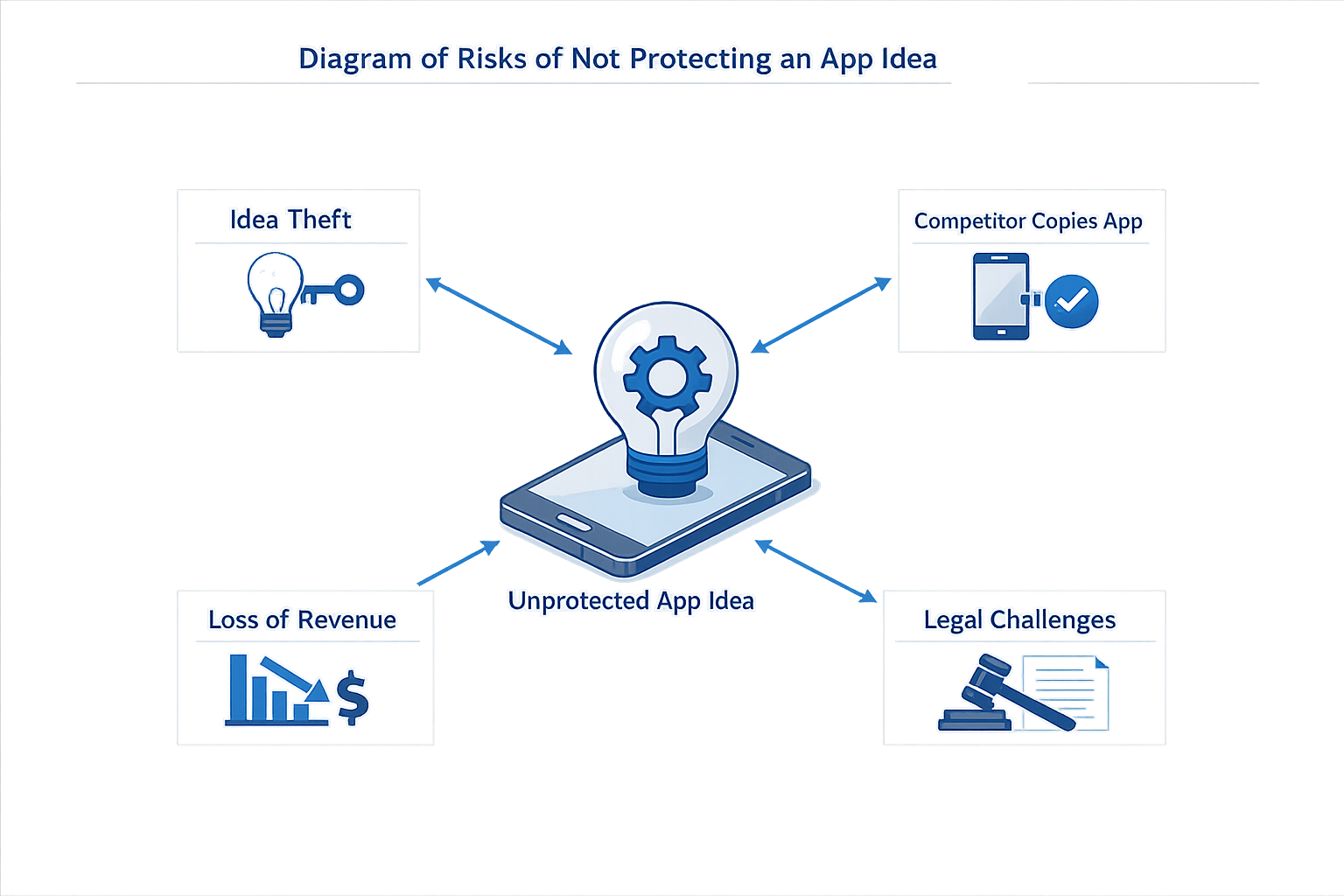
Most founders obsess over idea theft. They picture a competitor copying their concept overnight and beating them to market. The real risk is different: you spend months building in secret, ship late, and discover someone else already solved the same problem with a simpler approach.
The protection paradox works like this: the tighter you guard your idea, the less feedback you collect. Without feedback, you build the wrong thing. By the time you realize the mistake, your runway is gone.
The Actual Risks You Face
Idea theft is rare because execution matters more than the concept. Three risks actually threaten your app:
- Building without validation — you protect the idea so carefully that no one sees it until launch, when you discover the market doesn't care
- Losing speed to secrecy — NDAs and patent filings slow down hiring, partnerships, and investor conversations
- Missing the window — while you file provisional patents, a competitor ships a working product and owns the mindshare
The fourth risk is subtler: you protect the idea but not the implementation. Someone sees your launched app, reverse-engineers the workflow, and rebuilds it with better infrastructure. No NDA stops that.
What Founders Get Wrong About Protection
Founders treat idea protection as a binary: either lock it down or let it leak. The smarter play is selective disclosure. You share enough to test demand and recruit talent, but you hold back implementation details until you've shipped.
The mistake isn't talking about your app. The mistake is describing your entire technical architecture to someone who doesn't need it. A potential user needs to understand what problem you solve. They don't need your database schema.
The cost of secrecy is always higher than the cost of competition — you lose velocity, feedback, and the chance to pivot before you're committed.
If you're building a standard CRUD app with a novel workflow, an NDA won't save you. If you've invented a new algorithm or data structure, a provisional patent might. Most apps fall into the first category. Founders who recognize that ship faster and learn more.
For practical guidance on structuring your app's requirements before you share them with anyone, see What Is a PRD? Product Requirements Documents, Explained.
Solution Steps: Protecting Your App Idea
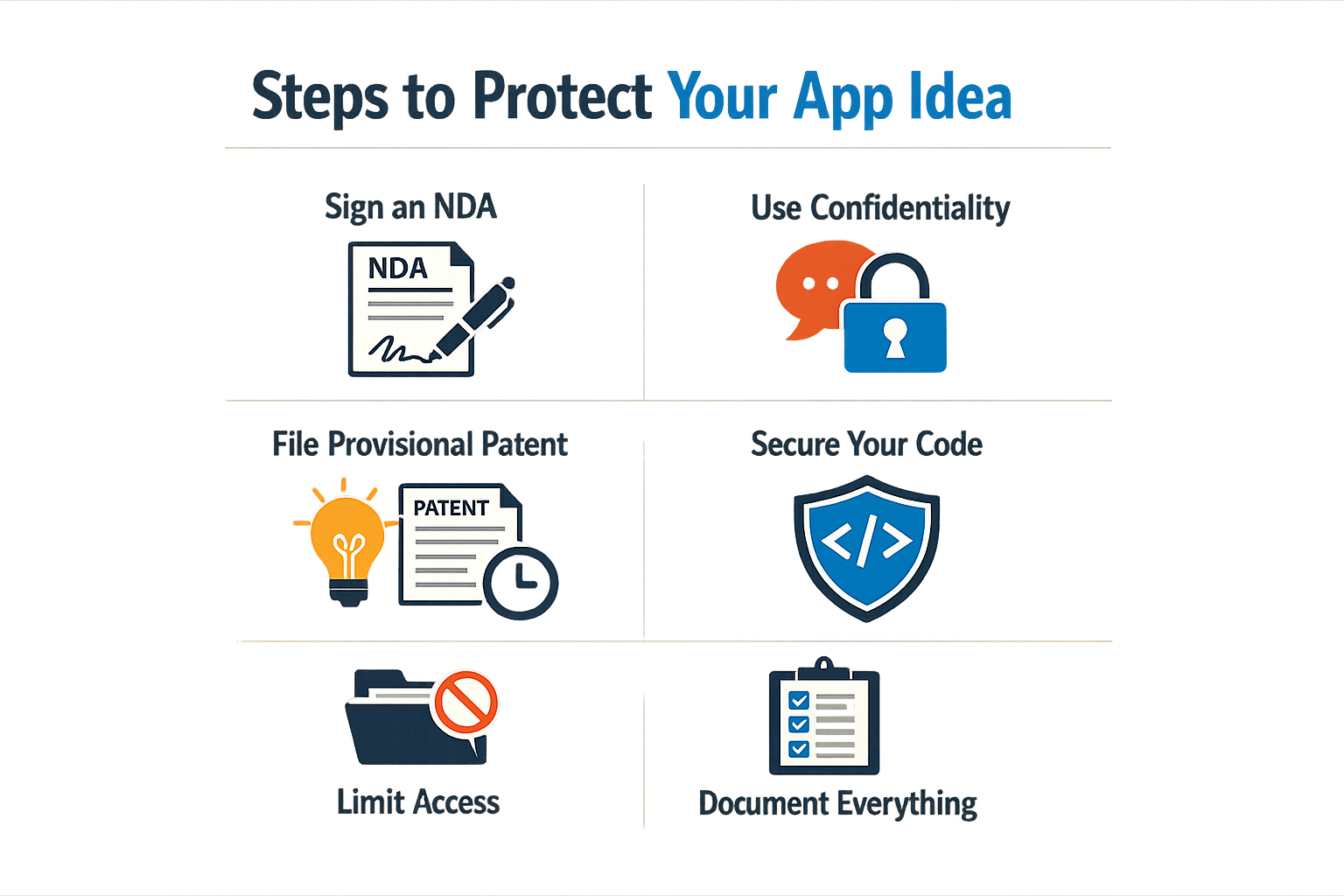
Three paths exist. Each carries different trade-offs in cost, speed, and enforceability.
Non-Disclosure Agreements (NDAs)
An NDA creates a legal obligation for anyone who sees your concept to keep it confidential. Use them when discussing your app with potential developers, contractors, or early advisors.
Step 1
Draft or obtain a standard NDA template
Most law firms offer boilerplate NDAs for software projects. A one-page mutual NDA covers the common case where both parties share sensitive information.
Step 2
Send it before the first detailed conversation
Timeline matters. If you describe your feature set in an email before the NDA is signed, the confidentiality obligation does not apply retroactively.
NDAs do not stop someone from building a similar app if they never saw your materials. They only bind people who actually received confidential information under the agreement.
Provisional Patent Applications
A provisional patent establishes a filing date with the USPTO. It does not grant a patent, but it reserves your place in line for 12 months while you develop the app.
Step 3
File a provisional application with the USPTO
A provisional application requires a written description of your invention but no formal claims or oath. Filing fees start around $150 for small entities.
Step 4
Convert to a nonprovisional within 12 months
The provisional filing date only protects you if you file a full nonprovisional application before the 12-month window closes. If you miss the deadline, the provisional expires and offers no protection.
Provisional patents cost time and money. They make sense when your app includes a novel technical method that competitors could copy once they see it in action. For most consumer apps, the idea is not patentable; execution and speed matter more.
Ship Quickly to Establish Market Presence
Launching a working product before others can replicate your concept is often the strongest protection. Once your app is live, you own the user relationships, the data on what works, and the brand.
Step 5
Build a minimum viable version in weeks, not months
Focus on the one feature that delivers value. If you are still writing specs after 30 days, your idea is at higher risk than if you had a rough prototype in users' hands. Tools like Lovable let you go from concept to deployed app in days.
Step 6
Publish and start acquiring users immediately
An app with 100 daily active users is harder to displace than an app with zero users and a pending patent. User feedback also shows you which parts of your idea actually matter, so you iterate on reality instead of protecting a concept that might not work.
The best defense is a live product and a growing user base—legal instruments buy time, but shipping buys momentum.
Shipping first only works if you can move faster than potential competitors. If your concept requires months of regulatory approval or hardware partnerships, a provisional patent might be necessary while you work through those dependencies.
Tips and Tricks for Safeguarding Your Idea
Protection isn't just legal paperwork. Most founders lose control of their idea through operational mistakes, not IP theft. The real risk is building something insecure that leaks user data or ships with obvious authorization holes that competitors reverse-engineer in an afternoon.
Harden Your App's Security From Day One
If your app handles user accounts, implement defense in depth. Don't rely on a single framework to enforce access control. Misconfiguration in one component can bypass everything else.
Build authorization logic that matches your app's specific security requirements. Generic prebuilt solutions are convenient but rarely sufficient. Take time to understand any technology you're building on — the authorization logic it provides may not cover your edge cases.
Create tests that validate permissions as mapped in your design phase. After deployment, periodically review user privileges for "privilege creep" — users accumulating more access than they need. It's easier to prevent over-privileging than to revoke it later.
Document Your Security Posture
If you're pitching investors or enterprise customers, they'll ask what your security looks like. Some platforms let you publish a trust center at /.well-known/trust.html on your domain — a page that shows verifiable security facts about your live app. Your code can't edit this page, so it's credible to auditors.
Automated security scans during development catch vulnerabilities before they ship. Quick scans and deep scans identify common mistakes; use them before every major release. For more advanced workflows, consider how to vibe code with built-in security checks integrated into your development loop.
Treat Third-Party Components as Risk Surface
Even robust, popular libraries can introduce authorization bypasses. Vulnerabilities in third-party components let attackers sidestep your controls. Writing secure software is hard; assume every dependency has undiscovered flaws.
The cheapest protection is the one you build into your workflow, not the one you bolt on after a breach.
Review dependencies regularly. Pin versions. Monitor security advisories. When a CVE drops for a library you use, you need to know within hours, not weeks.
Conclusion
Protecting an app idea is not about locking it in a vault. It's about choosing the right level of protection for your current stage and moving forward.
NDAs work when you control who sees the idea and can afford to enforce them. Provisional patents buy you twelve months to validate the market before committing to the full filing cost. But for most solo founders, the fastest protection is shipping a working product that people actually use.
I've built apps where the idea felt precious at the start. What mattered in the end was not the secrecy of the concept but the speed of execution and the willingness to iterate in public. The market rewards builders who ship, not planners who wait.
Start with the protection method that matches your resources and timeline. If you're pre-revenue and solo, that usually means skipping the NDA and focusing on a fast MVP. If you have funding or a technical moat worth defending, consider the provisional patent. Either way, the goal is the same: get your idea into the hands of users before someone else does.
For practical workflows on turning ideas into shipped products quickly, see How to Vibe Code: A Step-by-Step Workflow Guide. The best protection is a product people depend on.